Three different checkbooks, three different bets
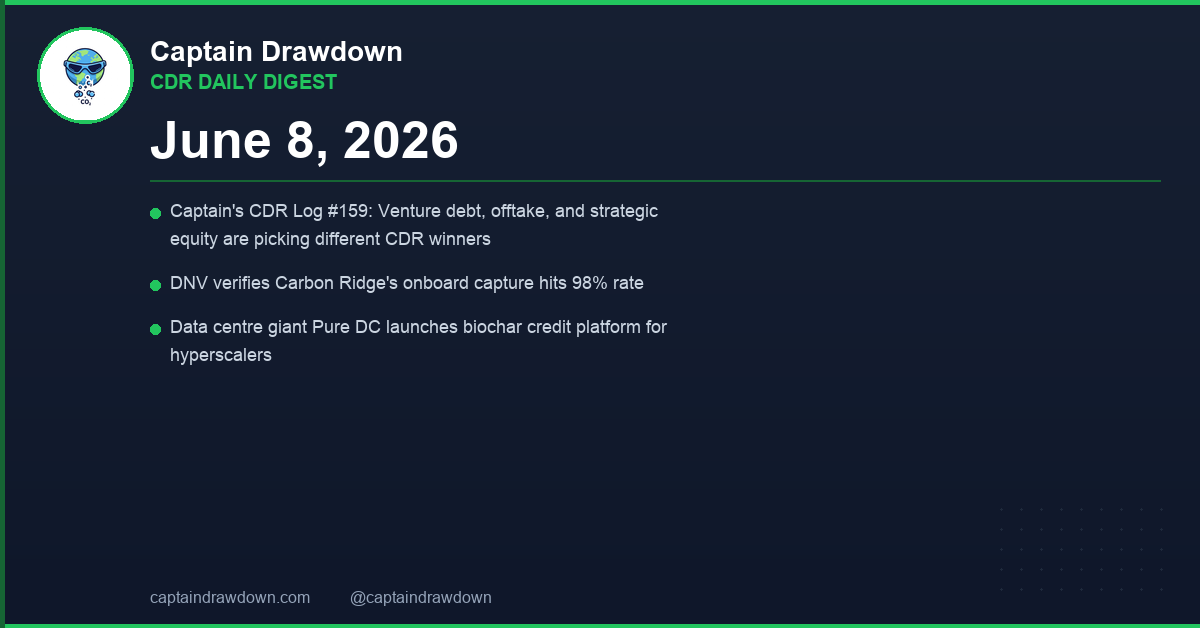
The pattern across today’s stories is that CDR financing has split into distinct lanes, and each lane is picking a different kind of winner. Venture debt is backing hardware that already has revenue. Offtake contracts are pulling early-stage removal projects through their first commercial deployments. Strategic equity from industrial buyers is locking in supply before it exists. Same industry, three checkbooks, three theories of what scales.
That fragmentation showed up clearly in the other two stories on the desk today: a verification milestone for shipboard capture, and a hyperscaler-targeted biochar platform from a data centre operator. Both are downstream consequences of the financing split.
The financing split, in plain terms
In Captain Drawdown’s daily CDR Log #159 today, the through-line was that different capital types are no longer competing for the same deals. They are sorting.
Venture debt lenders want hardware companies with bookings, recurring revenue, and assets they can secure against. They are funding the build-out, not the science. Offtake-led financing, where a buyer pre-commits to purchasing tonnes, is doing the work that grant capital used to do: de-risking first-of-a-kind plants by giving them a revenue line a bank can underwrite. And strategic equity from large emitters and infrastructure players is going into the pathways those buyers expect to need at million-tonne scale a decade from now.
The practical effect: a founder’s pitch now has to match the checkbook. A mineralization startup with a pilot does not need venture debt. A DAC company with three operating units and signed offtake does not need another seed round. Reading the room is becoming a core skill.
Shipboard capture clears a verification bar
DNV verified that Carbon Ridge’s onboard carbon capture system hit a 98% capture rate during testing. That is a strong number for any capture system, and notable for a marine application where space, weight, and motion all work against steady-state operation.
A few caveats worth naming. Onboard capture from ship exhaust is point-source capture of fossil CO2, not atmospheric CDR. It belongs in the avoided-emissions column unless the captured CO2 is then permanently stored and accounted against a removal standard. The shipping industry needs both: cut the emissions at the stack, and buy durable removals for what cannot be cut. CDR is for hard-to-abate residual emissions. It is not a reason to slow the underlying decarbonization of the fleet.
The reason this matters for the CDR audience is verification methodology. DNV’s measurement, reporting, and verification work (MRV) on a moving vessel is the kind of protocol development that will get reused when shipping starts buying ocean-based removals at scale. The verifiers learning to certify capture at sea are the same ones who will end up certifying ocean alkalinity enhancement and direct ocean capture deployments.
Pure DC brings biochar to the hyperscaler shelf
Pure DC, a data centre operator, launched a biochar credit platform aimed at hyperscale cloud buyers. The pitch is straightforward: give the largest corporate compute customers a procurement channel for durable biochar credits without having to build their own sourcing team.
Two things stand out. First, the buyer is the seller’s customer. Pure DC sells data centre capacity to hyperscalers, and now it is selling them removals too. That bundling is a quiet but important development. It suggests removal procurement is becoming a feature of infrastructure contracts, not a separate climate workstream.
Second, biochar continues to win on availability. It has durability in the centuries range when produced and stored correctly, it has working MRV protocols, and it is one of the few pathways with enough supply on the market right now to absorb hyperscaler-sized orders. DAC and mineralization will get there. Biochar is there today.
The risk to watch: biochar’s credit quality varies widely by feedstock, pyrolysis conditions, and end-use. A platform is only as good as the protocol it underwrites against. Buyers should be asking which standard Pure DC’s credits are issued under and who is verifying.
What’s next
Two things to watch over the next few weeks. First, whether any of the strategic equity deals flagged in Captain Drawdown’s daily CDR Log #159 convert into offtake announcements. Equity without offtake is a bet on a category. Equity plus offtake is a commitment to a specific supplier. The pairing tells you who the buyers actually believe in.
Second, watch whether DNV or another verifier publishes a public protocol for shipboard capture verification. A documented methodology, even a draft, would accelerate similar work for ocean-based removal pathways and give the market a reference point for what good MRV looks like at sea.