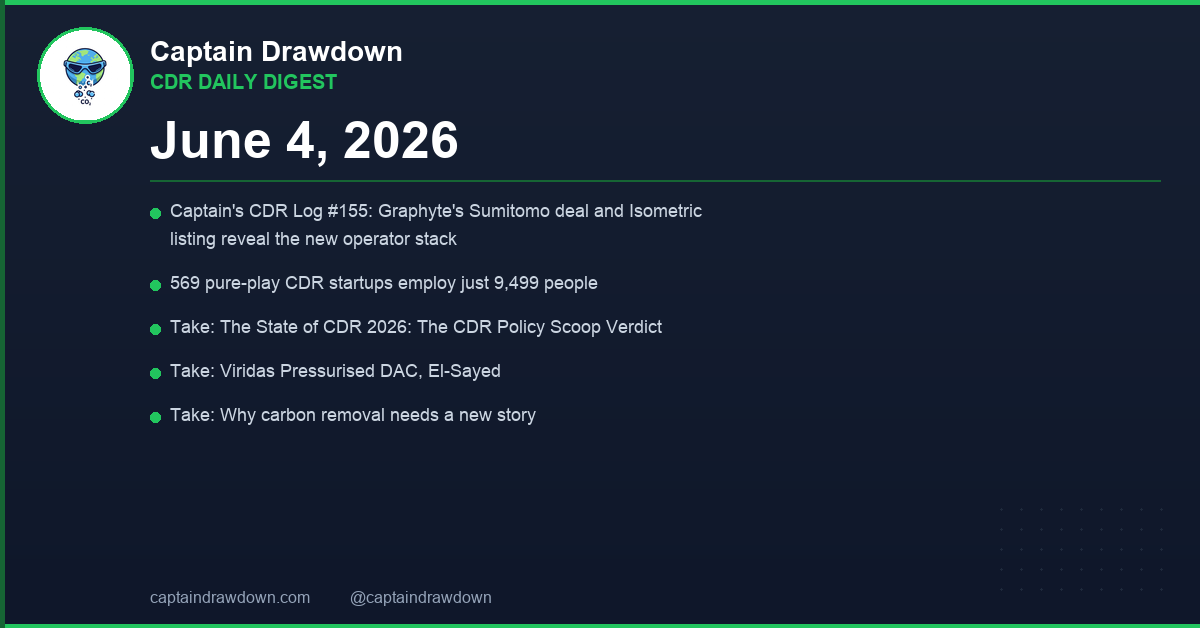
The operator stack is finally visible
Today’s stories share one thread: carbon removal is becoming an industry with a defined shape. We can see who builds, who measures, who buys, and how many people actually work in it. That picture is smaller than the press cycle suggests, but it is more legible than it was a year ago.
The Graphyte-Sumitomo deal, paired with Graphyte’s listing on Isometric, shows the stack snapping into place. Graphyte does the carbon casting. Sumitomo brings industrial offtake and capital. Isometric certifies the tonnes. Three roles, three companies, one delivered tonne. That separation of duties is what a real industry looks like. It is also what buyers have been asking for: an operator they can contract with, a registry they can audit, and a balance sheet behind both.
The headcount problem nobody wants to print
Captain Drawdown’s CDR Company Directory now tracks 569 pure-play carbon removal startups. Combined headcount: 9,499 people. That is roughly the staff of a single mid-sized refinery, spread across every removal pathway on Earth.
Hold that number against the gigatonne-by-2050 charts and the gap is obvious. We are not short on companies. We are short on the engineers, geologists, MRV (measurement, reporting and verification) specialists, and project developers who turn a pilot into a plant. The bottleneck for the next five years is not capital and not policy. It is people who have built something before.
This also reframes the consolidation question. With an average of about 17 people per company, most of these firms are pre-commercial. Consolidation is not failure. It is how 569 teams become the 50 or so operators who will actually deliver tonnes at scale. The Graphyte-Sumitomo structure is a preview: small technical team, large industrial partner, third-party verifier.
The policy verdict: useful, not yet sufficient
The State of CDR 2026 review from CDR Policy Scoop lands on a measured verdict. Policy is moving. The EU Carbon Removal Certification Framework is producing draft methodologies. The US 45Q tax credit remains intact for now. Japan, the UK, and Canada all have procurement pilots running. But the volumes contracted by governments are still rounding errors against what the IPCC scenarios require for residual emissions from cement, aviation, and heavy industry.
Worth saying clearly: every tonne of CDR procurement assumes deep, fast fossil-fuel phase-out alongside it. Carbon removal handles the residuals. It does not buy time for the easy-to-abate sectors. The policy frameworks that work are the ones that name this constraint in their statutes. The ones that do not will be exploited.
Pressurised DAC and the engineering frontier
The Viridas pressurised DAC paper from El-Sayed and colleagues is the kind of work that does not make headlines but moves the cost curve. Running direct air capture (DAC) at elevated pressure changes the thermodynamics of CO2 binding and release. The modelled energy penalty drops meaningfully against ambient-pressure sorbent systems.
Two caveats. First, pressurisation adds capital expenditure for vessels and compressors, so the net cost win depends on energy prices at the site. Second, this is modelling, not a pilot. The technology readiness level here is low. But the direction matters: the DAC cost curve will be bent by chemistry and process engineering, not by scale alone. Anyone modelling 2035 DAC costs from a 2024 sorbent baseline is going to be wrong.
The story problem
The “carbon removal needs a new story” piece is the one I keep thinking about. The current narrative is split between two failure modes. One frames CDR as a moral hazard that lets polluters off the hook. The other frames it as a silver bullet that makes the climate math easy. Both are wrong, and both are losing the public.
The honest story is narrower and harder to tell. Carbon removal is industrial waste cleanup for emissions we cannot avoid. It is plumbing, not magic. It costs real money and uses real energy. It works only if fossil phase-out works first. That story does not trend, but it is the one that survives contact with a hostile audit.
What’s next
Watch two things this month. First, whether any other operators follow Graphyte onto Isometric with named industrial partners attached. That pattern, operator plus corporate plus registry, is the template that unlocks bank financing. Second, watch the EU CRCF methodology comment period closing dates. The technical decisions made in the next 60 days will define which pathways are bankable in Europe through 2030.