Today’s stories share a common thread: the gap between CDR’s narrative and its actual mass. A widely circulated Nature Reviews paper is being read as a breakthrough it does not claim to be. The global pure-play CDR workforce fits inside a mid-size tech company. And buyers, from Terraset to the seven-buyer coalition we covered, are still teaching suppliers how to pitch them. The field is small, the signals are loud, and the discipline to tell those apart matters more every quarter.
The “breakthrough” that wasn’t
Captain Drawdown’s CDR Log #148 walks through the new Nature Reviews paper that lit up feeds this week. It is a useful synthesis. It is not a breakthrough. The paper aggregates known pathway estimates, restates the durability-vs-scale tradeoffs the field has been working with for years, and lands on conclusions that anyone reading the IPCC AR6 mitigation chapter already holds. That is fine. Reviews are supposed to consolidate, not invent. The problem is the telephone game around it: a careful synthesis becomes “scientists confirm CDR can deliver gigatonnes,” which becomes a justification for delay.
That framing matters because CDR is for hard-to-abate residual emissions only. It is not a license to extend the fossil runway. Any reading of the paper that suggests otherwise is reading something the authors did not write.
The workforce is the story
A new headcount tally puts the global pure-play CDR industry at 569 companies and 9,499 workers. That is the entire dedicated workforce removing carbon dioxide on purpose, worldwide. For comparison, a single hyperscaler data-center build employs more contractors in one quarter.
This number reframes almost every other debate in the field. When people ask why MRV (measurement, reporting and verification) standards are inconsistent, why supplier diligence takes months, or why buyer coalitions keep re-explaining the same procurement questions, the answer is that fewer than 10,000 people are doing all of this work at once. Capacity is the binding constraint. Talent pipelines, especially in geochemistry for enhanced rock weathering, marine science for ocean alkalinity enhancement, and procurement for buyer-side teams, are where the next bottleneck sits.
The number also clarifies what credible scale looks like. Getting to a meaningful fraction of the gigatonne-by-2050 pathways implies an order-of-magnitude workforce expansion this decade. That is a hiring story, a training story, and an immigration-policy story before it is a technology story.
Buyers are still doing the teaching
Three of today’s takes are buyer-facing. Taylor Insley of Terraset walked through how suppliers should actually pitch a philanthropic CDR buyer: lead with the carbon math, show the cost curve, be honest about technology readiness level, and do not pad the deck. The “seven buyers in a trench coat” piece covers the growing pattern of small buyer coalitions pooling diligence so suppliers do not have to answer the same 80 questions seven times. And Asger Strange Olesen’s conversation on LULUCF (land use, land-use change and forestry), carbon farming and the EU’s Carbon Removal Certification Framework review surfaces the same theme from the policy side: buyers and regulators are converging on what “good” looks like, and suppliers who cannot speak that language get filtered out.
The signal across all three: the buy side is professionalizing faster than the sell side in some segments. Suppliers who treat a Terraset pitch like a generic VC deck are losing to suppliers who show up having read the buyer’s published criteria.
Wren opens a funding door
Wren opened its 2026 call for proposals to fund what it describes as scalable climate solutions, with CDR pathways explicitly in scope. Wren’s check sizes are not Frontier-sized, but the program has historically been a useful early credibility signal for pre-revenue suppliers, particularly in enhanced rock weathering and biomass-based pathways. Worth a look for any team with a credible MRV story and a clear cost-down trajectory.
What’s next
Two things to watch this week.
First, whether the Nature Reviews paper gets cited in any policy comment letters as evidence for relaxed near-term mitigation. If it does, expect a sharp correction from the authors themselves. Reviews get weaponized; authors usually push back.
Second, whether any of the buyer coalitions formalize a shared diligence template. The “seven buyers in a trench coat” pattern only saves supplier time if the questions actually converge. A published common questionnaire, even a rough one, would be the single highest-leverage thing the buy side could ship this quarter.
Small field. Loud signals. Read carefully.
Today’s Stories
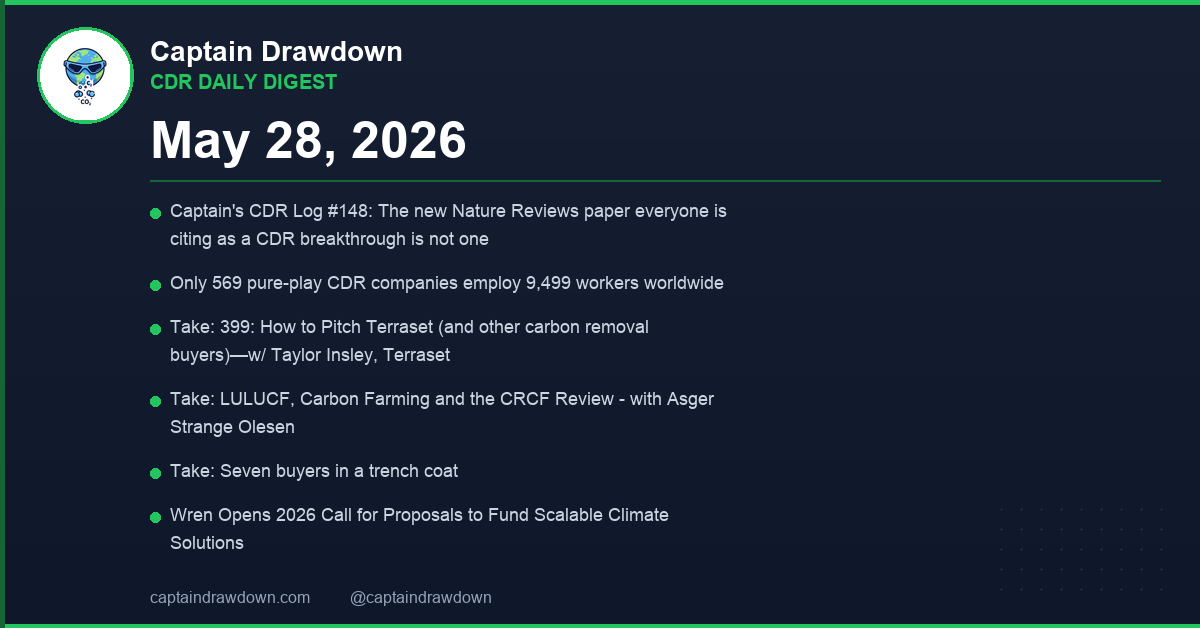
- Captain’s CDR Log #148: The new Nature Reviews paper everyone is citing as a CDR breakthrough is not one
- Only 569 pure-play CDR companies employ 9,499 workers worldwide
- Take: 399: How to Pitch Terraset (and other carbon removal buyers)—w/ Taylor Insley, Terraset
- Take: LULUCF, Carbon Farming and the CRCF Review - with Asger Strange Olesen
- Take: Seven buyers in a trench coat
- Wren Opens 2026 Call for Proposals to Fund Scalable Climate Solutions