Today’s three stories point at one uncomfortable truth: the carbon dioxide removal industry is being asked to scale faster than its safeguards, its capital stacks, and its pathway diversity can support. The risk is not that nothing works. It is that we are loading durability promises onto systems whose failure modes we have not yet priced.
The buffer pool problem is a time-machine problem
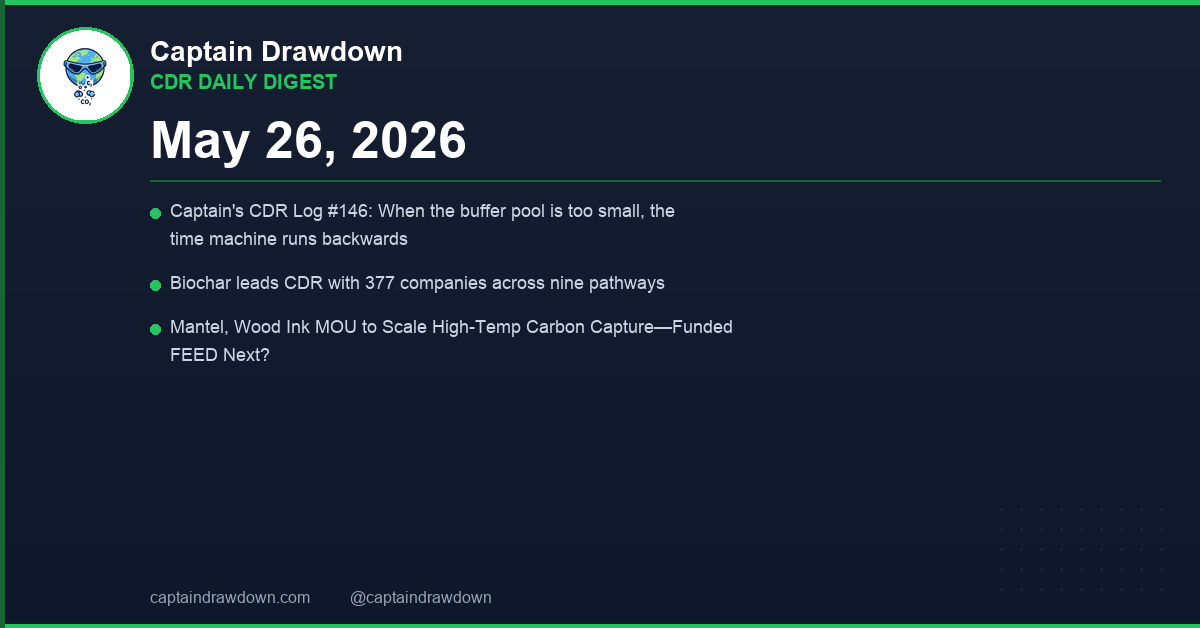
In Captain Drawdown’s daily CDR Log #146, the focus is on buffer pools, the shared insurance accounts that nature-based projects contribute credits into so that reversals, fires, pests, drought, can be covered without breaking the promise to the buyer. When a forest burns, credits get retired from the buffer to make the atmosphere whole.
The trouble is arithmetic. If the buffer is sized for a climate that no longer exists, every drawdown event runs the clock backwards on durability claims that were sold as permanent. A buffer calibrated to 20th-century fire return intervals is not a buffer in a 21st-century fire regime. It is a deferred liability.
This matters beyond forestry. Any pathway that leans on a shared insurance pool, including some soil carbon and blue carbon approaches, inherits the same actuarial question. Are the pool contributions, typically 10 to 20 percent of issued credits, sized for the actual reversal rate or for the rate we wish we had? If buyers want durability they can defend, they should be asking registries for the loss-ratio math, not just the buffer percentage.
Biochar’s 377-company footprint and what it signals
CDR.fyi data covered in today’s second post shows biochar leading the field with 377 companies operating across nine sub-pathways, from agricultural feedstock pyrolysis to urban green-waste conversion. That is a remarkable spread for a single approach, and it is worth sitting with what it means.
Biochar wins on three things right now: lower CapEx than engineered removal (capital expenditure, the upfront build cost), faster permitting because the unit operations are familiar, and a co-product story that helps farmers say yes. The durability sits in the 100 to 1,000 year range depending on production conditions and end use, which is shorter than DAC storage in basalt but long enough to qualify under most current crediting frameworks.
The concentration is also a warning. When 377 companies pile into one pathway, MRV (measurement, reporting and verification) standards have to do the heavy lifting to separate good projects from cosmetic ones. Production temperature, feedstock chain of custody, and field application accounting are where biochar credits live or die. Buyers should be reading methodology, not press releases.
This does not mean biochar is overbuilt. It means the pathway has reached the stage where the median project quality matters more than the headline count.
Mantel and Wood Ink: the FEED question
Mantel and Wood Ink signed a memorandum of understanding to scale high-temperature carbon capture for industrial heat applications. Mantel’s molten-salt sorbent operates at temperatures where flue-gas capture has traditionally been hardest, which is exactly the regime that pulp and paper, cement, and some chemicals plants live in.
MOUs are cheap. What matters next is whether this one converts into a funded FEED study. FEED, front-end engineering design, is the stage where a project commits real engineering hours and 2 to 5 percent of total project cost to figure out whether the thing can actually be built at the host site. Without a funded FEED, an MOU is a press release. With one, it is a project.
The reason to care: high-temperature capture is one of the few credible routes to addressing industrial process emissions that cannot be electrified. If Mantel can prove the heat integration story at a Wood Ink facility, it opens a category. Note that this is point-source capture, which reduces emissions at the stack. It is not CDR in the strict sense. The CDR-relevant question is whether the same sorbent chemistry and heat-integration approach can be paired with biogenic CO2 streams to deliver BECCS (bioenergy with carbon capture and storage) at industrial scale.
What’s next
Two things to watch this week. First, whether any registry publishes updated buffer-pool loss ratios in response to the 2025 fire season. Silence here is itself a data point. Second, whether the Mantel-Wood Ink MOU names a host site and a FEED budget within 90 days. If it does, this is real. If it does not, file it with the other handshake announcements and move on.