The gap between models and machines just got harder to ignore
Today’s stories share one uncomfortable thread: the distance between what climate models assume carbon removal will deliver and what the actual industry can build. One skeptic, one labor-force number, and one essay on stalled progress all point at the same problem from different angles. If you only have time for one takeaway from today, it is this: the modeled CDR future and the operational CDR present are roughly three orders of magnitude apart, and almost nobody is pricing that gap into their plans.
The 1000x problem, in two data points
Captain’s CDR Log #141 walks through a skeptic’s challenge that deserves a serious answer rather than a dismissal. Integrated assessment models routinely assume gigatonne-scale removal by mid-century. Today, durable CDR delivery is in the low hundreds of thousands of tonnes per year. That is a 1000x gap, and modelers tend to assume it closes on a schedule the industry has never demonstrated it can hit.
The labor data sharpens the point. Across 569 pure-play carbon removal companies, total headcount sits at just 9,499 people. That is an average of about 17 employees per company. Semiconductor fabs employ more people per facility than the entire global enhanced rock weathering sub-industry. You cannot build gigatonne infrastructure with a workforce the size of a mid-cap manufacturing firm. Either the workforce grows by orders of magnitude this decade, or the models are writing checks the sector cannot cash. This is also why CDR must be treated as a complement to fossil-fuel phase-out for residual hard-to-abate emissions, not a substitute for it. The math does not work the other way.
The “low earth orbit” essay running in today’s takes frames the same problem in different language. Carbon removal got off the launchpad. It has not reached the higher orbit where cost curves bend, projects replicate, and capital flows on autopilot. The author’s prescription: stop treating each project as a science experiment and start treating the sector like the heavy infrastructure build it actually is.
Carbon capture and storage gets its own certificate standard
The Cynthia and George Mitchell Foundation opened a 60-day public review on a new certification approach for carbon capture and storage, separate from removal credits. This is a meaningful structural move. Conflating CCS (capture at a point source, preventing new emissions) with CDR (pulling legacy CO2 out of the atmosphere) has muddied buyer markets for years. A dedicated certificate framework, if it lands well, lets buyers tell the two apart and price them accordingly.
For CDR buyers, the upside is cleaner signal. For CCS operators, it is access to a credit market without borrowing CDR’s reputational equity. The 60-day window matters. If you sell, buy, or verify removal credits, your comment on where the line sits between avoided and removed belongs in this process.
Policy and leadership: CBAM, credits, and what the operator job actually demands
Dan Maleski’s conversation on the EU’s Carbon Border Adjustment Mechanism (CBAM) and international credits covers a change worth tracking. The question of whether removal credits generated outside the EU can count against CBAM obligations is the kind of detail that sounds technical and turns out to reshape demand. If international credits get a defined role, non-EU suppliers gain a buyer of last resort. If they do not, the EU market stays internal and smaller.
Julia Reichelstein of Vaulted Deep, on episode 400 of the same podcast series, takes the leadership question head on. Her framing: what kind of leader does the company need from me right now, as opposed to what kind of leader I would prefer to be? It is a useful reframe for a sector where most founders are operating at the edge of their experience. The 17-employee average is not just a scale problem. It is a management-bandwidth problem.
What’s next
Two things to watch over the next 60 days. First, the Cynthia and George Mitchell Foundation CCS certificate review. The comments filed will signal whether buyers want a hard line between avoided and removed, or whether they would rather keep the categories blurry. Second, the workforce question. If the sector is serious about closing any meaningful share of the 1000x gap, hiring should accelerate visibly this year. Captain Drawdown’s CDR Company Directory will keep tracking headcount across the 569 pure-play firms. If that 9,499 number is not materially higher by year-end, the modelers and the operators are not in the same conversation yet.
Today’s Stories
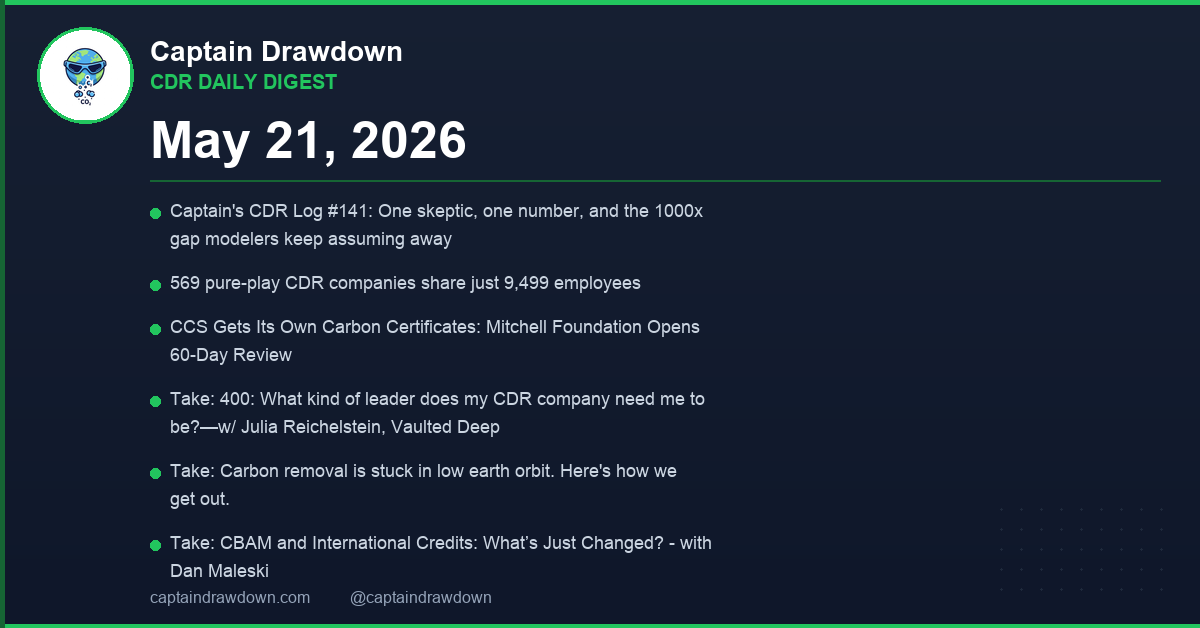
- Captain’s CDR Log #141: One skeptic, one number, and the 1000x gap modelers keep assuming away
- 569 pure-play CDR companies share just 9,499 employees
- CCS Gets Its Own Carbon Certificates: Mitchell Foundation Opens 60-Day Review
- Take: 400: What kind of leader does my CDR company need me to be?—w/ Julia Reichelstein, Vaulted Deep
- Take: Carbon removal is stuck in low earth orbit. Here’s how we get out.
- Take: CBAM and International Credits: What’s Just Changed? - with Dan Maleski