The CDR industry is still tiny, and that shapes everything else
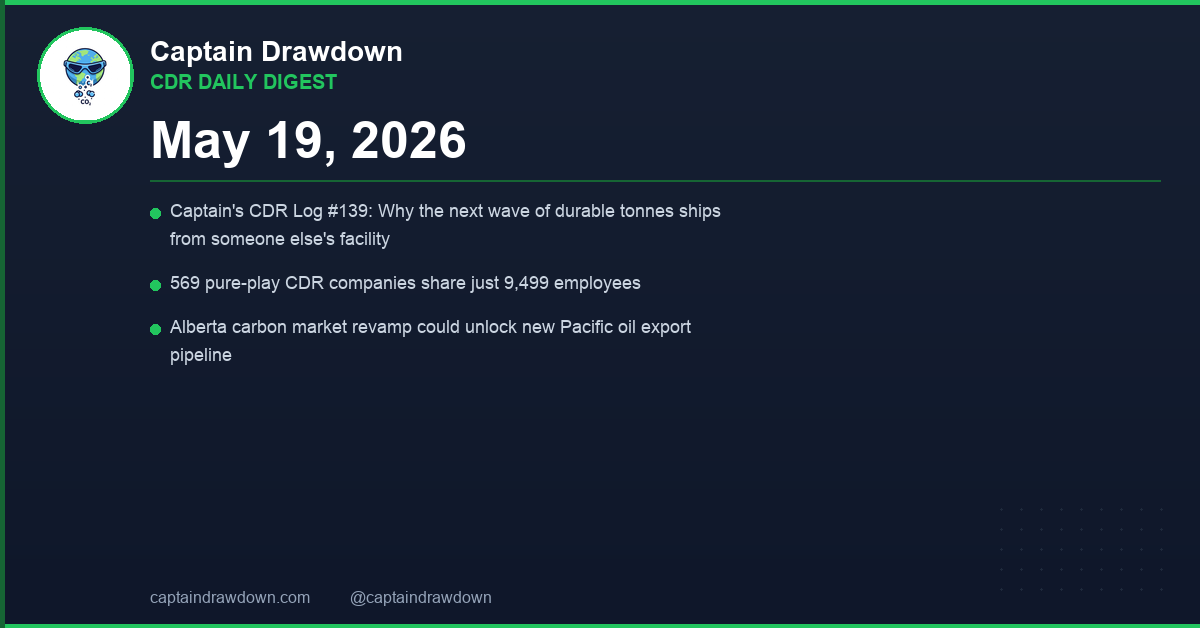
Today’s three stories point to one underlying fact: pure-play carbon dioxide removal is a very small industry trying to deliver very large promises. Across 569 pure-play CDR companies, total headcount sits at just 9,499 people. That is fewer employees than a single mid-sized refinery operator. It explains why durable tonnes are increasingly shipping from facilities the seller does not own, and why Alberta thinks it can rewrite its carbon market without much pushback from removal buyers.
Hold that number in your head. Then look at what is happening on the ground.
Tolling is becoming the default delivery model
In Captain’s Log #139 we walked through why the next wave of durable tonnes will ship from someone else’s facility. The pattern is now hard to miss. Project developers with offtake contracts in hand are routing CO2 through host-site capture units, third-party compression, and shared injection wells rather than building integrated plants. Think of it as toll manufacturing for negative emissions.
The reason is partly the headcount problem above. If you have 17 people and a 50,000-tonne contract with a Frontier Climate buyer pool, you cannot also staff a permitting team, a drilling crew, and a pipeline operations desk. You rent them. Heirloom’s mineralization partnership with CarbonCure-style concrete pours, 1PointFive’s use of OXY-operated injection infrastructure in the Permian, and the growing roster of BECCS (bioenergy with carbon capture and storage) developers paying ethanol plants for access all follow the same shape.
The implication for buyers is that MRV (measurement, reporting and verification) responsibility now spans multiple corporate boundaries on a single tonne. The seller you contracted with may not employ a single person who touches the molecule between capture and storage. That is not necessarily bad. It is how chemicals, LNG, and refining all work. But it does mean due diligence has to follow the molecule, not the logo on the invoice.
9,499 people, 569 companies, and what that math implies
The headcount data deserves a closer read. The median pure-play CDR company has roughly 17 employees. The top 20 firms employ more than half the total workforce. The long tail of 400-plus companies has fewer than 10 people each.
Two honest takeaways. First, the industry is structurally early. You cannot deliver gigatonnes from a workforce that fits in a football stadium, and nobody is pretending otherwise. The 2030 delivery curves assume aggressive hiring, consolidation, and a much larger share of work done by contractors and host-site operators, which is exactly what the tolling trend reflects.
Second, the moral-hazard critique sharpens here. When a fossil major announces a CDR purchase, the supplier on the other side often has fewer employees than the buyer’s communications team. CDR remains a tool for residual, hard-to-abate emissions only. It is not a reason to slow fossil phase-out, and the size mismatch between buyer and supplier is worth naming whenever the framing risks slipping.
Alberta’s carbon market and the pipeline question
Alberta is consulting on changes to its TIER (Technology Innovation and Emissions Reduction) industrial carbon pricing system. Proposed revisions would tighten benchmarks for oil and gas facilities while expanding credit eligibility for engineered removals including DAC and mineralization. Provincial officials have linked the redesign to support for a new Pacific export pipeline, with the argument that lower-carbon-intensity barrels need a credible removal market behind them.
For CDR developers this is a mixed signal. A tighter TIER price floor and expanded removal credit eligibility would make Alberta one of the few jurisdictions where engineered removals have a real compliance buyer beyond voluntary corporate pools. Deep Sky, Entropy, and Shell’s Quest expansion all benefit if the credit price rises and durability standards hold.
The risk is the framing. A carbon market reform that is publicly tied to enabling more oil exports is exactly the moral-hazard scenario the field needs to address head-on. Removals that offset operational emissions from extraction are not the same as removals that draw down legacy CO2. The accounting has to be clean, the additionality real, and the residual-emissions framing explicit. If Alberta wants engineered removals to underwrite a pipeline, the rules need to make clear that those tonnes are matching unavoidable emissions, not licensing avoidable ones.
What’s next
Two things to watch this week. First, whether Alberta publishes draft TIER rule text with specific durability tiers for removal credits. The difference between a flat credit and a tiered one that rewards 1,000-year storage will shape developer economics across western Canada. Second, watch for the next tolling-model announcement out of the Gulf Coast. Two developers have signaled deals using shared Class VI injection infrastructure, and the contract structures will tell us how MRV liability is being allocated between capture operator, transport, and storage host. That allocation, more than any single project announcement, is what the durable tonne market will run on.