The buyer concentration problem is now structural
Durable carbon removal logged a record 2.3 million tonnes of purchases in Q1 2026. That is real growth. But one buyer, Microsoft, drove 43% of it. Strip Microsoft out and the market looks roughly flat. Every other piece of today’s news, from a Climeworks pitch to AI hyperscalers to the slow grind of EU rulemaking on credit substitution, traces back to this same fact: durable CDR still has one anchor customer, and the field’s near-term survival depends on widening that base before the next funding winter.
One buyer is a feature, then a bug
Microsoft’s offtakes have been the single most useful signal the market has produced. They have validated mineralization, biochar, enhanced rock weathering (the process of spreading crushed silicate rock to react with and lock up atmospheric CO2), and BECCS (bioenergy with carbon capture and storage) at contract scale. Without those checks, several suppliers would not have reached financial close.
The problem is what concentration does to price discovery. When one buyer sets 43% of demand, supplier roadmaps optimize for that buyer’s diligence standards, contract terms, and tonnage windows. New entrants on the buy side then face a market shaped around someone else’s procurement, which slows them down further. The Q1 number looks like a record. It is also a warning that the second, third, and fourth anchor buyers have not arrived at the size the supply pipeline now needs.
Climeworks’ pitch: bundle removal into AI compute
Jan Wurzbacher’s argument this week was direct. Carbon removal should be priced into the cost of AI infrastructure, the same way land, power, and water already are. Hyperscaler data center buildouts are locking in electricity demand that, even on optimistic grid timelines, will run partly on gas through the early 2030s. If a fraction of a cent per query, or a defined per-megawatt-hour fee, were routed to durable removal contracts, the buyer base would diversify almost overnight.
Two cautions matter here. First, this only works if removal is treated as cleanup for residual emissions that cannot be cut at the source. It is not a substitute for clean power procurement or efficiency. If AI operators use CDR purchases to justify slower decarbonization of compute itself, the framing fails on its own terms. Second, the proposal needs contract structures that buyers other than Microsoft and Google will actually sign. That work is still early.
Cost curves and rulebooks, moving in parallel
Two quieter stories today point to where the next unlock comes from.
Caravel Bio reported improvements in enzyme durability for solvent-based capture systems. Enzymes that survive more cycles cut the OpEx (operating expenditure, the ongoing running cost) of capture by reducing replacement frequency and energy penalty. The company has not published full third-party numbers yet, so treat the claim as directional. But enzymatic capture has been stuck on durability for a decade, and incremental gains there flow straight into the levelized cost of removal for several pathways, including DAC and point-source-to-storage hybrids.
On the policy side, my conversations this week with Louisiana landowners negotiating pore-space leases and with Brussels officials drafting credit substitution rules under the EU’s carbon removal certification framework converged on the same worry. What happens when a delivered tonne fails verification two or five years after issuance? Who replaces it, at whose cost, and from which reserve? Louisiana landowners want that liability bounded before they sign. EU rulemakers want substitution mechanics tight enough that buyers can trust a certified tonne without re-diligencing every project. Neither group has a finished answer. Both are converging on buffer pools sized to pathway-specific reversal risk, plus clearer seller-of-last-resort rules. Suppliers planning 2027 deliveries should be modeling this now, not later.
What’s next
Watch two things over the next quarter.
First, the Q2 purchase data. If durable CDR hits another record but Microsoft’s share stays above 40%, the concentration problem is structural, not transitional. If a second hyperscaler, an oil major buying for residual scope-one emissions, or a sovereign buyer steps up with a multi-hundred-thousand-tonne contract, the picture changes.
Second, the EU certification framework’s draft text on substitution and reversal liability, expected before summer recess. The specifics on buffer pool sizing and cross-pathway substitution will shape which suppliers can sell into Europe in 2027 and which get stuck waiting for clarification. That document will move more tonnes than any single offtake announcement this year.
Today’s Stories
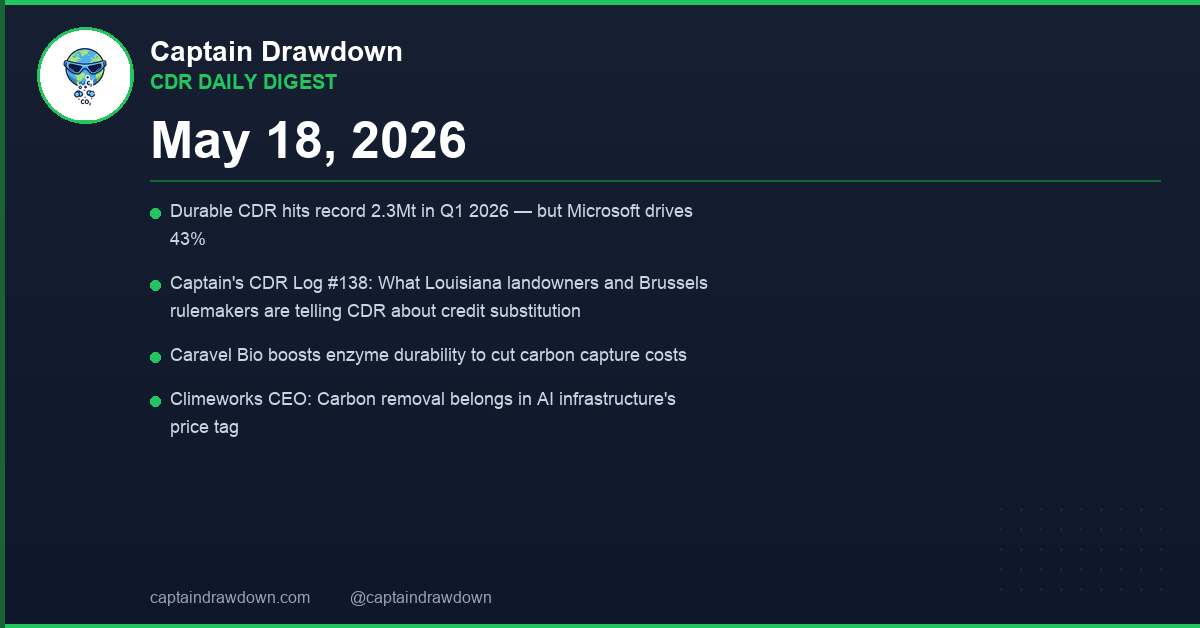
- Durable CDR hits record 2.3Mt in Q1 2026 — but Microsoft drives 43%
- Captain’s CDR Log #138: What Louisiana landowners and Brussels rulemakers are telling CDR about credit substitution
- Caravel Bio boosts enzyme durability to cut carbon capture costs
- Climeworks CEO: Carbon removal belongs in AI infrastructure’s price tag