Today’s stories circle one uncomfortable question: who is actually checking the work? From boardroom disclosures to rock dust in Darjeeling tea estates, the day’s reporting points to a CDR industry that is scaling faster than its verification, transparency, and risk-management systems can keep up.
The disclosure gap is now measurable
A joint audit by Senken and Sylvera of Germany’s DAX40 companies found that most large German firms either do not disclose their carbon credit purchases in a usable way, or disclose them without the registry detail needed to verify quality. Captain’s Log #134 walks through what the audit looked at and why it matters: when a buyer says “we retired X tonnes,” outside reviewers should be able to trace those tonnes to specific projects, vintages, and methodologies. Often they cannot.
This is not a small accounting quibble. If the largest listed companies in Europe’s biggest economy cannot be cross-checked on their offset claims, the integrity story the voluntary market has been telling investors and regulators is weaker than advertised. And to be clear on framing: CDR exists to handle residual emissions that cannot be cut at source. Opaque credit purchases by heavy emitters are exactly the case where the moral-hazard critique bites hardest, because buyers can quietly substitute cheap avoidance credits for the durable removals their net-zero plans actually require.
Biochar’s quiet dominance, and what it signals
CDR.fyi-style company tracking now counts 969 companies across the removal industry, with biochar accounting for 377 of them. That is roughly 39 percent of all tracked CDR companies sitting in one pathway.
Biochar is cheap to start, has a real agronomic story, and clears the lowest bar for buyers who want delivered tonnes this year rather than promised tonnes in 2032. But a market where nearly four in ten companies do one thing is not a diversified portfolio. It is concentration risk. If methodology updates tighten biochar’s durability assumptions, or if soil-application MRV (measurement, reporting and verification) standards get stricter, a large share of supply gets repriced at once. Buyers building long-term removal portfolios should be reading that 377 number as a prompt to ask harder questions about pathway mix.
Scientists, engineers, and the pressure to ship
Two podcast conversations today dug into the cultural fault line inside CDR companies. Erica Dorr and Samara Vantil of Rainbo argued that commercial pressure is pushing engineering decisions ahead of the science that should constrain them. The pattern is familiar: a startup raises on a TRL (technology readiness level) story, then has to deliver tonnes on a timeline that does not match how long it takes to actually characterize a system in the field.
Dr. Sambuddha Misra’s conversation on ERW (enhanced rock weathering) in Darjeeling tea estates is the counter-example. The work is slow, geochemically careful, and tied to a specific landscape where weathering rates, rainfall, and soil chemistry can be measured rather than modeled from afar. It is also the kind of work that does not scale on a venture timeline. The tension Dorr and Vantil name is real, and ERW is where it shows up most clearly: the rocks weather at the speed they weather.
Insurance is becoming infrastructure
Natalia Dorfman’s discussion of insurance, buffer pools, and what she calls the permanence trust is the piece that ties the day together. If disclosure is weak, supply is concentrated, and science-engineering tradeoffs are unresolved, then the financial layer that absorbs reversal risk becomes load-bearing. Buffer pools held by registries are one mechanism. Third-party insurance that pays out when stored carbon is lost is another. Together they are starting to look less like optional add-ons and more like the plumbing that lets buyers commit to long-dated removal contracts at all.
The honest read is that CDR insurance is still early. Pricing reversal risk for a biochar tonne, a basalt-amended field, and a DAC injection well requires three very different actuarial models, and the loss data is thin. But the direction of travel is clear: permanence will be underwritten, not just promised.
What’s next
Watch two things. First, whether other European exchanges follow the Senken-Sylvera template and audit their own listed companies. If the DAX40 result gets replicated on the CAC 40 or FTSE 100, voluntary disclosure norms will move faster than any regulator could push them. Second, watch for the first standardized reversal-insurance product covering more than one CDR pathway. That is the moment buffer pools stop being a registry feature and start being a market.
Today’s Stories
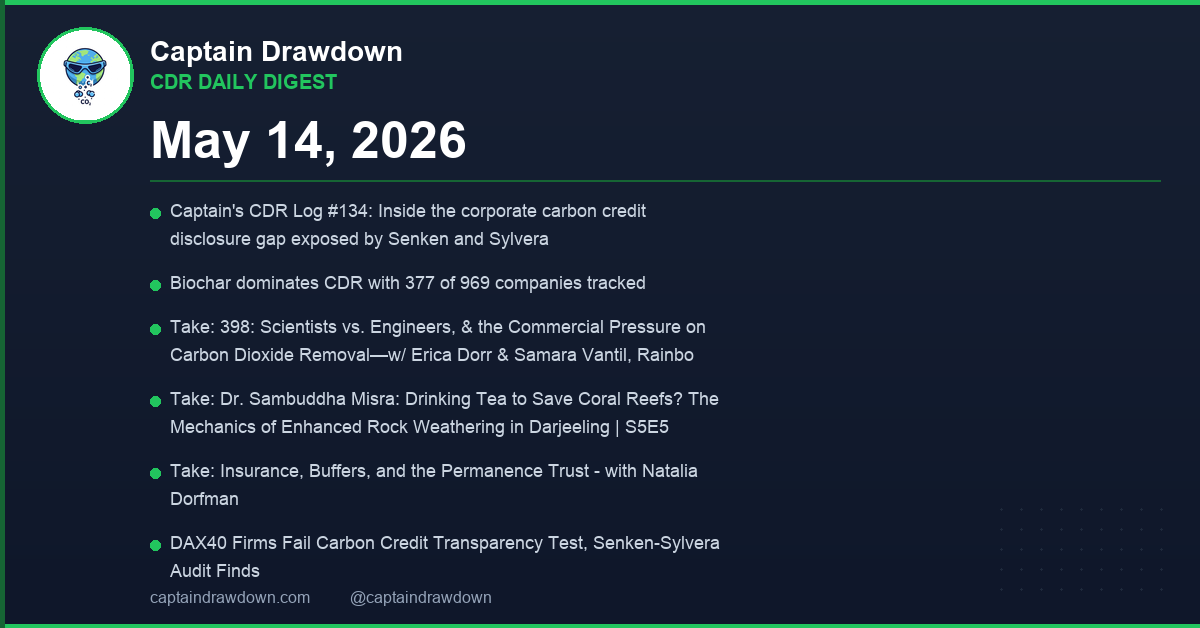
- Captain’s CDR Log #134: Inside the corporate carbon credit disclosure gap exposed by Senken and Sylvera
- Biochar dominates CDR with 377 of 969 companies tracked
- Take: 398: Scientists vs. Engineers, & the Commercial Pressure on Carbon Dioxide Removal—w/ Erica Dorr & Samara Vantil, Rainbo
- Take: Dr. Sambuddha Misra: Drinking Tea to Save Coral Reefs? The Mechanics of Enhanced Rock Weathering in Darjeeling | S5E5
- Take: Insurance, Buffers, and the Permanence Trust - with Natalia Dorfman
- DAX40 Firms Fail Carbon Credit Transparency Test, Senken-Sylvera Audit Finds