The market is maturing faster than the rulebook
Today’s stories share one thread: durable carbon removal is starting to behave like an industry, but the scaffolding around it - measurement costs, national policy, buyer concentration - is still catching up. April’s contracting data, India’s accidental export dominance, and the scramble to cut enhanced rock weathering verification costs all point the same direction. Demand is real. The plumbing is improvised.
April’s buying tells you who actually runs this market
1.14 million tons of durable CDR got contracted in April. Microsoft, JPMorgan, and Boeing did most of the lifting. That is a healthy month by any historical standard, and it keeps 2026 on pace to clear last year’s totals. But three names doing most of the volume is not a market. It is a club.
This matters because the technology mix in those contracts shapes which suppliers can raise their next round, hire their next engineer, and book their next plant. When buyer concentration is this tight, a single procurement team’s preference for, say, mineralization over biomass burial can redirect hundreds of millions in capital. Sellers know this. It is why so much founder energy goes into Microsoft’s RFP cycle and Frontier’s diligence process rather than into building a broader customer base.
The healthy version of this market has fifty buyers at the megaton scale. We have maybe five. Closing that gap is the single most important commercial problem in CDR right now.
India became a biochar export leader without trying
The Captain’s Log this week traces how one large offtake agreement turned India into the largest exporter of biochar credits, with no national CDR policy, no domestic compliance market, and no dedicated regulator. A single buyer’s check, routed through a handful of agricultural operators, did what years of policy white papers in Europe have not.
The lesson is not that policy does not matter. It is that demand-side commitments from credible buyers can pull supply out of geographies that policy alone would never reach. It also means the carbon stays removed in jurisdictions with limited verification infrastructure, which is exactly why MRV (measurement, reporting, verification) costs keep showing up as the binding constraint.
Which brings us to the Bedrock Initiative. Frontier and Google are backing a push to drag enhanced rock weathering MRV costs down from around $200 per ton. ERW (enhanced rock weathering) spreads crushed silicate rock on fields to pull CO2 out of the air through natural chemistry. The removal is real. Proving it has been brutally expensive, because you are measuring small chemical changes across large, messy farm fields. If Bedrock gets verification under $50 per ton, ERW’s unit economics shift from interesting to competitive. If it stalls, ERW stays a science project with a procurement department.
377 biochar startups is a signal, not a problem
The biochar startup count hit 377. That sounds like a bubble. It is not, yet. Biochar has the lowest capital intensity of any durable removal pathway, the shortest time from permit to first ton, and the clearest agricultural co-benefit story. Of course founders are piling in.
The shakeout will come when buyers start demanding standardized MRV and longer permanence guarantees. Most of those 377 will not survive that filter. The ones that do will look more like industrial operators than climate startups, with feedstock contracts, kiln fleets, and soil-science teams. Watch which ones lock in multi-year offtakes this year. That is the real survival signal.
Data centers are the next design fight
The piece on baking carbon removal into AI data centers at the design stage is worth taking seriously. Hyperscalers are pouring concrete now for capacity that will run for twenty years. Retrofitting CO2 capture, waste-heat integration for direct air capture, or on-site mineralization later costs far more than designing for it on day one.
This is not a license to wave away the underlying emissions. Power for these facilities still needs to be clean, and CDR only addresses the residual share that cannot be eliminated. But for that residual share, co-locating removal with compute load is one of the few siting stories that actually pencils out. The window to design it in closes in the next two or three build cycles.
What to watch
Two things. First, whether any new buyer above 500,000 tons of annual commitment shows up in the next quarter. Market depth is the real bottleneck. Second, whether Bedrock’s MRV work produces a published methodology that other ERW developers can adopt, or stays proprietary. Open methods compound. Closed ones do not.
Today’s Stories
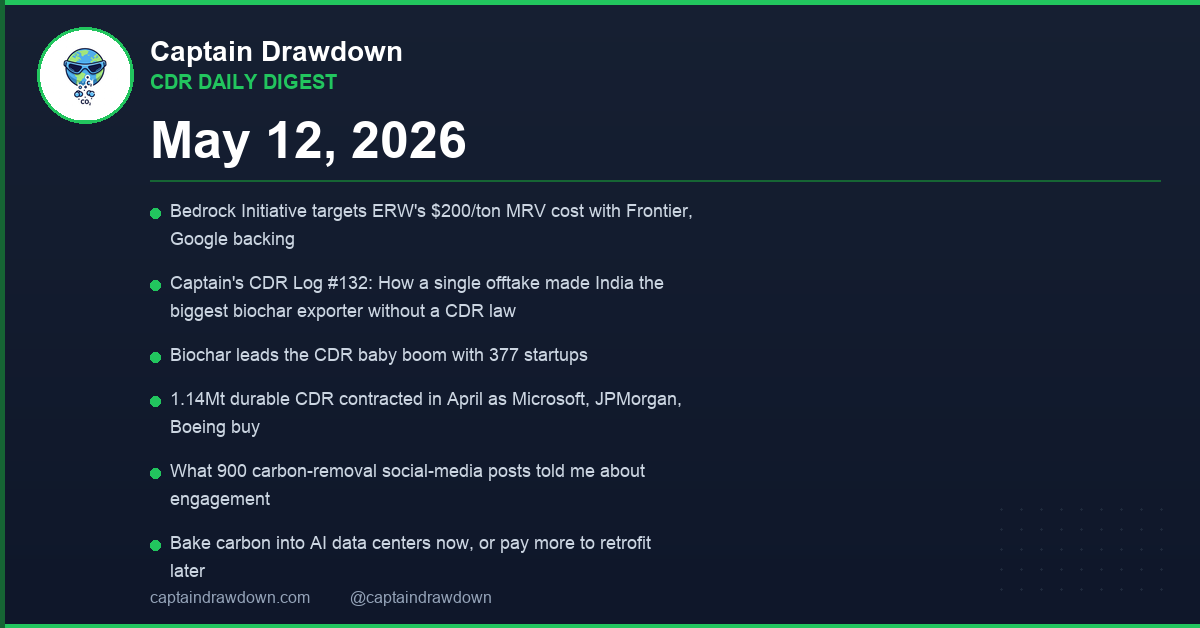
- Bedrock Initiative targets ERW’s $200/ton MRV cost with Frontier, Google backing
- Captain’s CDR Log #132: How a single offtake made India the biggest biochar exporter without a CDR law
- Biochar leads the CDR baby boom with 377 startups
- 1.14Mt durable CDR contracted in April as Microsoft, JPMorgan, Boeing buy
- What 900 carbon-removal social-media posts told me about engagement
- Bake carbon into AI data centers now, or pay more to retrofit later