The buyer base is getting wider, but it is also getting more fragile
Today’s stories point to one pattern: the CDR offtake market is no longer a Microsoft monologue, but the supporting cast is not yet ready to carry the show. Boeing signed a real multi-pathway deal. Germany put almost six billion dollars behind industrial decarbonization. The EU’s CDR lobby is taking a victory lap on policy wins. And underneath all of it, the question I keep circling in the Captain’s Log is whether the demand side can survive one anchor buyer pulling back.
Boeing steps in, and the pathway mix matters
Boeing’s new agreement covers 20,000 tonnes of durable removals split between biochar and enhanced rock weathering, the process of spreading crushed silicate rock on fields so it reacts with CO2 and locks it into bicarbonate. That is not a giant tonnage compared to the seven-figure deals Microsoft has signed, but the structure is interesting. Aviation is exactly the hard-to-abate sector CDR is supposed to serve. Sustainable aviation fuel will not close the gap by 2050, and Boeing buying durable removals for residual emissions is the textbook use case. To be clear: this only makes sense as a complement to cutting jet fuel emissions at the source, not a substitute.
The pathway split also tells you something. Biochar is cheaper and at higher technology readiness, meaning it is closer to commercial deployment. Enhanced rock weathering is earlier stage but offers longer storage durability. Buyers are starting to build portfolios across the cost-durability curve rather than betting on one method. That is healthy.
Germany’s CCfD program is a CDR story whether it says so or not
Germany approved a 5.9 billion dollar Carbon Contracts for Difference scheme. The mechanism is simple: the government pays industrial emitters the gap between the EU carbon price and the actual cost of their cleaner production method. If carbon prices rise above the contract strike price, the company pays the government back.
The headline use is steel, cement, and chemicals switching to hydrogen or electrification. But CCfDs are also one of the cleanest tools governments have to underwrite engineered CDR. A direct air capture plant in Germany faces the same problem a green steel mill does: the cost of the clean output exceeds the carbon price signal. A CCfD closes that gap with public money and removes the risk that a future carbon price collapse kills the project. Watch whether Berlin extends the framework to BECCS (bioenergy with carbon capture and storage) and DAC (direct air capture and storage) projects. The legal scaffolding is now in place.
The EU lobby’s report card
The European CDR industry association published its 2025 annual report, flagging a COP30 pavilion presence and several policy wins, including progress on integrating permanent removals into the EU Emissions Trading System and advancing the Carbon Removal Certification Framework. The framework matters because it sets the measurement, reporting, and verification rules that will decide which tonnes are sellable into compliance markets.
The political reality is that Europe is now the most coherent jurisdiction for durable CDR demand creation. The US picture is murkier on federal support, though the 45Q tax credit remains. If you are a project developer choosing where to site your next facility, the regulatory clarity gap between Brussels and Washington is widening.
The Microsoft question
This week’s Captain’s Log digs into what Microsoft’s recent climate posture shift means for the offtake pipeline. The short version: Microsoft has been roughly half of all durable CDR offtake volume in some recent quarters. If their pace slows, even temporarily, the entire supply side feels it. Frontier buyers, Google, Stripe, Shopify, JPMorgan, plus newer entrants like Boeing, are growing, but not fast enough to fill that hole on a one-year timeline.
The structural fix is compliance demand. Voluntary buyers will always be cyclical because they answer to shareholders and quarterly earnings. Compliance buyers, those required by regulation to buy removals, are not optional. Germany’s CCfD framework and the EU’s removal certification work are the slow-building infrastructure for that compliance layer. The question is whether it arrives before the voluntary market goes through a painful contraction.
What’s next
Two things I am watching this month. First, whether any other aviation or shipping major follows Boeing with a multi-pathway durable removals deal in the next 60 days. One signing is a transaction. Three is a trend, and aviation is the sector where the residual-emissions logic is hardest to argue with. Second, whether the German CCfD program guidance explicitly names CDR pathways as eligible, or quietly leaves the door open through a broader industrial decarbonization category. The fine print will tell us how serious Berlin is about engineered removals as part of its 2045 climate-neutrality target.
Today’s Stories
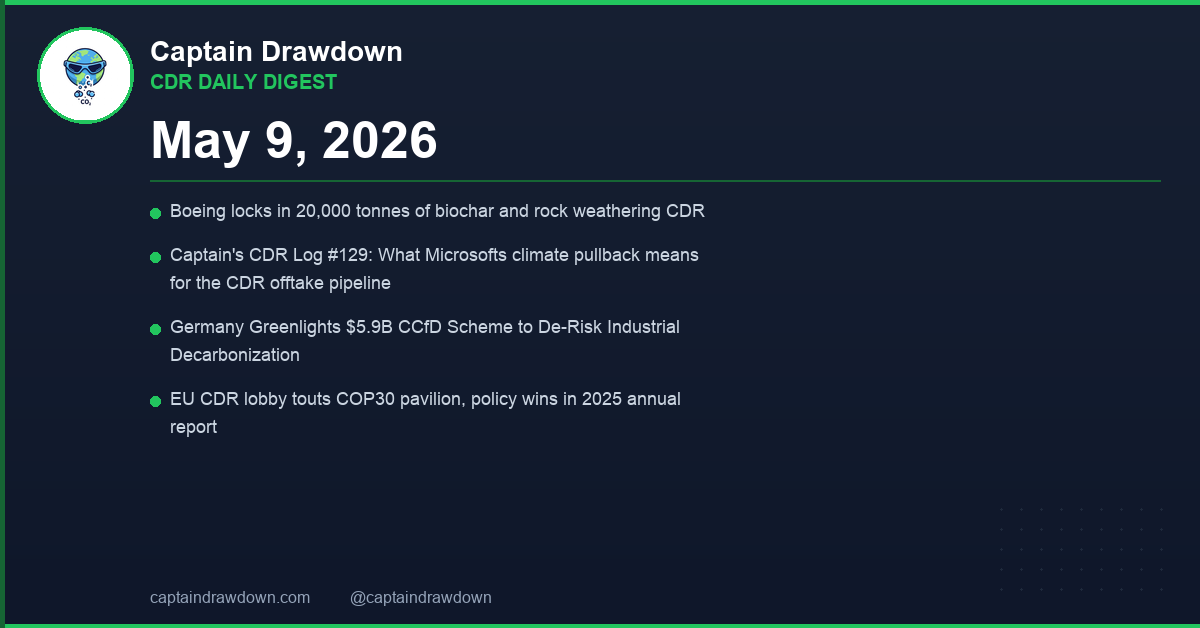
- Boeing locks in 20,000 tonnes of biochar and rock weathering CDR
- Captain’s CDR Log #129: What Microsofts climate pullback means for the CDR offtake pipeline
- Germany Greenlights $5.9B CCfD Scheme to De-Risk Industrial Decarbonization
- EU CDR lobby touts COP30 pavilion, policy wins in 2025 annual report