The day CDR’s biggest buyer blinked
Microsoft paused new carbon removal purchases today, and the rest of the day’s news has to be read through that lens. One company has driven the bulk of durable CDR demand for three years. When that company stops buying, even briefly, the market learns how thin its foundations really are.
The pause is reportedly tied to a portfolio review and tighter scrutiny on delivery risk and verification quality. Microsoft has not walked away. But suppliers who built business plans around the assumption of steady offtake from Redmond are now reworking their models. Several developers I spoke to expect a slower second half of 2026 for new contracts across direct air capture, biochar, and enhanced rock weathering.
That backdrop makes the rest of today’s stories sharper.
A market with one buyer is not a market
A new dataset out today counted 570 pure-play CDR startups worldwide. Their combined headcount is 9,498 people. That is smaller than a single mid-size oil services firm. It tells you two things at once. First, the sector is still early, and most companies are pre-revenue or barely past it. Second, the talent base is concentrated enough that a demand shock from one buyer ripples through nearly every team.
If Microsoft’s purchases drove roughly half of high-durability tonnes contracted in 2024 and 2025, a pause of even two quarters forces the question every CDR founder hates. Who is buyer number two, three, four? Frontier members keep buying. Google and Meta are active but smaller. The rest of the Fortune 500 is still mostly watching.
Infrastructure keeps moving, with or without spot demand
Two stories today show that the build-out of physical CDR and carbon capture and storage capacity is not waiting for the voluntary market to sort itself out.
Deep Sky signed with ENGIE to use the utility’s Power Scale platform to speed DAC deployment in Canada. The deal targets faster siting, power procurement, and grid interconnection, which are usually the slowest parts of getting a DAC plant operating. Power and permitting, not the capture technology itself, are what gate most projects today.
In the UK, the Avonmouth deal near Bristol unlocks a new CCS hub serving England and South Wales. This is point-source capture, not removal, but the shared transport and storage backbone matters for engineered CDR too. BECCS, which is bioenergy with carbon capture and storage, and DACCS, which is direct air carbon capture and storage, both need somewhere to put the CO2. Avonmouth adds optionality on the western side of the country.
The pipeline politics problem
In the US, eminent domain fights are threatening the carbon pipeline buildout across the Midwest. Landowners in Iowa, South Dakota, and parts of Nebraska are pushing back against forced easements for CO2 transport lines. Some state legislatures are responding with bills to limit eminent domain for private CO2 projects.
This is the unglamorous part of CDR scaling. You can finance a DAC plant. You can verify the tonnes. But if you cannot move CO2 from the capture site to a storage site, the project does not work. The US has spent two years assuming pipelines would get built. That assumption is now contested in the places where the pipes actually have to go.
What’s next
Two things to watch over the next four to six weeks.
First, whether any large corporate buyer steps forward with a multi-year offtake announcement while Microsoft is on pause. The market needs a signal that demand is broader than one logo. Frontier’s next purchase round and any move from a European buyer would matter most.
Second, whether the US pipeline backlash forces a shift toward distributed storage models, where capture and injection happen at the same site. That changes project economics and favors developers who already control storage rights. It would slow the hub-and-spoke vision that Summit and Navigator have been chasing.
The fundamentals of CDR have not changed. Residual emissions from cement, aviation, and heavy industry still need durable removal. But today was a reminder that a sector with 9,498 employees and one anchor buyer is fragile in ways that matter.
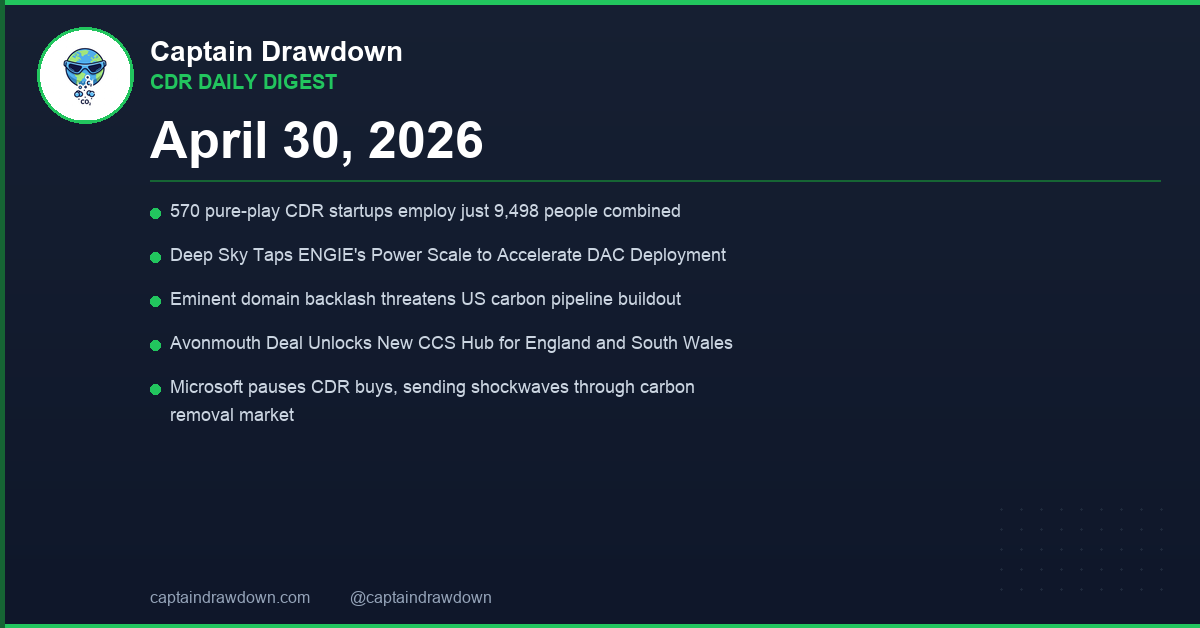
Today’s Stories
- 570 pure-play CDR startups employ just 9,498 people combined
- Deep Sky Taps ENGIE’s Power Scale to Accelerate DAC Deployment
- Eminent domain backlash threatens US carbon pipeline buildout
- Avonmouth Deal Unlocks New CCS Hub for England and South Wales
- Microsoft pauses CDR buys, sending shockwaves through carbon removal market