Mining waste, market concentration, and the feedstock question
Today’s stories cluster around one uncomfortable truth: the CDR market is still defined by who buys, not what works. Microsoft’s pause has revealed that a single buyer drove roughly 80% of durable demand. Meanwhile, the supply side keeps innovating on feedstocks and certification, building infrastructure for a market that does not yet have enough customers.
This is the gap CDR has to close in 2026. Technology readiness is running ahead of demand depth.
The Microsoft revelation
When Microsoft slowed its purchasing cadence, the underlying market structure became visible. One company was responsible for roughly four out of every five tons of durable CDR demand. That is not a market. That is a procurement program with a long tail of smaller buyers attached.
The implication for suppliers is direct. Project finance built on assumed offtake from a concentrated buyer base carries risk that internal rate of return models, the percentage return investors expect, often understate. If you are pricing a 12-year DAC offtake against one anchor customer, you are pricing correlation risk, not just delivery risk.
Frontier, JPMorgan, and Google have grown their commitments, but none approach Microsoft’s volume. The buyer pool needs to widen before suppliers can plan capacity with confidence.
Mining waste as feedstock
Captain’s Log #119 covered the shift this week: mine tailings, slag, and alkaline industrial residues are becoming the feedstock layer for durable removal. Enhanced rock weathering, the practice of spreading crushed silicate rocks to absorb CO2, runs better when the rock is already crushed and sitting in a pile. Ocean alkalinity enhancement, which adds alkaline material to seawater to lock in dissolved carbon, has similar logic.
The reason this matters is unit economics. Capital expenditure on grinding and transport is the single largest cost line for ERW. Mining waste removes most of it. It also turns a liability for mining companies into a revenue line, which changes the politics of permitting.
The measurement, reporting, and verification challenge, known as MRV, gets harder with variable feedstock chemistry. That is the next bottleneck.
Biochar’s quiet dominance
A new count puts biochar at 377 of 970 CDR companies tracked. That is 39% of the supplier base. Biochar wins on technology readiness and low capital costs. It loses on durability claims and price per ton compared to DAC or mineralization.
The number tells you where founders went when capital was easy. Whether 377 biochar companies survive a tighter buyer market is a different question. Consolidation looks likely.
Infrastructure and certification keep moving
DNV was named Independent Certifier for the Northern Endurance pipeline, the UK offshore CO2 transport system serving the East Coast Cluster. Pipeline certification is unglamorous and necessary. Without verified transport, point-source capture and DAC at coastal sites cannot reach permanent storage.
Separately, Verde and Isometric launched a “Pathway Unspecified” credit category. Buyers commit to durable removal without locking in the method at purchase. The pitch is portfolio flexibility for buyers and earlier revenue for suppliers across pathways. The risk is that it weakens the price signal that pushes buyers toward specific durability tiers. Worth watching how the verification protocol handles substitution.
A reminder on framing: every credit, certified or not, is for residual emissions that cannot be cut at the source. CDR does not extend the runway for fossil fuel use. It addresses what is left after deep decarbonization.
What’s next
Watch two things. First, whether any single buyer announces a commitment in Q2 large enough to dilute Microsoft’s share of the durable market. Until that happens, supplier financing remains fragile. Second, whether mining-waste-based ERW projects begin reporting verified tons at scale. The economic case is strong on paper. The MRV record is still thin.
The feedstock question and the buyer question are connected. Cheaper tons need more buyers to absorb them. Otherwise the supply curve runs ahead of the demand curve, and good projects stall waiting for offtake.
Today’s Stories
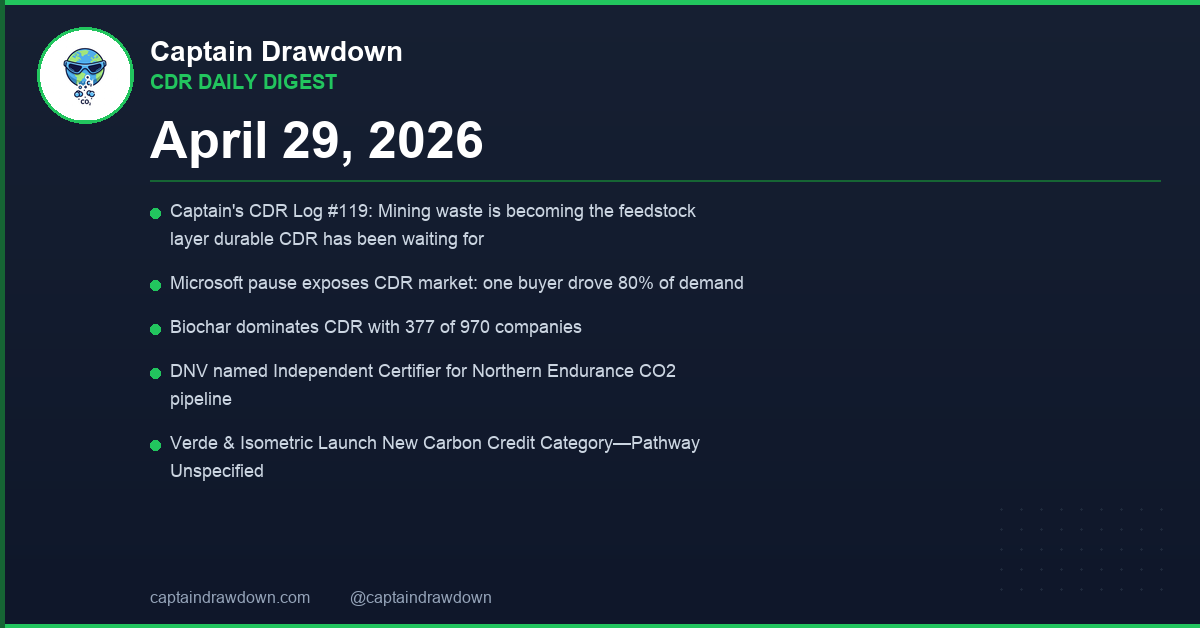
- Captain’s CDR Log #119: Mining waste is becoming the feedstock layer durable CDR has been waiting for
- Microsoft pause exposes CDR market: one buyer drove 80% of demand
- Biochar dominates CDR with 377 of 970 companies
- DNV named Independent Certifier for Northern Endurance CO2 pipeline
- Verde & Isometric Launch New Carbon Credit Category—Pathway Unspecified