The UK is trying to corner CDR finance. The plants are showing up to match.
Today’s stories line up around one country. The UK posted a $1.6 billion voluntary carbon market, the City of London made the case for scaling it further, and Wiltshire became home to what will be the country’s largest biochar carbon-removal facility. Meanwhile in Germany, a CO2-to-concrete demo went live, and a separate piece argued that buyers can no longer treat offtake diligence as a one-and-done check. The pattern: CDR is moving from pilot announcements to operating plants, and the financial plumbing around them is getting more demanding.
UK pulls ahead, but the lead is fragile
The City of London Corporation published findings that the UK voluntary carbon market has reached $1.6 billion and could deliver major economic gains if scaled. The report frames the UK as a global hub for carbon market services, including ratings, MRV (measurement, reporting and verification), and legal infrastructure.
The caveat in the same coverage: the lead is at risk. Singapore, the EU, and US states are building competing frameworks. Without clearer integration between voluntary credits and compliance markets, plus firmer rules on what counts as a high-integrity removal, the UK’s first-mover position erodes. The City’s pitch is essentially that financial services depth is the moat, but moats need rules to defend.
A £24M biochar plant in Wiltshire
The capital is starting to land on physical assets. A £24 million project in Wiltshire will become the UK’s largest biochar carbon-removal plant. Biochar locks carbon from biomass into a stable solid form that can be applied to soils, with durability typically measured in centuries.
This matters because UK CDR has been heavy on announcements and light on operating tonnes. A single plant does not change the national balance sheet, but biochar at this scale gives domestic buyers something to actually purchase, and it tests whether feedstock supply chains and soil-application MRV hold up under commercial volume. CDR here is for residual emissions in hard-to-abate sectors. It does not replace cutting fossil use.
Co-reactive turns on a continuous concrete line
In Erkrath, Germany, Co-reactive switched on a continuous demo plant that mineralizes CO2 into concrete inputs. The word that matters is continuous. Batch demos prove chemistry. Continuous operation starts proving unit economics, throughput, and the kind of run-time data that buyers and project finance teams need before writing larger checks.
Mineralization in concrete is one of the most durable storage routes available, and it slots into an existing industrial buyer base. The demo will not move global tonnage on its own, but it is the kind of milestone that turns a technology readiness story into a procurement conversation.
Offtake diligence is now continuous
A piece today argued that buyers reviewing CDR offtake agreements can no longer treat diligence as a single pre-signing check. Project risk shifts as plants commission, feedstock contracts change, MRV protocols update, and registries revise rules. Buyers who locked in terms two years ago are finding that the project they diligenced is not quite the project delivering tonnes today.
The practical implication: legal and technical teams need ongoing review rights written into contracts, not just rep-and-warranty language at signing. Expect more buyers to push for staged payments tied to verified delivery rather than upfront commitments.
What’s next
Watch two things. First, whether the UK’s policy follow-through matches the City of London’s ambition. The $1.6 billion figure is real, but the integrity rules and compliance-market linkages are still drafts. Second, whether continuous operation at Co-reactive and the Wiltshire biochar plant produces the kind of monthly delivery data that turns CDR offtake into a normal procurement category rather than a bespoke negotiation each time.
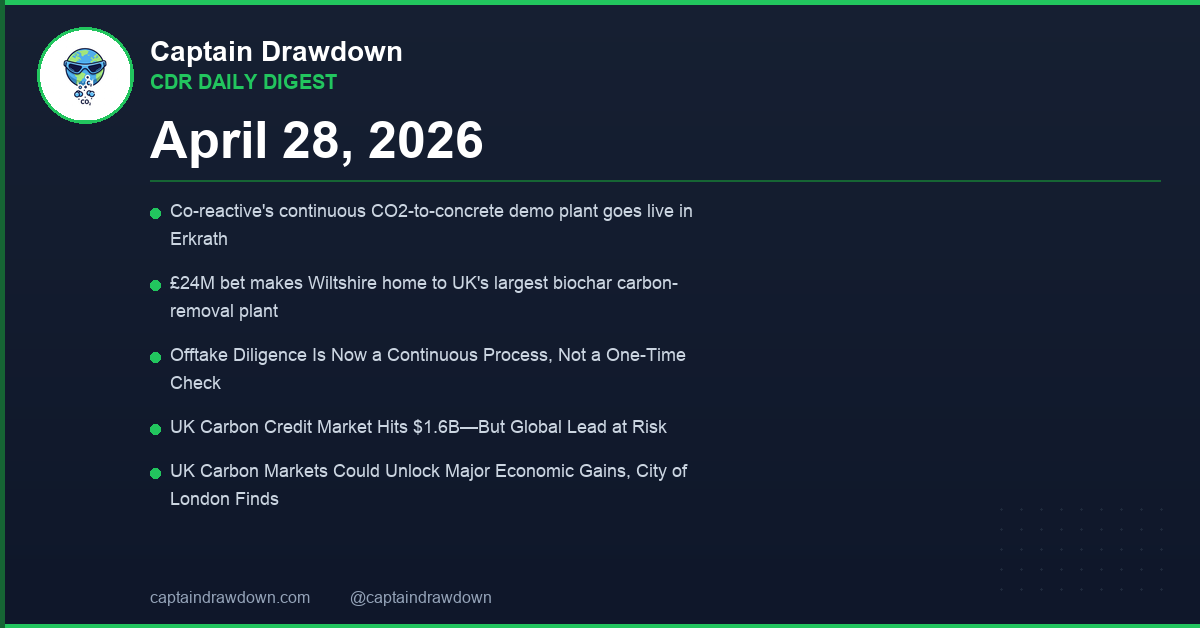
Today’s Stories
- Co-reactive’s continuous CO2-to-concrete demo plant goes live in Erkrath
- £24M bet makes Wiltshire home to UK’s largest biochar carbon-removal plant
- Offtake Diligence Is Now a Continuous Process, Not a One-Time Check
- UK Carbon Credit Market Hits $1.6B—But Global Lead at Risk
- UK Carbon Markets Could Unlock Major Economic Gains, City of London Finds