The Single Buyer Problem Is Now Impossible to Ignore
Today’s stories share a common thread: CDR is bumping into the limits of its current shape. Carbon pricing covers most of the world economy on paper but barely moves emissions. Public money is starting to fill gaps that private buyers cannot. And one company stepping back from the market sent a tremor through the entire industry. The question is no longer whether CDR can scale technically. It is whether the buyer base, the policy scaffolding, and the financing pipes can carry the weight.
Microsoft’s pause is a stress test for the whole market
Microsoft slowed new CDR purchases this quarter and the reaction was loud. That is because Microsoft has anchored a huge share of durable removal offtakes over the past two years. When one buyer can move the market by clearing its throat, the market is too thin. Suppliers told reporters they had built project pipelines around the assumption that Microsoft demand would keep growing on the same curve. It will not, at least not this quarter.
The lesson is structural. A market that depends on three or four hyperscaler buyers is not a market. It is a procurement program. Diversifying the buyer base, through compliance demand, sectoral mandates, or aviation and shipping obligations, is now the most important variable for whether early CDR projects reach financial close in 2027.
Carbon pricing has reach without depth
The World Bank’s annual update shows carbon pricing instruments now cover 63% of global GDP. That sounds like progress until you look at price levels and exemption rules. Most covered emissions trade below $20 a ton. Very few schemes recognize durable removals as compliance instruments. So the headline coverage number tells us almost nothing about whether CDR projects can sell into compliance markets.
The gap between coverage and impact is where the next round of policy fights will happen. The EU ETS is moving slowly toward integrating removals. California is studying it. Until compliance buyers can purchase durable removals, the voluntary market will keep doing the heavy lifting, and we just saw how fragile that is.
Public money steps in where private money hesitates
Croatia committed $3.2 million in public funds to seed carbon capture projects. The number is small. The signal matters more. Smaller EU member states are starting to deploy national budgets to attract CCS and CDR developers, rather than waiting for Brussels-level instruments to mature. Expect more of this. When private offtake is uncertain, public co-funding lowers the risk enough to keep early projects alive.
Carbonyx raised $1.2 million to convert mining waste into carbon-storing construction materials. Small round, interesting thesis. Mineralization pathways that piggyback on existing industrial waste streams have a cost advantage because the feedstock is already aggregated and often a liability for the host site. If the company can show durable storage and a buyer for the material, this is the kind of business that survives a soft offtake market because it sells a product, not just a credit.
Scientists raise the volume
Captain’s Log #117 covered a notable shift in tone from the climate science community this week. Several lead authors of recent assessments published commentary urging faster CDR deployment alongside aggressive emissions cuts. The framing matters. Scientists are not arguing for CDR instead of mitigation. They are arguing that residual emissions in hard-to-abate sectors will require removals at gigaton scale, and the current pipeline is not on track. That distinction gets lost in headlines, but it is the only honest framing. CDR is for the emissions you cannot eliminate, not the ones you choose not to.
What’s next
Watch two things. First, whether any other hyperscaler steps up offtake volume in Q2 to fill the Microsoft gap, or whether the slowdown spreads. Second, watch the EU ETS removal integration timeline. If Brussels signals a clear pathway in the next few months, compliance demand could finally start to relieve pressure on voluntary buyers. If it slips again, expect more small public funding announcements like Croatia’s, and more startups like Carbonyx pivoting toward product revenue rather than credit revenue.
Today’s Stories
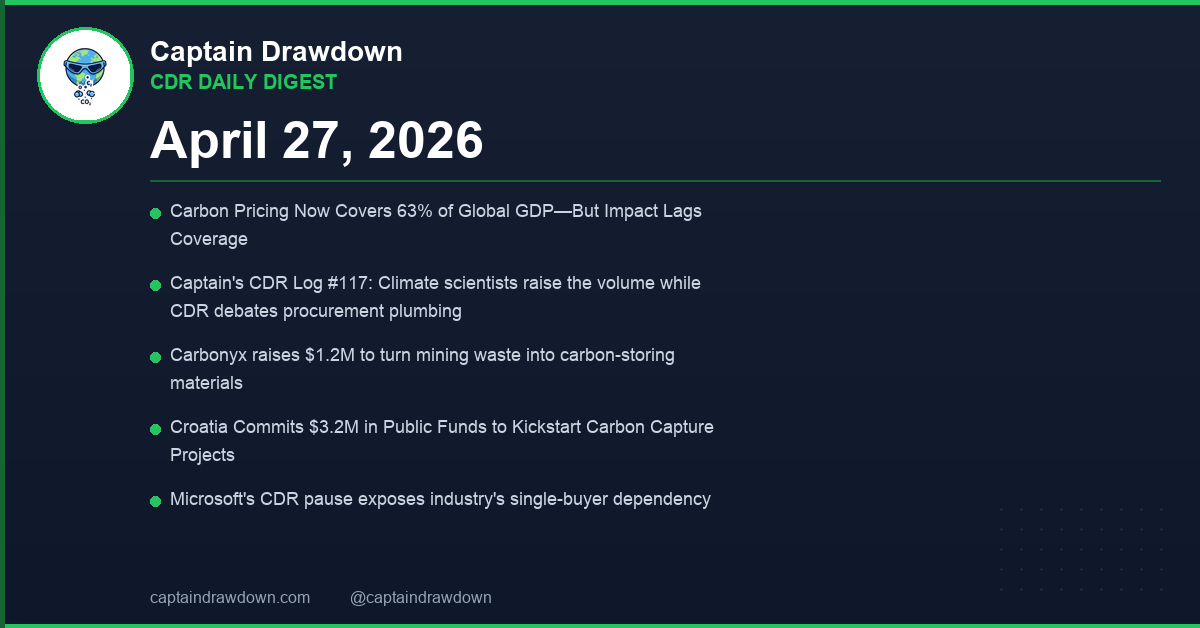
- Carbon Pricing Now Covers 63% of Global GDP—But Impact Lags Coverage
- Captain’s CDR Log #117: Climate scientists raise the volume while CDR debates procurement plumbing
- Carbonyx raises $1.2M to turn mining waste into carbon-storing materials
- Croatia Commits $3.2M in Public Funds to Kickstart Carbon Capture Projects
- Microsoft’s CDR pause exposes industry’s single-buyer dependency