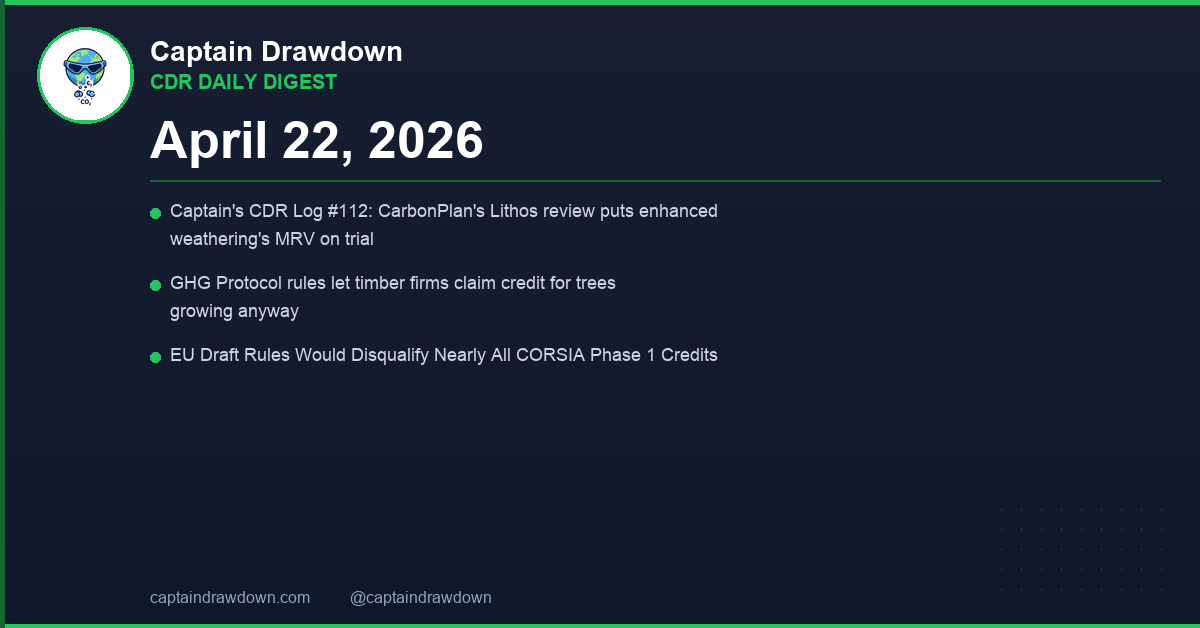
Today’s three stories share one uncomfortable thread: the accounting rules that CDR markets depend on are being rewritten in real time, and a lot of what counts as “removal” today will not count tomorrow.
The MRV reckoning is here
CarbonPlan’s review of Lithos Carbon, published this week, is the clearest sign yet that enhanced rock weathering (spreading crushed basalt on fields to pull CO2 from the air) is running ahead of its measurement science. The review questions how Lithos models cation loss, how it handles soil sampling variance, and whether current protocols can distinguish a real removal signal from background noise. This matters because Lithos has been one of the better-funded ERW suppliers, with Frontier among its buyers. If the critique lands, every ERW developer will face tougher questions from buyers about measurement, reporting, and verification — the MRV stack that turns a field trial into a tonne you can sell.
The fix is not to abandon ERW. The fix is to publish uncertainty ranges honestly, tighten sampling, and let buyers price the discount. CarbonPlan is doing the market a favor by forcing that conversation in public.
Timber’s free-rider problem
The GHG Protocol’s draft land sector guidance contains a loophole that lets timber companies book removal credit for forest growth that would have happened without any intervention. In plain terms: if a tree was going to grow anyway under normal rotation, the company can still claim the carbon it stored. That is not additionality. That is paying someone for doing nothing new.
This is the oldest critique in carbon markets, and it keeps coming back because the economic incentive to claim baseline growth is enormous. The timber sector manages hundreds of millions of hectares. Even a small accounting tilt toward inflated baselines could flood voluntary markets with credits that represent no real change in atmospheric CO2. Buyers serious about residual-emissions offsetting, which is the only defensible use of CDR, should treat any LULUCF credit without a tight counterfactual as suspect.
CORSIA’s credibility problem gets worse
The EU’s draft rules on aviation offsetting would disqualify nearly all CORSIA Phase 1 credits from counting toward the bloc’s climate goals. CORSIA is the International Civil Aviation Organization’s scheme, and Phase 1 runs 2024 to 2026. The EU’s objection is that most approved credits do not meet its stricter additionality and permanence tests, particularly credits from avoided deforestation and older renewable projects.
If the rules hold, airlines operating into EU airports face a split regime: credits that clear CORSIA but not the EU. That will pressure ICAO to tighten its own standards or watch its flagship program lose relevance in the world’s second-largest aviation market. It also sharpens the case for durable CDR, meaning removals that stay out of the atmosphere for centuries, as the only category that survives rising regulatory scrutiny.
The pattern
Three stories, one message: the easy credits are getting squeezed from every direction. MRV critiques are tightening the science bar on novel removals like ERW. Baseline-gaming loopholes in forestry are getting named and shamed. And regulators are starting to reject offset programs wholesale when they do not meet additionality and permanence standards.
None of this means CDR is in trouble. It means the market is maturing toward a smaller set of credits that actually represent a tonne of CO2 kept out of the atmosphere. Buyers who want defensible claims should welcome this. Suppliers who cannot show their work should worry.
What’s next
Watch whether Lithos and other ERW developers publish detailed responses to the CarbonPlan critique in the next 60 days. A substantive reply with updated uncertainty ranges would be a healthy sign. Silence or deflection would not.
Watch the final GHG Protocol land sector guidance. If the additionality language stays weak, expect corporate buyers with serious climate commitments to write their own stricter procurement rules, as Microsoft and Frontier have already begun doing.