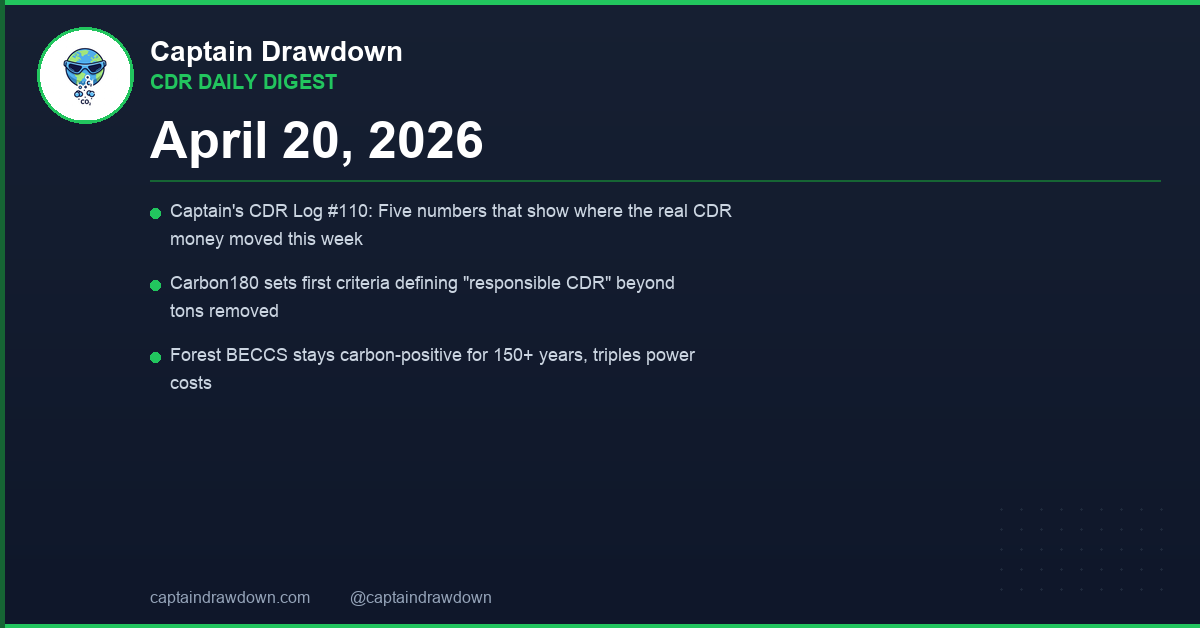
The week CDR stopped being graded only on tons
Something shifted this week. Three separate stories, from three different corners of the field, all pointed at the same question: what counts as a good ton of carbon removal?
For two years the answer has been “a cheap one that verifies.” This week that answer started to break.
The money is moving, but not where the headlines suggest
The Captain’s Log tracked five numbers from the past seven days. The pattern underneath them is what matters. Capital is still flowing into CDR, but it is flowing toward projects that can prove durability and clean supply chains, not just low price per ton. Buyers who spent 2024 chasing the cheapest verified credit are now asking harder questions about what happens in year 40, where the energy comes from, and who lives near the project.
That shift in buyer behavior is what gives the other two stories their weight.
Carbon180 draws a line
Carbon180 published the first concrete criteria for what it calls “responsible CDR.” The framework goes past tons removed and asks about community consent, labor practices, water and land use, energy source, and whether a project displaces existing climate work or adds to it.
This matters because until now, “responsible” has been a marketing word. Every developer claimed it. No one had to prove it. Carbon180’s criteria give buyers, registries, and policymakers a shared checklist. A DAC plant running on a dedicated solar array with a community benefit agreement now looks measurably different from one pulling grid power in a region already struggling with air quality, even if both deliver the same tonnage.
Expect registries and large buyers to cite this framework within months. Expect some projects to fail it.
And a reminder the framework itself makes clear: CDR is for residual emissions that cannot be cut at the source. It is not a reason to slow the fossil phase-out. Responsible CDR starts with that boundary.
Forest BECCS takes a hit
A new study found that forest-based BECCS, which is bioenergy with carbon capture and storage using wood feedstock, stays carbon-positive for more than 150 years in most modeled cases. The same analysis found it roughly triples the cost of the electricity produced.
Read that carefully. The pathway does eventually go net-negative. But “eventually” means beyond the lifetime of anyone alive when the plant is built, and the power it produces is three times more expensive than alternatives.
This is not an argument against all BECCS. Waste-stream BECCS, agricultural residues, and short-rotation feedstocks sit in different parts of the ledger. But the image of cutting mature forest to feed a power plant and calling it removal has taken a serious hit. Project developers relying on forest biomass in their 2030 pipelines should be running their numbers again.
Combined with Carbon180’s criteria, a clear picture emerges. A pathway that takes 150 years to break even on carbon, costs three times the grid, and depends on cutting standing forest is going to struggle on almost every row of a responsible CDR scorecard.
What connects these three
The link is simple. The field is moving from “can you remove a ton and verify it” to “can you remove a ton, verify it, defend the timeline, defend the supply chain, and defend the siting.”
Projects that can do all five will raise capital. Projects that can only do the first two will find buyers walking away. That is a healthier market than the one we had in 2024, even if it means a smaller one in 2026.
What’s next
Watch two things. First, which registries formally adopt language from the Carbon180 criteria, and how fast. Puro, Isometric, and Verra all have revision cycles open or approaching. Second, watch the forest BECCS project pipeline in the UK and EU. If developers quietly swap feedstocks or pause projects in the next quarter, the new durability math is doing its job.