The Day CDR Started Writing Its Own Rulebook
Today’s four stories point at one pattern: the CDR field is no longer waiting for governments to define what counts as good carbon removal. Buyers, nonprofits, and companies are writing the rules in real time, and the definitions they pick now will shape which projects get funded for the next decade.
That is the headline. The rulebook is being drafted in public, by the people placing the bets.
Who gets to define “durable”
Captain’s Log #109 walked through the core tension. Durability, permanence, additionality, and verification all sound technical, but each one is a policy choice dressed up as a measurement. A 100-year storage floor excludes most forestry. A 1,000-year floor excludes most soil and most biochar. A flexible tonne-year accounting approach lets nearly everything in.
No single body owns this decision. The IPCC offers framing. Isometric, Puro, and Verra write protocols. Frontier and the US 45Q tax credit set buyer and policy thresholds. Each pulls the definition in a different direction, and projects chase whichever door is open.
Carbon180 tries to widen the frame
Carbon180 published what it calls the first standards for “good” CDR, and the interesting move is that durability is not the top criterion. The three anchors are community consent, equity in benefit-sharing, and ecosystem integrity. That is a direct response to a field that has often treated local communities as a permitting hurdle rather than a partner.
The practical question is whether buyers adopt it. If Frontier, Microsoft, or JPMorgan start asking suppliers to show free prior informed consent documentation and benefit-sharing agreements, the standard has teeth. If not, it sits next to a dozen other voluntary frameworks. Watch the next wave of large offtakes for language that cites it.
Biochar consolidation arrives
Mangrove Systems acquired Grain Ecosystem this week, which looks small on its own but signals something bigger. Biochar has been the volume leader in delivered CDR tonnes for two years running, and the sector is full of sub-scale producers running one or two pyrolysis units. Consolidation was inevitable once buyers started demanding audited MRV, which is measurement, reporting and verification, at a level small operators cannot afford to build alone.
Expect more deals. The economics favor operators who can spread MRV and sales costs across many sites. The risk is that consolidation narrows feedstock diversity and concentrates the failure modes everyone is betting on.
JPMorgan and the dynamic baseline
JPMorgan bought 85,000 tonnes of forest credits under a new dynamic baseline methodology. Dynamic baselines adjust the counterfactual over time based on what similar untreated forests actually do, rather than freezing a projection at project start. This fixes one of the oldest criticisms of forest credits, which is that static baselines reward projects for trends that would have happened anyway.
It does not fix everything. Leakage, reversal, and the 100-year durability gap between forests and geologic storage are still there. But a major bank buying at this volume under stricter accounting is a meaningful signal that forest credits are not going away, they are being re-engineered. And to be direct, forest credits bought by a fossil-adjacent financial player only help the climate if they sit on top of real emissions cuts, not instead of them. CDR is for residual emissions, not a license to delay the phase-out.
What’s next
Two things to watch. First, whether Carbon180’s standards show up by name in the next Frontier or NextGen purchase announcement. That is the test of whether equity and consent criteria make it from nonprofit paper to buyer contract. Second, whether the biochar consolidation wave produces one or two operators large enough to negotiate directly with hyperscaler buyers on multi-year offtake terms. If yes, biochar graduates from a cottage category to an industrial one.
The rulebook is being written. Pay attention to who holds the pen.
Today’s Stories
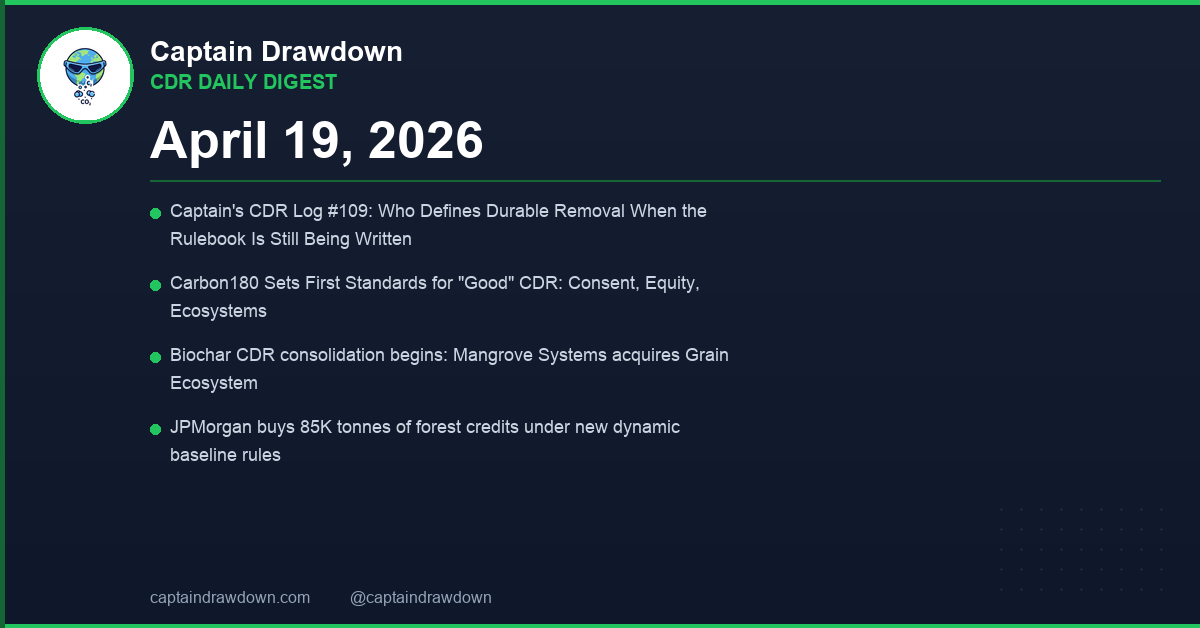
- Captain’s CDR Log #109: Who Defines Durable Removal When the Rulebook Is Still Being Written
- Carbon180 Sets First Standards for “Good” CDR: Consent, Equity, Ecosystems
- Biochar CDR consolidation begins: Mangrove Systems acquires Grain Ecosystem
- JPMorgan buys 85K tonnes of forest credits under new dynamic baseline rules