Today’s signal is a widening split in carbon markets. Engineered removals are posting record volumes and long-term contracts, while a major avoided-emissions category just got downgraded by an order of magnitude. Buyers are voting with their checkbooks, and the vote is for durable, measurable tons.
The record month nobody should gloss over
March 2026 logged 1.51 million tonnes of CDR purchases in a single month. That is not a cumulative figure. It is one month. The pace suggests 2026 will blow past every prior year, and the mix is shifting toward contracts with real delivery schedules rather than speculative forward offtakes. The buyers driving this are familiar names, but the volumes per deal are climbing.
Two deals from today show what that growth looks like on the ground.
Google, McKinsey, and Meta committed to 131,000 tons from Living Carbon, the startup using engineered poplar trees designed for faster growth and higher carbon uptake. This is one of the larger nature-based purchases tied to a specific biotech approach rather than generic forestry. It also puts engineered trees on the same buyer ledger as direct air capture and biochar, which is new.
Novocarbo signed a long-term biochar CDR and heat supply deal with a German municipal utility. The structure matters more than the tonnage. Pairing carbon removal with district heat revenue turns biochar plants into infrastructure, not pilot projects. Municipal utilities have balance sheets built for 20-year contracts. If more of them follow, biochar economics improve because the heat offtake covers operating expenditure and the carbon credit becomes upside rather than the whole business case.
Cotierra delivered 1,200 tCO2e of soil carbon to myclimate and extended the agreement to 2027. Small number, but soil carbon delivery at all is noteworthy given how many soil projects have stumbled on measurement, reporting, and verification (MRV).
The REDD+ correction
A new analysis found that REDD+ credits, which are supposed to represent avoided deforestation, overstated their climate benefit by 10.7 times. REDD+ is not CDR. It is an avoided-emissions category. But it sits next to CDR in most corporate portfolios and shapes how buyers think about quality.
The 10.7x figure is not a rounding error. It means a company that retired 100,000 REDD+ credits to claim neutrality actually covered closer to 9,000 tons of real climate benefit. Buyers who mixed REDD+ with removals to hit targets cheaply are now holding paper that regulators, auditors, and journalists will treat as suspect.
This is why the March removal volumes matter. Durable CDR with measurable delivery, biochar you can weigh, trees you can inventory, mineralized CO2 you can track, is becoming the only defensible path for companies that need their claims to survive scrutiny. The price premium for durability is starting to look less like a premium and more like the cost of not getting sued.
What the buyer mix tells us
Google, McKinsey, and Meta are not buying engineered trees because they are cheap. They are buying because the MRV story is tighter than conventional forestry and the counterparty is building something auditable. The same logic drives the Novocarbo deal. A municipal utility is not signing a 10-plus year contract for vibes.
The pattern across today’s five stories: contracts are getting longer, buyers are getting pickier, and the gap between removal credits and avoided-emissions credits is becoming a chasm. CDR remains a tool for residual emissions only. None of today’s deals change that. Fossil phase-out still has to happen on its own track.
What’s next
Watch whether April 2026 volumes confirm March as a new baseline or reveal it as a pull-forward. And watch how corporate buyers holding large REDD+ inventories respond to the 10.7x finding. Quiet retirement of those positions and replacement with durable removals would be the clearest signal yet that the two markets have split for good.
Today’s Stories
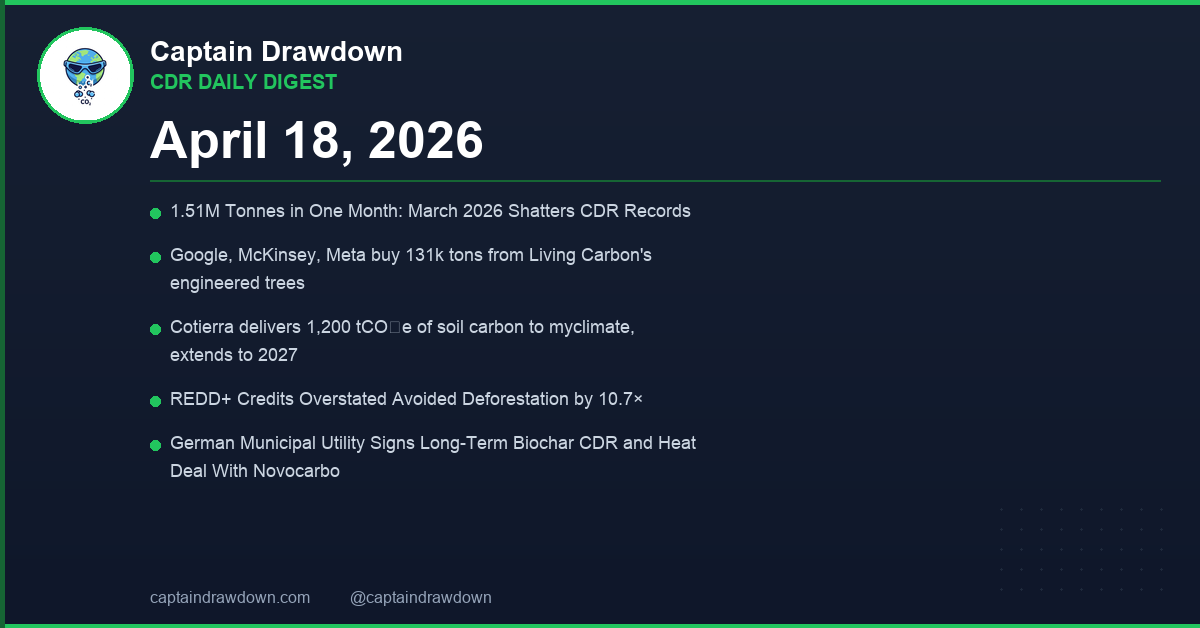
- 1.51M Tonnes in One Month: March 2026 Shatters CDR Records
- Google, McKinsey, Meta buy 131k tons from Living Carbon’s engineered trees
- Cotierra delivers 1,200 tCO₂e of soil carbon to myclimate, extends to 2027
- REDD+ Credits Overstated Avoided Deforestation by 10.7×
- German Municipal Utility Signs Long-Term Biochar CDR and Heat Deal With Novocarbo