The gap between carbon credit claims and real-world carbon removal just got another data point. A new study finds that REDD+ avoided-deforestation projects overclaimed their climate benefit by a factor of 10.7. Meanwhile, buyers and developers are shifting toward removal credits with tighter measurement, and the signals are everywhere in today’s stories.
The crediting gap is reshaping where money flows
A peer-reviewed study found that REDD+ projects, which sell credits based on forests they claim would have been cut down, overstated their avoided deforestation by 10.7 times on average. That means for every ton of CO2 these credits claimed to protect, roughly a tenth of a ton was real. This isn’t new territory. Earlier analyses flagged similar problems. But the scale of the overclaim keeps getting confirmed, and it matters because these credits still circulate in voluntary markets.
The response from serious buyers is visible. JPMorganChase just locked in a purchase of 85,000 tons of carbon removal using dynamic baselines, a method that updates the reference scenario over time instead of fixing it at the start. That design directly addresses the kind of baseline inflation that plagues REDD+. When your baseline adjusts to new data, it’s harder to overclaim. JPMorgan’s deal signals that large corporate buyers are willing to pay for that rigor.
Biomass burial finds a market faster than expected
Mast Reforestation sold out its Montana biomass burial credits in weeks. The approach takes forest residues, wood that would otherwise decompose or burn, and buries it in conditions designed to keep the carbon locked away for centuries. It’s a lower-tech CDR method compared to direct air capture, but the speed of the sellout suggests buyers see value in approaches that are measurable, near-term, and grounded in physical storage.
This is worth watching alongside the REDD+ findings. Buyers burned by avoidance credits with shaky baselines appear to be migrating toward removal credits where the carbon accounting is more straightforward: you can weigh the biomass, measure the burial conditions, and track durability.
System change vs. net-zero targets
One of today’s stories argues that chasing net-zero targets right now is less productive than investing in the system-level changes, infrastructure, incentives, measurement standards, that make net zero achievable later. The argument isn’t that net zero is wrong. It’s that declaring a target without the underlying systems to deliver it leads to the kind of accounting gaps we see in REDD+.
This framing connects directly to the CDR world. Carbon removal only works as a climate tool if the measurement and verification systems are trustworthy. Dynamic baselines, physical storage verification, and transparent crediting methodologies are all system-level investments. They’re less exciting than a big removal number, but they’re what makes the number real.
Private capital steps up as public funding gets complicated
Gevo, a sustainable aviation fuel company, abandoned its Department of Energy loan and is now seeking private capital for its SAF plant. The reasons are specific to Gevo’s situation, but the broader pattern matters for CDR. Public funding timelines and conditions don’t always match what companies need. When private capital is available and willing, some developers will choose speed and flexibility over government-backed financing.
For CDR companies watching this, the lesson is practical: diversify your capital strategy. DOE loans and grants remain important, but they come with constraints. The companies that build relationships with private investors alongside public funders will have more options when timelines shift.
What’s next
Two things to watch. First, whether JPMorgan’s dynamic-baseline structure becomes a template for other large buyers. If it does, it could push credit developers to adopt more rigorous baseline methods across the board. Second, whether biomass burial, after Mast’s quick sellout, attracts enough capital to move from project-scale to regional-scale operations. The demand signal is there. The question is whether supply can follow.
Today’s Stories
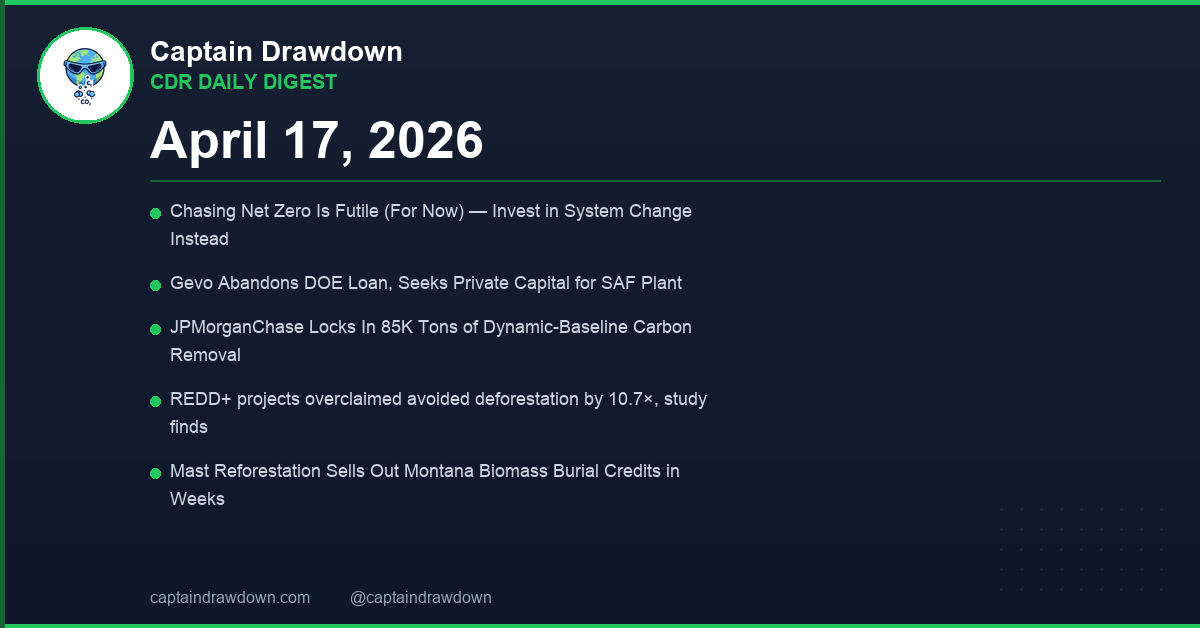
- Chasing Net Zero Is Futile (For Now) — Invest in System Change Instead
- Gevo Abandons DOE Loan, Seeks Private Capital for SAF Plant
- JPMorganChase Locks In 85K Tons of Dynamic-Baseline Carbon Removal
- REDD+ projects overclaimed avoided deforestation by 10.7×, study finds
- Mast Reforestation Sells Out Montana Biomass Burial Credits in Weeks