The CDR market is splitting into two lanes: one where small hardware companies race to prove unit economics, and another where policy and credit-quality questions threaten to reshape demand. Today’s five stories sit neatly across that divide.
Ucaneo fires up a room-temperature DAC plant in Berlin
German startup Ucaneo has opened a direct air capture facility in Berlin that operates at room temperature, a notable departure from the energy-intensive thermal processes most DAC companies rely on. The plant targets 150 tonnes of CO₂ removed per year by July 2026. That is tiny by industrial standards, but the room-temperature angle matters. Heat is the biggest cost driver in conventional DAC. If Ucaneo’s sorbent chemistry holds up at steady state, the energy bill per tonne could drop meaningfully. The next milestone to watch: whether the plant hits its 150 t/yr nameplate and what the verified cost per tonne looks like once it does.
Biochar consolidation arrives
Mangrove Systems has acquired Grain’s biochar platform, one of the clearest consolidation signals the CDR sector has sent so far. Biochar, the practice of converting biomass into stable carbon and locking it into soil, has dozens of small operators but few with the scale buyers want. Mangrove is betting that absorbing Grain’s technology and customer base gets it closer to the volume thresholds corporate purchasers need. Expect more deals like this. The biochar segment is fragmented, margins are thin at small scale, and buyers increasingly want single counterparties who can deliver thousands of tonnes, not hundreds.
Credit quality takes another hit
A new study finds that REDD+ credits, which pay landowners to avoid cutting forests, overstated their climate benefit by a factor of 10.7. In plain terms: for every tonne of avoided deforestation these credits claimed, only about a tenth of a tonne was real. This is not a CDR story in the strict sense. REDD+ is an avoidance credit, not a removal credit. But it matters for CDR because every credit-quality scandal pushes serious buyers further toward durable removal, where a tonne stored underground or locked in biochar is physically verifiable. The gap between avoidance-credit pricing and removal-credit pricing should keep widening.
Carbon180 reframes community engagement
Carbon180 released a new framework that puts affected communities at the center of CDR project development, not as an afterthought. The framework is a direct response to growing local opposition at proposed DAC and biomass sites. Whether or not you think community frameworks change outcomes, the political reality is clear: projects that skip genuine local engagement are getting delayed or killed. Carbon180’s contribution is to codify what “genuine” looks like, giving developers a checklist and giving communities a standard to hold them to.
DOE keeps awards but most cancelled projects stay gone
The Department of Energy confirmed it will honor roughly 2,000 awards made during the Biden administration. That sounds like good news for CDR grantees. The catch: 94% of previously cancelled projects remain cancelled. So the surviving awards are the exception, not the rule. For CDR companies that had DOE funding pulled earlier this year, today’s announcement changes nothing. For the lucky few whose grants survived, the money is now on firmer footing.
What’s next
Two things to track. First, Ucaneo’s July performance data. If a room-temperature DAC plant can hit 150 t/yr reliably, it will draw serious attention from investors hunting for lower-energy pathways. Second, watch for more biochar M&A. Mangrove’s acquisition of Grain likely kicks off a wave. The segment has too many sub-scale operators and too few scaled suppliers for the consolidation to stop here.
Today’s Stories
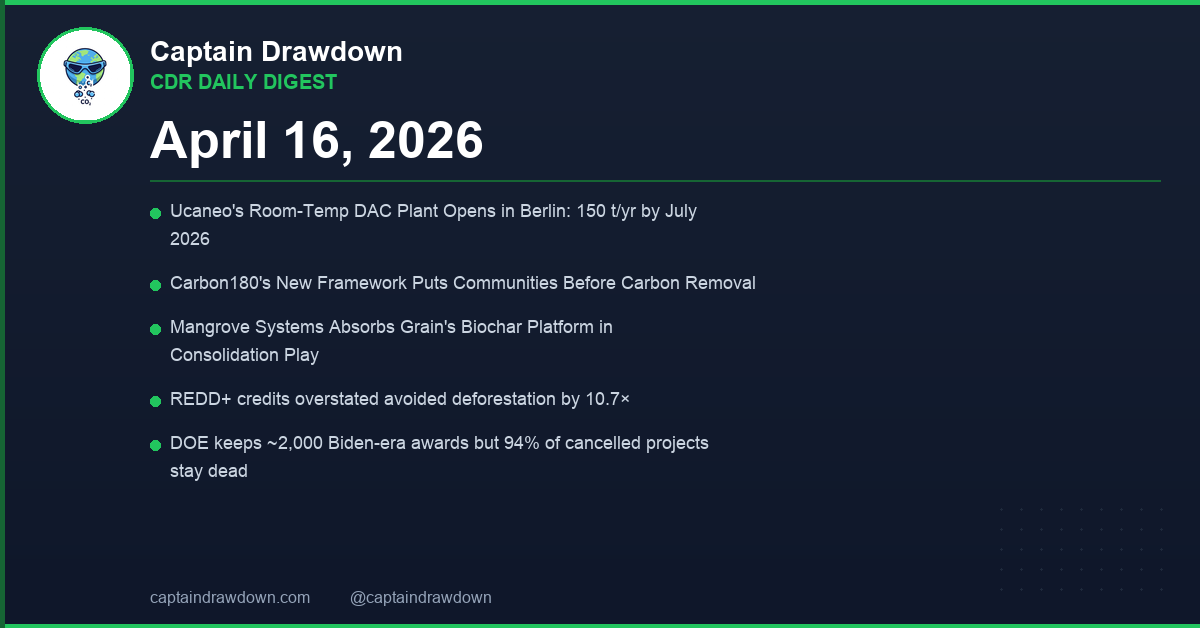
- Ucaneo’s Room-Temp DAC Plant Opens in Berlin: 150 t/yr by July 2026
- Carbon180’s New Framework Puts Communities Before Carbon Removal
- Mangrove Systems Absorbs Grain’s Biochar Platform in Consolidation Play
- REDD+ credits overstated avoided deforestation by 10.7×
- DOE keeps ~2,000 Biden-era awards but 94% of cancelled projects stay dead