The CDR market is being rewired around buyers who actually need it, not patrons who wanted to look good. That’s the thread connecting today’s stories, from Europe’s first certified enhanced rock weathering (ERW) field pilots to Germany’s stark admission that it needs up to 51 million tonnes of CO₂ removed per year by 2045. The question is no longer whether CDR will matter. It’s whether the infrastructure, policy, and commercial plumbing can keep pace with the demand signals now arriving.
The post-patronage stack takes shape
Two Captain’s Log entries this week lay out the same thesis from different angles. Log #103 argues that the CDR stack being built right now doesn’t depend on tech-company goodwill purchases. It runs on compliance demand, co-benefits, and industrial logic. Log #102 zeroes in on what happens when a major voluntary buyer walks away: the projects that survive are the ones whose carbon removal also delivers something else, better soil, usable materials, waste heat, local jobs. Co-benefits aren’t a nice-to-have. They’re the business model’s immune system.
This framing matters because the voluntary market’s biggest patrons, the Microsofts and Stripes, set the early pace but can’t carry the sector forever. The next wave of demand has to come from compliance frameworks and from buyers whose purchase is driven by regulation, not reputation.
Europe is building the plumbing
Several of today’s stories show Europe actively constructing that compliance-driven demand. ClimeFi has structured the first publicly announced transaction for carbon removal units under the EU’s Carbon Removal Certification Framework (CRCF). That’s a small but real milestone: actual money moving through a framework that didn’t exist two years ago.
Meanwhile, a new analysis makes the case for a short-term EU purchasing programme for permanent CDR, essentially a bridge mechanism to create demand before the full compliance market kicks in. Denmark is already ahead here. Rock Flour Company just landed €1.6 million for Denmark’s first certified ERW field pilots, spreading crushed rock on farmland to lock away CO₂ while improving soil health. And a separate piece draws lessons from Denmark’s CDR progress to offer a reality check for the UK, which has ambitions but less infrastructure.
Germany’s numbers are the starkest. A new assessment says the country needs 36 to 51 million tonnes of CO₂ removed per year by 2045 to hit its climate targets. Delays in building capture and storage capacity risk making those targets unreachable. That’s not a talking point. It’s a logistics problem measured in megatonnes.
Hardware hitting the ground
On the deployment side, ZEN Carbon announced it has partnered with a concrete plant for its first live industrial deployment. Biochar supplier Altitude is scaling up credit purchases specifically to unclog supply bottlenecks, buying ahead of demand so that credits are ready when buyers show up. And Kansas just received its first Class VI permit for CO₂ storage, the deep-well injection permit that’s a prerequisite for any serious geological sequestration in the US.
Verra also launched a new buyer tool that lets companies check whether specific carbon credits are eligible under emerging compliance regimes. It’s a small product update with a big implication: the market is complex enough now that buyers need software just to figure out what counts.
What’s next
Two things to watch. First, whether the EU’s short-term purchasing programme for permanent CDR actually materializes. If it does, it creates a demand floor that could unlock private capital at a pace voluntary markets never managed. Second, Germany’s 51 Mt/yr figure will force hard conversations about where that removal capacity physically sits, which regions accept storage, which supply chains scale first, and how fast. The number is out. Now comes the planning.
Today’s Stories
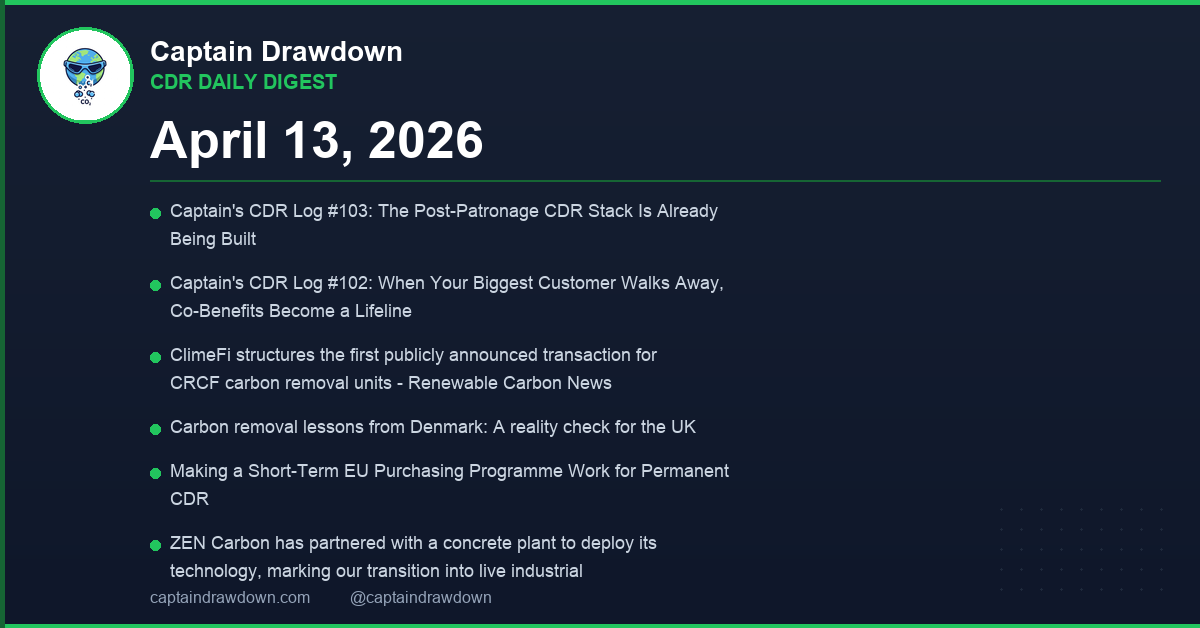
- Captain’s CDR Log #103: The Post-Patronage CDR Stack Is Already Being Built
- Captain’s CDR Log #102: When Your Biggest Customer Walks Away, Co-Benefits Become a Lifeline
- ClimeFi structures the first publicly announced transaction for CRCF carbon removal units - Renewable Carbon News
- Carbon removal lessons from Denmark: A reality check for the UK
- Making a Short-Term EU Purchasing Programme Work for Permanent CDR
- [ZEN Carbon has partnered with a concrete plant to deploy its technology, marking our transition into live industrial deployment.
This is a defining step,not just for us, but for how carbon removal… | Zen Carbon](/posts/zen-carbon-has-partnered-with-a-concrete-plant-to-deploy-its/)
- Verra Launches Buyer Tool to Check Carbon Credit Compliance Eligibility
- Rock Flour Company Lands €1.6M for Denmark’s First Certified ERW Field Pilots
- Kansas Gets Its First Class VI CO2 Storage Permit
- Germany Needs Up to 51 Mt CO₂/yr CDR by 2045—Delays Risk Missing Targets
- Altitude scales biochar credit buys to unclog CDR supply bottlenecks