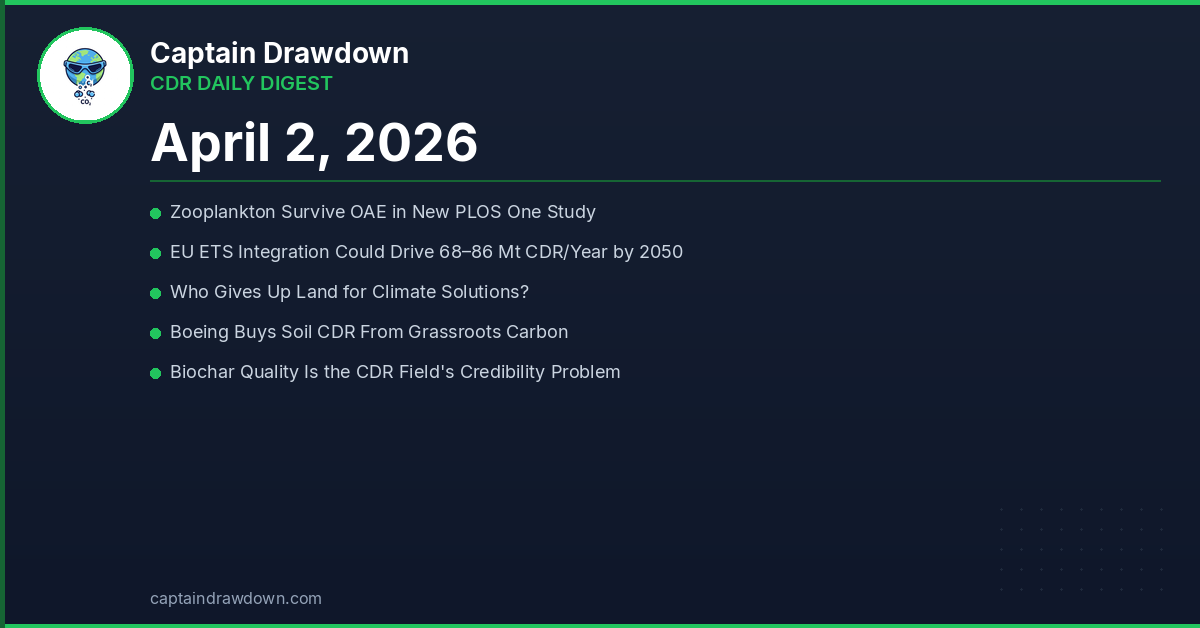
A busy science day. Five original posts covered ocean CDR ecology, EU carbon market policy, land justice, a corporate soil CDR deal, and biochar quality standards. Here’s the full picture.
What We Published Today
Good News for Ocean CDR: Zooplankton Survive OAE in New PLOS One Study
A new peer-reviewed study in PLOS One tested Oikopleura dioica — a gelatinous zooplankton species central to ocean carbon export — under ocean alkalinity enhancement conditions. The species showed resilience. One species, one data point, but the direction matters for the OAE risk literature. The study DOI: 10.1371/journal.pone.0344503.
Joule Paper: EU ETS Integration Could Drive 68–86 Mt CDR Per Year by 2050
Researchers from the Potsdam Institute for Climate Impact Research published a model in Joule finding that integrating permanent CDR into the EU Emissions Trading System could incentivize 68–86 Mt CO₂ of removals annually by 2050. The EU Carbon Removal Certification Framework is building the registry — but the market signal is still missing. This paper makes the case for closing that gap.
Who Gives Up Land for Climate Solutions? A New Study Maps the Tradeoffs
A Nature Climate Change study by Ruben Prütz (PIK) maps where five major 1.5°C models place their land-intensive CDR demands. The finding: the models concentrate land requirements in the Global South. This is not a neutral technocratic assumption — it is a justice question baked into every IPCC pathway. One more reason why land-light CDR pathways (DAC, enhanced weathering, ocean-based) deserve investment.
Boeing Buys Soil CDR From Grassroots Carbon in a Multi-Year Deal
Aviation giant Boeing signed a multi-year soil carbon removal purchase agreement with Texas-based Grassroots Carbon. Financial terms undisclosed. Corporate aviation buying durable soil removals is still unusual — and each deal like this shifts the reference point for what “normal” CDR procurement looks like in hard-to-abate sectors.
Biochar Quality Is the CDR Field’s Credibility Problem
Biochar costs $50–200/tonne CO₂ at scale — well below DAC. But there’s a wide gap between high-quality and low-quality biochar in terms of carbon permanence, and buyers often can’t tell the difference. This post walks through the key quality markers: H/C ratio, pyrolysis temperature, feedstock, and certification standards (EBC, IBI). Also published today: CDR Misconception #4: Carbon Credits Are All Scams — our weekly series tackling the myths that slow the field down.
Stories We Didn’t Cover (But Should Be On Your Radar)
Climeworks adds biochar to its portfolio (scores 30) — Climeworks announced integration of high-quality biochar to diversify its carbon removal portfolio beyond DAC. A CDI portfolio company moving into a new pathway is worth watching. Pairs naturally with today’s biochar quality post.
Tapestry × Climeworks 10-year partnership (score 30) — Fashion holding company (Coach, Kate Spade) signed a decade-long CDR deal with Climeworks. Corporate demand for DAC from non-tech, non-aviation sectors is still rare and signals broadening buyer base.
Hemp biochar enters EU ETS (score 30) — According to a post by a carbon market analyst, hemp-derived biochar is now eligible under the EU ETS. An early signal of what biochar integration into compliance markets could look like.
EPA authorizes first ocean CDR deposit (score 20) — Axios reported that the EPA has for the first time authorized a carbon removal company to deposit material in the ocean under the Marine Protection, Research, and Sanctuaries Act. Covered without mentioning climate — notable both for the regulatory milestone and the framing gap.
High Seas Treaty ocean CDR implications (score 20) — New analysis on obligations the High Seas Treaty creates for protecting the deep sea from CDR interventions. Relevant to OAE and sub-seabed storage governance.
Market Snapshot
The Boeing/Grassroots Carbon deal continues a quiet trend: hard-to-abate sectors starting to build CDR into their long-term procurement. Not offsets. Durable removals. The market is small but the signal direction is clear. The EU ETS modeling from today’s Joule paper puts a scale on what policy integration could unlock — 68–86 Mt/year is not a rounding error, it is a new market of significant size.
Biochar is worth watching closely. Three separate signals today (quality whitepaper, Climeworks diversification, EU ETS eligibility) suggest the pathway is at an inflection point between niche and mainstream. Quality differentiation will determine which producers capture value.
CaptainDrawdown covers carbon removal — the science, the markets, and the policy — every day. Browse all posts or explore the CDR company directory.