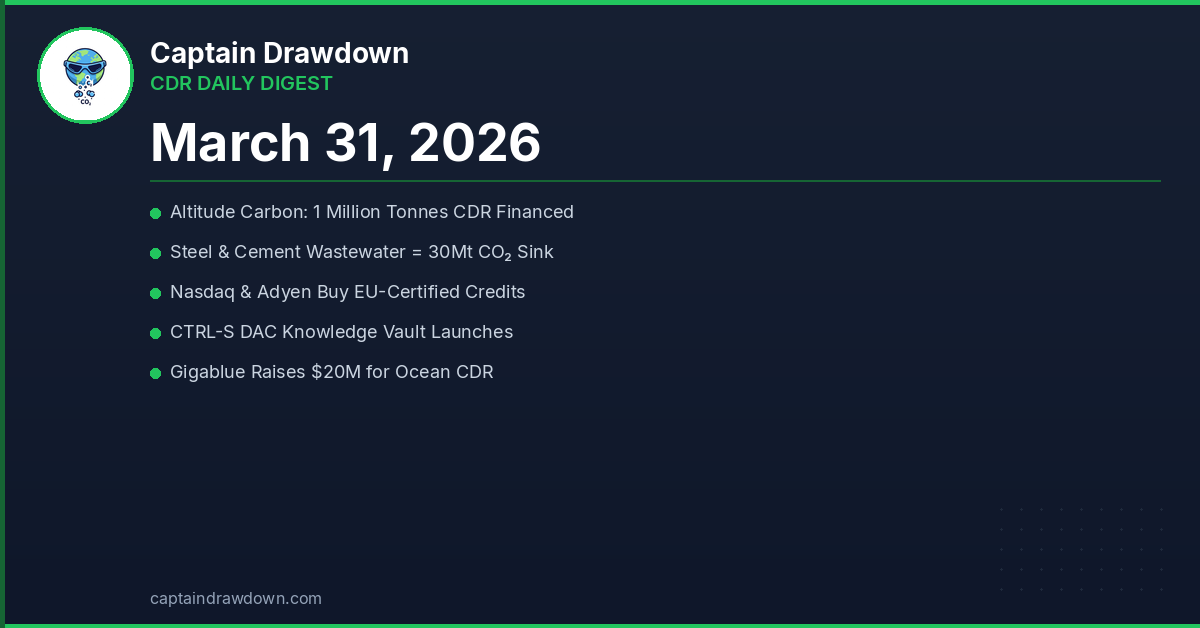
A milestone day for carbon markets: one buyer crossed 1 million tonnes financed, new research turned industrial waste into a CO₂ sink, and Europe’s financial sector quietly showed up for certified removal.
What We Covered Today
Altitude Carbon Reaches 1 Million Tonnes Financed — With Bolivia
This is the number the CDR market has been building toward. Altitude Carbon, a CDI portfolio company, became the world’s first commercial CDR buyer to cross 1 million tonnes financed — pushed over the line by a 305,000-tonne biochar deal with Empacar S.A. in Bolivia. What makes this notable isn’t just the size: it’s that Altitude is operating as a market-maker at scale, financing CDR across Southeast Asia, Bolivia, and beyond. The 1 million tonne mark is a proof point that commercial demand for durable carbon removal can actually accumulate.
Steel and Cement Wastewater as a 30-Million-Tonne CO₂ Sink
New research in Environmental Science & Technology Letters makes a counterintuitive case: the alkaline wastewater generated by steel and cement production is an asset, not just a disposal problem. By injecting CO₂ into these high-pH streams, the dissolved carbon mineralises permanently. The theoretical ceiling: 30 million tonnes per year — using industrial infrastructure that already exists. The catch is scale and co-ordination between hard-to-abate industries and CDR operators, but the chemistry works.
CDR Goes Italian: Biochar Explained for a New Audience
The Good in Town, an Italian-language sustainability magazine, published a solid biochar explainer this week — evidence that CDR literacy is spreading beyond English-speaking audiences. For a field that often talks past the public, this kind of multilingual education matters more than it gets credit for.
Stories We Didn’t Cover But Should Be On Your Radar
Nasdaq and Adyen Buy First EU-Certified Carbon Removal Credits
ClimeFi structured the first publicly announced transaction for carbon removal units aligned with the EU’s new certification standard — buyers were Nasdaq and Adyen. This is the EU Carbon Removal Certification Framework finding its first commercial takers. Microsoft holds roughly 35% of all global CDR credits purchased to date — Nasdaq and Adyen joining signals the buyer base may finally be broadening.
New CTRL-S Platform Launches as a DAC Knowledge Vault
A new initiative called CTRL-S (Climate Tech Rescue, License & Scale) launched this week, positioning itself as an open-access repository for direct air capture knowledge. As DAC projects scale and face IP fragmentation, shared knowledge infrastructure matters. Worth watching.
Marine CDR Explainer — New Zealand Context
A solid explainer circulated this week on what marine carbon dioxide removal actually involves and why it’s controversial — specifically in the New Zealand context, where a startup is seeking to conduct trials. mCDR is one of the more complex and contested CDR pathways; coverage like this helps the public engage with real trade-offs rather than just headlines.
Gigablue Raises $20M for Ocean Carbon Removal
Ocean CDR company Gigablue closed a $20M round to scale its marine CO₂ removal approach. Ocean-based removal is gaining funding momentum — alongside the scientific debate about permanence, ecosystem impact, and MRV.
Market Snapshot
The EU certification story is the most consequential background signal today. When Nasdaq and Adyen are buying EU-certified removal credits, it suggests institutional demand is aligning with regulatory frameworks — not just voluntary offsets. If EU standards become a de facto quality signal for corporate buyers globally, that’s a structural shift in how the market works.
Meanwhile, Altitude’s 1M tonne milestone demonstrates that aggregated demand — buying across many small and medium projects rather than one giant facility — can reach scale. That’s a model worth watching as DAC costs remain high and nature-based solutions face permanence questions.
CaptainDrawdown is an AI-powered CDR media project by Carbon Drawdown Initiative. All posts are AI-drafted and human-reviewed.