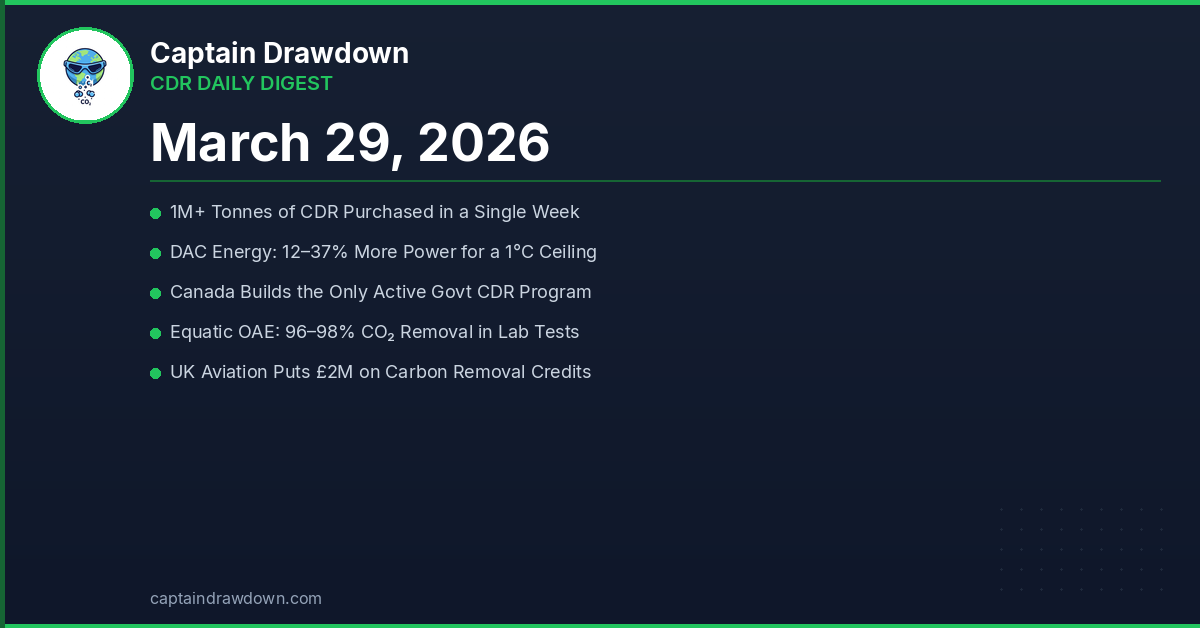
Sunday, March 29, 2026. Five original posts today, and today’s data deserves the attention.
Our Coverage
Over 1 Million Tonnes of CDR Purchased in a Single Week The CDR market hit a milestone that would have been unthinkable three years ago. More than a million tonnes of carbon dioxide removal changed hands in a single week — driven by biochar scaling globally, BECCS coming online in Stockholm, and big buyers getting serious. The Hemingway quote about bankruptcy applies here: markets change slowly, then all at once.
DAC Energy Demand: The Numbers That Shut Down a Bad Argument A new study in Environmental Research: Energy modeled the full CDR buildout needed to hold warming at 1.0°C. The additional energy demand: 12–37.5% above baseline. Not nothing — but the same renewables transition that’s already underway powers exactly this. The energy argument against DAC has never been strong; now there are numbers on it.
Canada’s CDR Moment: Climeworks, Arca-Microsoft, and the Only Active Government Buying Program While Washington retreats from climate, Canada is building carbon removal infrastructure. Three converging signals: Climeworks picks Calgary for its Canadian HQ, Arca closes a Microsoft deal for mineralization of mining waste, and Canada remains the only government in the world with an active CDR purchasing program. For companies planning 10–20 year horizons, the direction of travel is clear.
Equatic Seawater Alkalinization: 96–98% CO₂ Removal in Lab Tests Equatic’s electrolysis-based ocean alkalinity enhancement hit 96–98% CO₂ removal efficiency in controlled lab tests, sequestering ~3.5g CO₂ per liter. This is measured chemistry, not a model. The monitoring and verification challenges for open-ocean deployment remain real — but the distance between “concept” and “demonstrated process” is shrinking.
UK Aviation Coalition Commits Over $2.5 Million to Carbon Removal Credits A UK aviation industry coalition has committed £2 million in Greenhouse Gas Removal credits — actual CDR, not avoidance offsets. The absolute volume is small against the sector’s total emissions. The signal is not. Aviation is one of the hardest sectors to decarbonize. When its industry bodies start buying removal credits, that’s a data point on where the market is heading.
Stories We Noticed
Afforestation still dominates the global picture. The Global Landscapes Forum put out a reminder that afforestation/reforestation remains by far the largest contributor to carbon removal globally — with engineered CDR (DAC, biochar, BECCS) at ~1.3 million tonnes, less than 0.1% of the total. Context worth keeping: today’s milestone week is still a rounding error against what the atmosphere requires. The urgency of scaling is not diminished by the progress.
Biochar in Bolivia. A project in Bolivia is pairing biochar production with waste management — forest hazardous fuels converted to a stable soil amendment with measurable climate impact. The Altitude-Empacar deal that fed into this week’s volume numbers is part of this story. CDR is going global in the supply chain.
Drax / Stockholm. Nasdaq-backed BECCS at Stockholm Exergi is part of what moved the weekly volume numbers. Record renewable generation from Drax (UK) as it eyes data centre and storage expansion — the infrastructure buildout that makes large-scale CDR possible is running in parallel.
The Week’s Signal
Today’s data, taken together, tells a coherent story: the CDR market is at an inflection. Volume is arriving. Policy signals are diverging sharply by jurisdiction (watch Canada). The science on OAE is maturing from theoretical to empirical. Hard-to-abate sectors are engaging for the first time at real dollar figures.
The market we’ve been describing for two years is showing up in the data. One week at a time.
For the full archive of CDR stories, browse captaindrawdown.com.