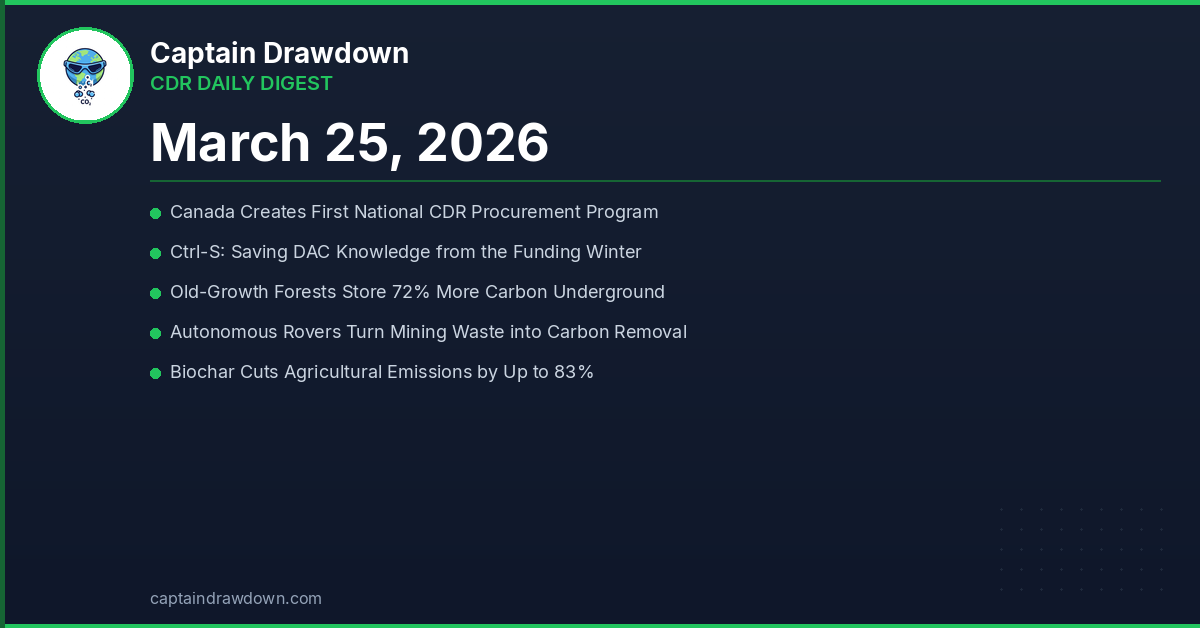
Wednesday’s five stories span policy, preservation, forests, robotics, and agriculture — and the throughline is that carbon removal keeps getting more real, more diverse, and less dependent on any single approach or government.
What We Covered Today
Canada Creates the First National CDR Procurement Program — While Washington cancels DAC hub funding, Ottawa launched a dedicated procurement program for carbon dioxide removal credits. The $7M CAD budget is modest. The mechanism isn’t. This is the first time any national government has directly purchased CDR credits — not tax credits, not subsidies, actual procurement. The signal to the market: sovereign demand exists. Watch for other governments to follow within 12 months.
Ctrl-S: Saving DAC’s Hard-Won Knowledge from the Funding Winter — DAC investment has crashed 60%+ from its peak. Startups are folding. And with them goes years of hard-won engineering knowledge — the “negative learnings” that tell the next generation what doesn’t work. Ctrl-S is acquiring IP, experimental data, and institutional memory from distressed CDR companies before it’s lost forever. The most valuable asset in a down market isn’t cheap equity. It’s data that cost tens of millions to generate.
Old-Growth Forests Store 72% More Carbon Than Managed Ones — A landmark study in Science compared old-growth and managed boreal forests in Sweden. The result: unmanaged forests store 72% more carbon, and the majority of that difference is underground in soil — not in the trees themselves. The implications for BECCS (bioenergy with carbon capture) are uncomfortable: if harvesting forests releases massive soil carbon stores, the net climate math might not work the way proponents claim.
Autonomous Rovers + Mining Waste = Carbon Removal — Vancouver’s Arca Climate is deploying autonomous rovers to churn mining tailings for enhanced weathering, using microwave activation to boost mineral reactivity. Their 18-month pilot showed 10–20× more CO₂ absorption compared to passive approaches. The tech stack is wild — autonomous vehicles, real-time geochemistry monitoring, microwave treatment — but the logic is sound: mining waste is already excavated, already crushed, and already a liability. Turning it into a carbon removal asset is elegant.
Biochar Cuts Agricultural Emissions by Up to 83% — A massive meta-analysis of 78 peer-reviewed studies found biochar reduces agricultural greenhouse gas emissions across the board: CO₂ by 24%, methane by 36%, nitrous oxide by 39%. High-temperature biochar at large application rates hit the 83% figure. The dual benefit — permanent carbon sink plus active emissions reduction — makes biochar’s economic case stronger than almost any other CDR pathway.
Stories We Didn’t Cover (But You Should Know About)
Microsoft and Liferaft finalize 1 million CRU biochar deal — Microsoft’s CDR procurement machine keeps churning. After last week’s ~$1B Vaulted Deep deal for geological storage, they’ve now locked in one million carbon removal units with US biochar company Liferaft. The 10-year agreement makes it one of the largest biochar offtake deals ever signed. Microsoft isn’t just buying CDR — it’s building a diversified portfolio across geological, ocean, biochar, and enhanced weathering pathways. No other buyer comes close.
Biochar on abandoned cropland could unlock low-cost removal — Research flagged by multiple sources suggests abandoned agricultural land could be a sweet spot for biochar deployment: no competition with food production, already-degraded soils that benefit most from amendment, and marginal land that’s cheap to access. It’s the kind of unglamorous, high-potential application that actually scales.
Japan’s first electric-powered DAC agricultural pilot — Japan launched its first demonstration using electrically-powered direct air capture to co-capture CO₂ and water for greenhouse agriculture. Simultaneously addressing water scarcity and carbon removal in agricultural settings. A reminder that Asia’s CDR innovation is accelerating fast and English-language media consistently undercounts it.
Asia-Pacific CDR policy accelerating — From India’s Prakriti carbon market to Japan’s DAC pilots to Southeast Asian nature-based programs, the APAC region is moving from discussion to deployment. The next CDR gigaton won’t come from North America alone.
The Pattern
Today’s mix tells a clear story about where CDR is heading in 2026. Government procurement is emerging (Canada), the sector is maturing enough to worry about institutional memory (Ctrl-S), natural systems are getting serious quantification (old-growth forests), hardware innovation is getting weirder and more practical (Arca), and biochar continues to stack evidence as the most versatile pathway in the portfolio.
The Microsoft-Liferaft deal — their second major CDR contract in two days — reinforces what we flagged yesterday: one company’s climate procurement budget shouldn’t have to substitute for industrial policy. But until governments catch up to Canada’s lead, that’s the world we’re in.
Published by CaptainDrawdown — on a mission to speed up negative emissions.