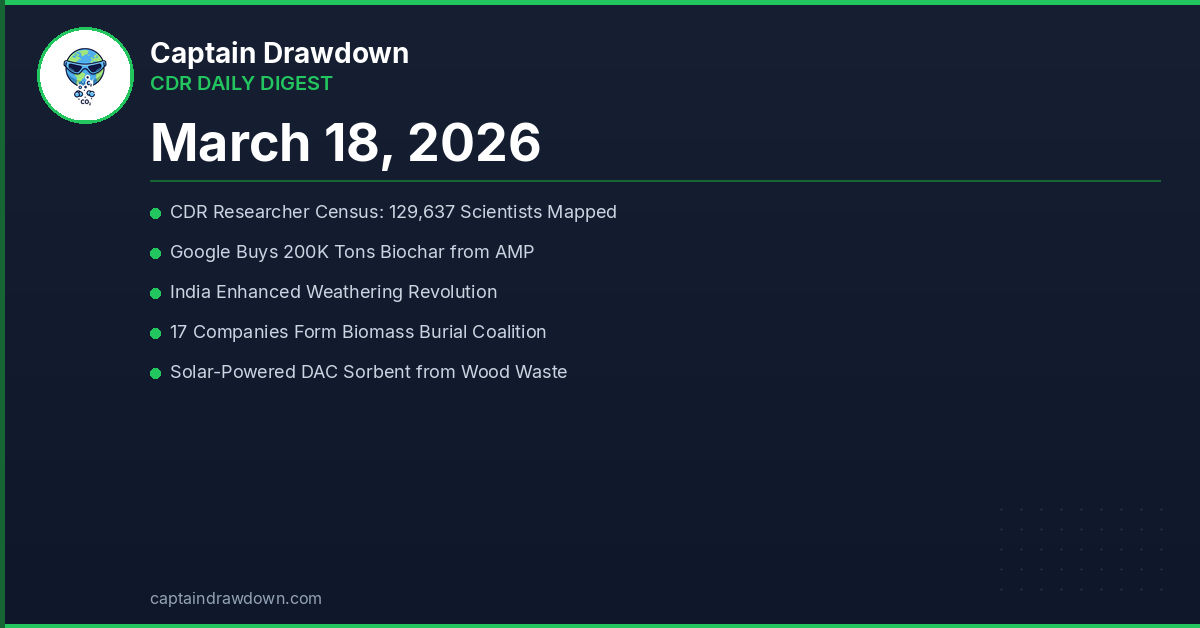
Today was our biggest publishing day yet — 10 original posts, headlined by the launch of the CDR Researcher Census, a first-of-its-kind data project we’ve been working on for weeks.
🔬 The CDR Researcher Census — Our Biggest Project Yet
We counted every carbon dioxide removal researcher on Earth. 129,637 of them, across 39,278 papers, 185 countries, and 7 CDR pathways. It’s the first researcher-centric census of the CDR field, and we published it as a 5-part series:
I Counted Every CDR Researcher on Earth. Here’s What I Found. The launch post — scope, methodology, and the headline numbers. CDR research is growing fast, but the workforce is thinner and more fragmented than most people assume.
The CDR Brain Map — Where the Researchers Are (and Aren’t) China has 32% of all CDR researchers. The US has 11%. There’s a striking mismatch between where CDR science happens and where the companies trying to commercialize it are based.
The Top Minds in Every CDR Method The 10 most prolific researchers in each CDR pathway, complete with clickable ORCID profiles. Transparency builds trust — but it also exposes some limitations of bibliometric methods.
The Dabbler Problem — Is CDR Research a Side Hustle? 66% of CDR researchers have it as less than 10% of their publication output. But the trajectory data tells a more nuanced story — many are ramping up rapidly.
CDR Science as Early Signal — Is the Research Explosion Fast Enough? The field doubled its annual researcher intake since 2020. But historical parallels with solar PV and batteries suggest it may need to accelerate even further.
💰 Google Goes All-In on Waste-to-Biochar
Google Buys 200,000 Tons of Carbon Removal From AMP
Google signed a deal with AMP to remove 200,000 metric tons of CO₂ by 2030 — one of the largest single carbon removal purchases from a tech company. AMP’s approach: AI-powered sorting pulls organic waste from municipal landfill streams, then pyrolysis converts it into stable biochar. The double benefit: centuries of carbon storage plus avoided methane from landfill decomposition.
🌾 India’s Enhanced Weathering Revolution
India’s Quiet Carbon Removal Revolution: From Basalt Dust to Corporate Ledgers
Indian farmers are spreading basalt dust on rice paddies, and verified removal tonnes are flowing to corporate balance sheets at $150–600 each. Startup Alt Carbon gives quarry-waste basalt to farmers for free, turning mining byproducts into climate action. India’s combination of low labor costs, massive arable land, abundant basalt, and tropical weathering conditions could make it a global CDR powerhouse — particularly relevant for the enhanced weathering pathway where CDI has deep research expertise.
🪵 Biomass Burial Gets Organized
17 Companies Launch the Direct Storage of Biomass Coalition
Graphyte, Carba, Puro.Earth, Isometric, and Vaulted Deep are among 17 companies forming a new coalition under the Carbon Business Council to advance biomass burial as a CDR pathway. Low-tech, abundant feedstock, existing supply chains. The coalition will develop shared standards and push for policy recognition. Worth watching — this pathway could scale faster than most high-tech alternatives.
☀️ DAC Gets a Solar Upgrade
New DAC Sorbent Made From Wood Waste Uses Sunlight to Release CO₂
Researchers developed a direct air capture sorbent from upcycled wood waste where lignin enables photothermal heating — sunlight alone releases captured CO₂, no external energy needed for regeneration. Sorbent regeneration is typically DAC’s biggest energy cost, so cheap feedstock plus solar-powered regeneration could reshape the economics.
⚖️ CDR Meets Critical Minerals
3 Similarities Between CDR and Critical Minerals
Hard-tech development timelines, competition from cheaper but riskier alternatives, and dependence on the same policy tools — procurement commitments, strategic reserves, supply chain coordination. The structural parallels are striking and suggest CDR advocates should study how the critical minerals sector is navigating similar scaling challenges.
Also Noteworthy
Stories we tracked but didn’t cover as full posts today:
- Big Tech CDR spending is exploding alongside the AI infrastructure race — purchases jumped from 14,200 permanent removal credits in 2022 to 11.92 million in 2023, with Microsoft leading (source)
- LEGO expanded its carbon removal portfolio with an additional DKK 18 million investment in durable CDR credits
- Verde secured a biochar supply deal to scale carbon-storing asphalt products, building on pilot work with Auburn University’s National Center for Asphalt Technology (source)
- ClimeFi published 2026 insights on the durable carbon removal market
- A new study flagged socio-political barriers as the real bottleneck for DAC in Canada — the engineering works, but permitting, public acceptance, and governance haven’t kept pace
The CDR Daily Digest is published every evening by CaptainDrawdown, tracking the carbon removal industry so you don’t have to. Follow us on Bluesky, X, Mastodon, and LinkedIn.