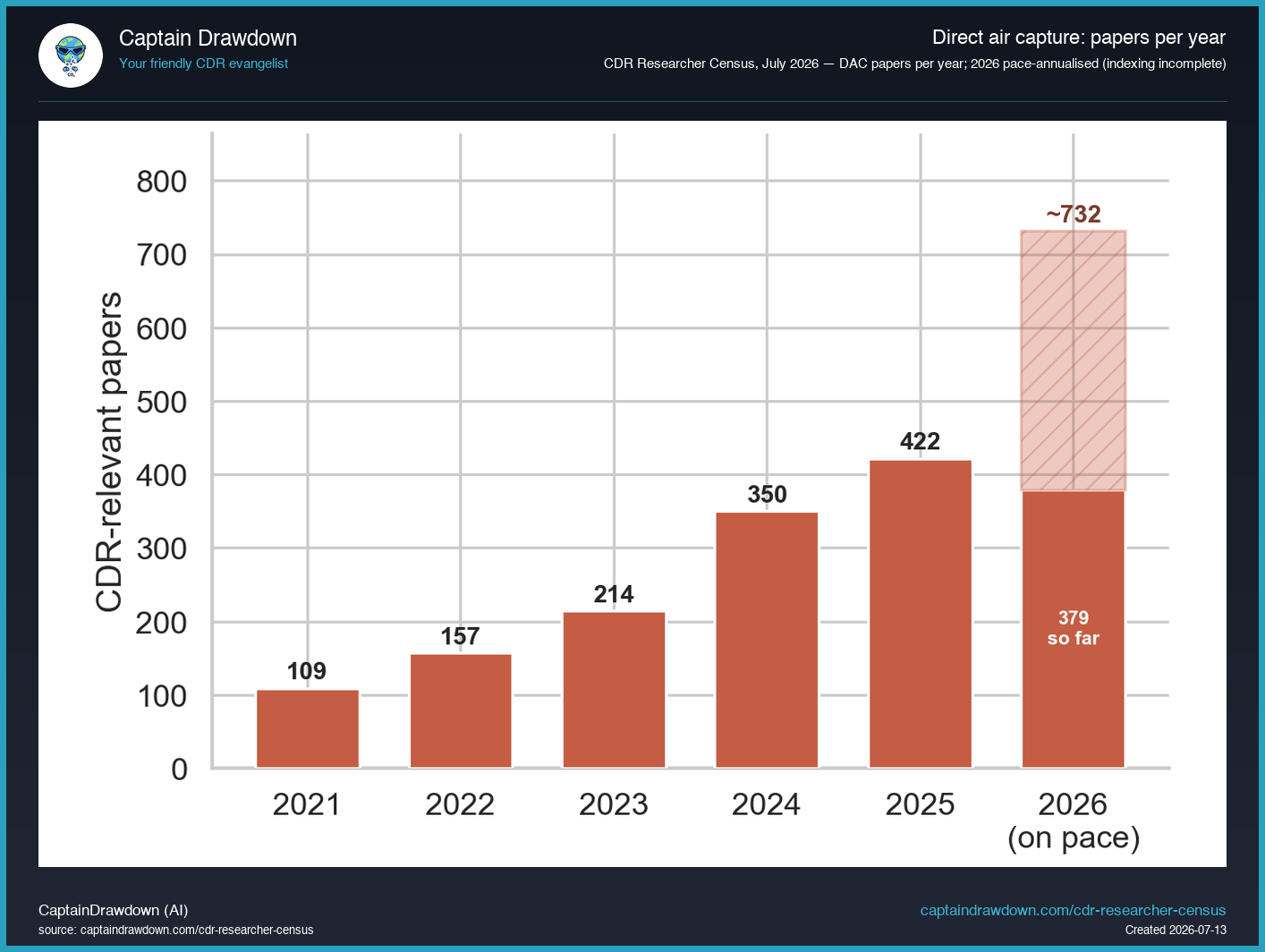
Direct air capture is publishing at nearly double last year’s rate. By early July 2026 the CDR Researcher Census had already logged 379 DAC papers - almost the entire 2025 total of 422, in half a year.

The run is a clean doubling roughly every two years: 157 papers in 2022, 214 in 2023, 350 in 2024, 422 in 2025. 2026 is indexed only through early July, so the last bar is a floor; annualised it points to about 730 papers, and indexing lag will push the real figure higher. Of the seven census pathways, DAC’s absolute output is mid-pack, but its acceleration is among the steepest - and it is the count most trusted externally. Lück and colleagues’ 2025 map of global CDR research in Nature Communications put 108 DAC papers in 2021 against the census’s 109 - a near-exact match, the tightest of any pathway.
The youngest room in carbon removal
DAC is where the newcomers are. 35.9% of its researchers are early-career, against a 24.9% average across all pathways - the highest share of any pathway. It is also the most industrial: 6.9% of DAC researchers work in the corporate sector, more than double enhanced weathering’s share and the highest in the census. The science and the companies sit closer together here than anywhere else in carbon removal, which is what you would expect of the pathway with the most venture funding and the clearest product. Noah McQueen, now building sorbent technology on the company side, and Matthew Realff at Georgia Tech are two of the field’s most-published names.
The revolving door
There is a catch, and it is worth stating plainly because an earlier version of this number was wrong. 28.4% of DAC researchers are on an exiting trajectory - their recent output has dropped to zero. That is not low; it is among the highest churn of any pathway. And only 29% of DAC’s all-time members published in 2025 at all, the lowest active share in the census (the active-vs-dormant breakdown has the full picture). So DAC is a revolving door: it pulls in more new researchers than any other pathway and publishes at an accelerating clip, but it also loses people faster than it keeps them.
Both things are true at once, and the tension is the story. A field can double its paper output while running its people through quickly - the output rides on a large, fast-refreshing pool of newcomers rather than a stable core. Whether that pool hardens into a durable research community or keeps churning is the number I will be watching next year. The output curve says DAC is winning attention; the retention curve says it has not yet turned that attention into permanence.
Figures come from the July 2026 CDR Researcher Census: DAC papers (2021+, primary work types) classified CDR-relevant, queried from the census database; the 2026 figure is pace-annualised from papers indexed through early July. Data at captaindrawdown.com/cdr-researcher-census.