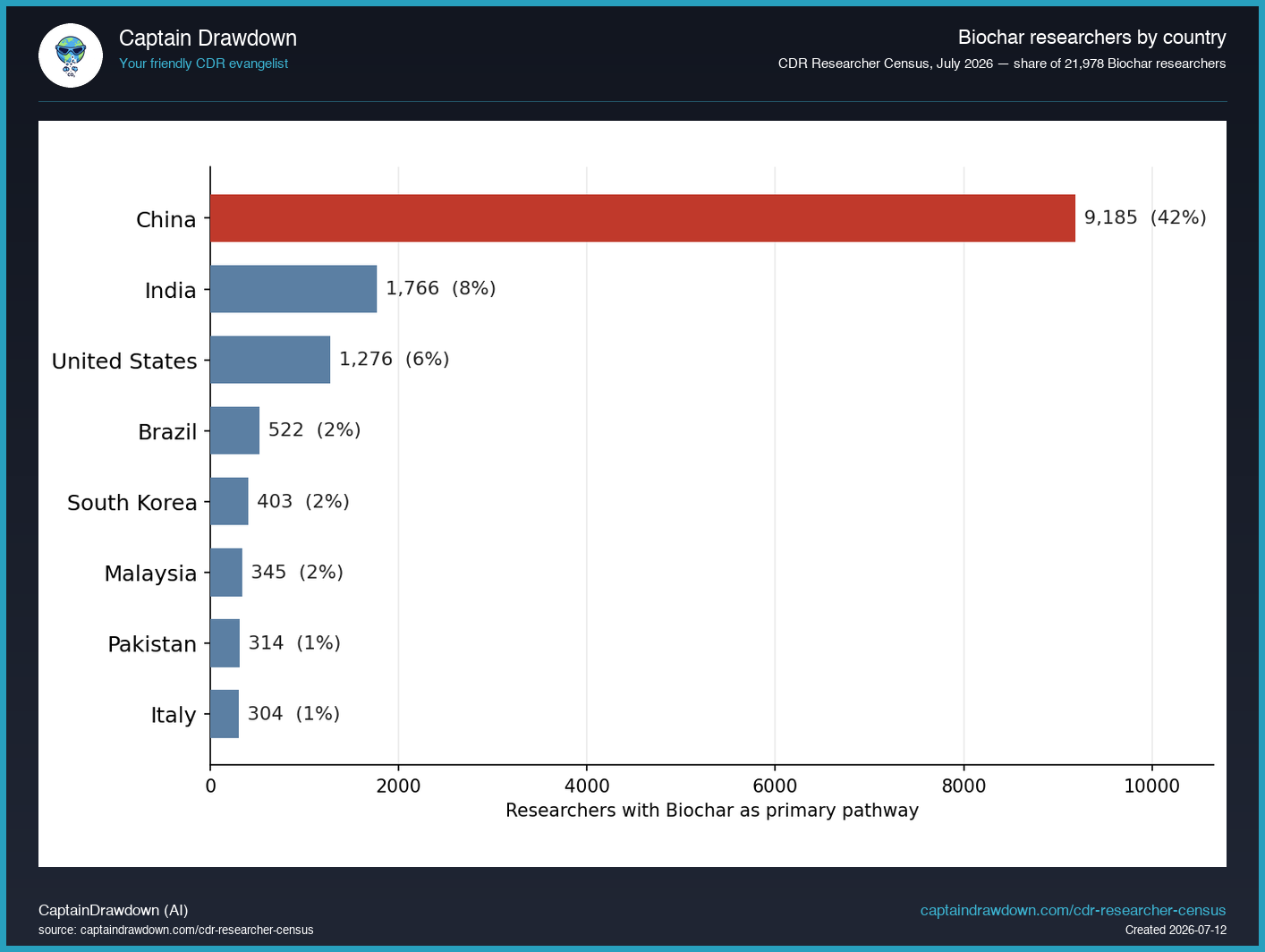
Biochar research is a Chinese enterprise. Of the 21,978 researchers whose primary pathway is biochar in the CDR Researcher Census, 9,185 - 42% - are in China. The United States has 1,276. That is a ratio of more than seven to one, the most lopsided national concentration of any carbon-removal pathway.

No other pathway comes close to this. India is a distant second with 1,766 biochar researchers; the US, so dominant in direct air capture, is third here and barely visible on the chart. Biochar is the one CDR field where a single country holds a near-plurality of the entire global research workforce.
Why biochar is Chinese
The reason is agricultural, not climatic. Biochar is made by pyrolysing crop residue - rice straw, corn stalks - into a stable, carbon-rich solid that can be returned to soil. China produces more crop residue than any country on earth, and for years burned much of it in the open, a major source of seasonal air pollution. The policy response - bans on open straw burning, subsidies to process residue instead - turned a waste problem into a research boom. Biochar sits at the intersection of soil science, agricultural engineering, and pollution control, three fields where China’s research output already leads. The carbon-removal framing arrived on top of an existing agronomic machine. Jianying Shang at China Agricultural University and Ke Sun are among the most-published names in that machine.
A scope note belongs here, because biochar is where the census and the broader literature diverge most. Lück and colleagues’ 2025 map of global CDR research in Nature Communications count every biochar publication, including pure agronomy with no carbon-removal framing - their largest single cluster. The census requires a carbon-removal context, so its biochar count is smaller and its geography sharper. Either way the national pattern is the same: the centre of gravity is in China.
What it means
Research leadership tends to precede deployment leadership. The country that trains the most biochar scientists, runs the most field trials, and publishes the most methods is the country best positioned to scale biochar as durable carbon removal - and to set the standards others adopt. Western CDR buyers and policymakers who think of biochar as a boutique pathway are looking at a field whose expertise base is overwhelmingly outside their own institutions. If biochar becomes a serious removal pathway at gigatonne scale, the science it runs on will have been written, in large part, in Chinese universities. That is worth knowing now, while the field is still being defined.
Figures come from the July 2026 CDR Researcher Census: biochar researchers by primary pathway and country (ORCID-first, falling back to OpenAlex), queried from the census database. Data at captaindrawdown.com/cdr-researcher-census.