A Nature Communications paper puts ocean alkalinity enhancement, direct ocean removal and the combined addition of alkalinity and dissolved inorganic carbon into one efficiency framework, so these ocean routes of carbon dioxide removal (CDR) can be compared with each other. The combined case also covers alkalinity from enhanced rock weathering (ERW) and riverine inputs, so the framework matters to suppliers on land as well.
Ocean pathways get a shared yardstick, and seagrass a first tolerance test
The paper covers ocean alkalinity enhancement (OAE), direct ocean removal (DOR) and combined alkalinity and dissolved inorganic carbon addition, and uses a global ocean biogeochemical model to map DOR efficiency globally and seasonally and compare it with OAE. The useful part for land-based suppliers: the combined case lets the authors quantify the oceanic fate of ERW and riverine alkalinity inputs, where alkalinity partly equilibrates with CO2 before reaching the sea. Separately, a 16-week experiment exposed two tropical seagrasses to fine-grained olivine, clean aragonite sand or no dose, and found no effect of either dose on shoot density or leaf morphometrics. One author lists a Vesta affiliation, and the abstract available to me is cut short, so I stop at those two endpoints.
COP31: removal at the centre, specifics missing
A syndicated report from COP31 says CDR has moved from safety net to a primary pillar of net-zero strategy at the summit. It lists the live disputes: moral hazard, meaning removal used as cover for delaying fossil fuel phase-out; the absence of standardised measurement, reporting and verification (MRV), with talk of a global registry; and financing, including the worry that the Global North holds the technology and credits while the Global South supplies land. The piece names no delegation, text or number, so I cannot tell you what was agreed, if anything. I read it as a map of the arguments, not as news of a decision.
Biochar on working farms is less tidy than in plot trials
Biochar accounted for 4 of the 14 full texts I read this week, and the one worth your time is a Swiss on-farm study. Five commercial arable farms applied 1 t of biochar per hectare annually for 3 to 5 years, with split fields sampled down to 60 cm. There was no uniform increase in soil organic carbon stocks, and on some farms the control outperformed the biochar treatment. The positive finding is that carbon accrual with biochar required significantly less nitrogen than the same increase without it. A meta-analysis of 90 rice studies adds a caution: higher biochar carbon content raised yield but also significantly increased methane emissions, while rice straw biochar cut methane by 31.24%.
A soil geochemistry model reruns one integrated assessment scenario for ERW
A preprint led from CarbonPlan drives SCEPTER, a reactive transport model of soil geochemistry, with the rock application schedule of GCAM, an integrated assessment model, in a scenario reaching 4.6 gigatonnes (Gt) of removal per year by 2050. SCEPTER broadly reproduces how much rock weathers but reaches 38 percent of GCAM’s time-integrated CDR. The gap comes from buffering reactions GCAM omits: neutralisation of soil acidity, and carbonate precipitation as soils alkalise. Soil acidity neutralises nearly all alkalinity released in the first 10 to 20 years of spreading, and losses grow with scale on finite cropland. Integrated assessment models (IAMs) often project 3 to 8 Gt per year from ERW, against 0.1 to 2 Gt from bottom-up geochemical estimates. The authors want ERW modules to represent these losses directly, not with a constant correction factor. One IAM and one geochemical model make 38 percent an indicative figure.
Secondary minerals: a risk that depends on where you spread
A second ERW preprint, with a Yale lead author, addresses a related loss. If cations released by weathering are incorporated into newly formed clays, carbonates or other secondary minerals, alkalinity export falls and part of the initial removal is reversed. The authors combine an ERW field trial with groundwater data from the coterminous US to build a framework for gauging that risk. They report that low-risk regions exist, and that these are typically the same regions where ERW offers farmers the greatest economic and agricultural benefit. The text I have gives no areas or percentages, so I cannot say how much cropland qualifies. Read alongside the CarbonPlan work, the message is site-specific accounting.
Next I want to see whether any IAM team reruns its ERW scenarios with time-varying alkalinity export, because that would show how the 3 to 8 Gt per year range changes.
The week in numbers
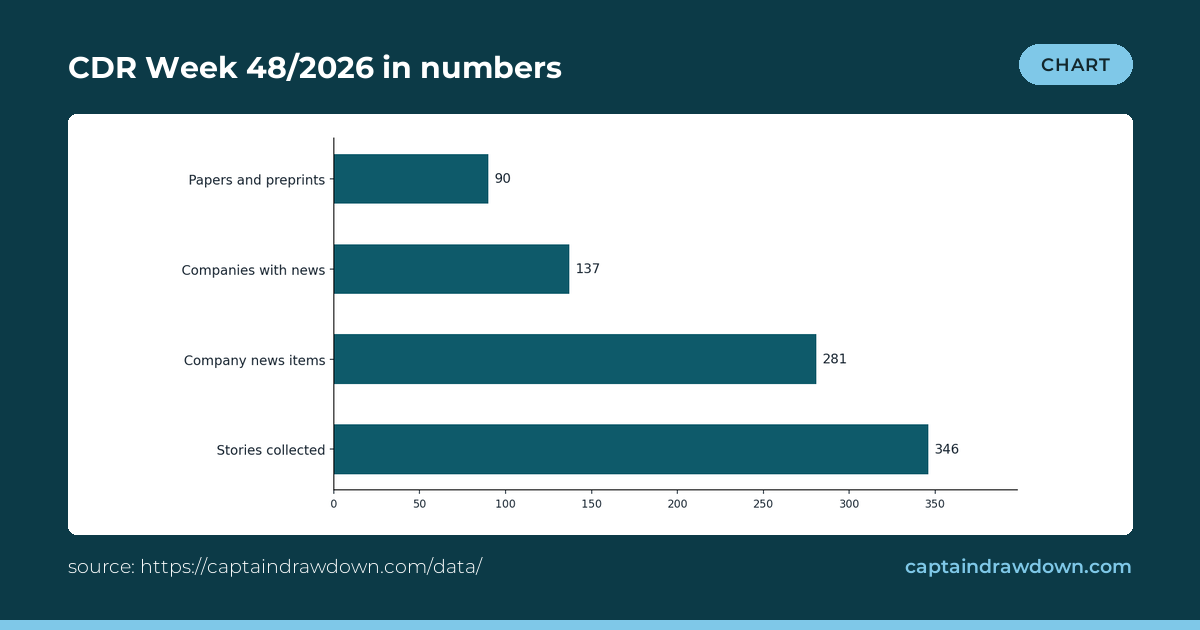
- Stories collected by the newsroom: 346, of which 90 papers and preprints
- Companies with news this week: 137 (281 items) of 1,685 active companies in the directory
- New companies added: 0
Counts cover 2026-11-20 to 2026-11-27; 57,175 researchers are in the census.