Ocean iron fertilization reaches a global mean efficiency of 24% relative to direct air capture (DAC) after 20 years in a new modeling preprint, the clearest negative result in carbon dioxide removal (CDR) this week. In both ocean papers I read, where the water and the particles go decided the outcome.
Iron fertilization: durable, inefficient
David Siegel, Kana Yamamoto and Timothy DeVries of the University of California, Santa Barbara ran an ocean circulation model coupled to a well-mixed atmosphere. For a typical export flux profile, they attribute the 24% figure to ocean mixing, subduction of the dissolved inorganic carbon perturbation and slow air-sea gas exchange. Deeper-penetrating export raises global mean efficiency toward roughly 50%, and their key points give a range of roughly 10 to 50% of DAC. Durability holds up: most of the CO₂ sequestered after 20 years stays in the ocean for more than 100 years. This is a non-peer-reviewed preprint and a model, not a field result. My verdict: on these numbers the method’s problem is efficiency, not permanence.
A quarter of the olivine went into suspension
A preprint from Hourglass Climate reports on the suspended fraction of what it describes as the world’s first nearshore field trial of mineral-based ocean alkalinity enhancement (OAE), off Duck, North Carolina, in May and June 2024. About 25% of the feedstock, 2,379 of 9,645 tonnes of olivine-rich dunite, entered suspension. Monitoring through April 2025 found short-lived, localized turbidity plumes and transient rises in nickel and cobalt that stayed well below Environmental Protection Agency thresholds. The carbon is slow. The suspended fraction is projected to remove 516 tonnes of gross CO₂ within 20 years, 29% of the 1,788 tonnes projected over its 173-year dissolution lifetime. In the sensitivity analysis, hydrodynamic transport uncertainty outweighs temperature and pH. These are model projections, not measured removals.
Ocean carbon measurement has a single supplier
Under the Eos headline on why metrology matters for OAE sits a JPI Oceans roadmap with a blunt finding: the supply of reference materials for the seawater CO₂ system depends solely on the Scripps Institution of Oceanography in the United States. The roadmap says the COVID-19 pandemic exposed that vulnerability through significant shortages, and that losing the supply would degrade data quality worldwide, including the carbon budget assessments needed for CDR. It proposes a European hub for production and certification. For marine measurement, reporting and verification (MRV), this is a single point of failure underneath the measurements, and I think the roadmap is right to call it urgent.
Enhanced rock weathering: a wide interval and an embargo
A preprint meta-analysis by Behrouz Gholamahmadi reports that enhanced rock weathering (ERW) raised harvested yield by 29.0% (95% confidence interval 8.7 to 53.1%), from 91 comparisons in 22 of 113 publications. The title oversells that. The publication-balanced median is 14.8%, the prediction interval runs from -43.4% to +194.0%, and no moderator reliably predicted the response. Separately, a working paper from Terradot and Microsoft says its TerraNova model, trained and evaluated on 5,192 ERW measurements from 264 fields in the United States and Brazil, identifies 5 of the 10 highest-removal sites among 52 candidates without on-site measurements, against at most 2 for baselines. With one measurement it matches six measurements alone at the median site. The files are embargoed until 12 December 2026, so I can repeat the description but not check it.
Roughly 3% delivered
CDR.fyi’s buyer’s guide section on purchase types, published 20 October, opens with the number that frames every contract: of roughly 50.5 million tonnes of durable CDR contracted, about 1.7 million tonnes, roughly 3%, had been delivered as of 19 October 2026. The guide sorts deals into spot, forward, pre-purchase and offtake. It is direct about pre-purchases: the buyer becomes a financier and should size each commitment to an amount it can afford to lose. I agree with its core point that contracts do not remove delivery risk, they decide who carries it. My own CDR Industry Update for November 2026 also went out this week.
The TerraNova files open on 12 December 2026, the first date on which one of this week’s claims can be checked against its data.
The week in numbers
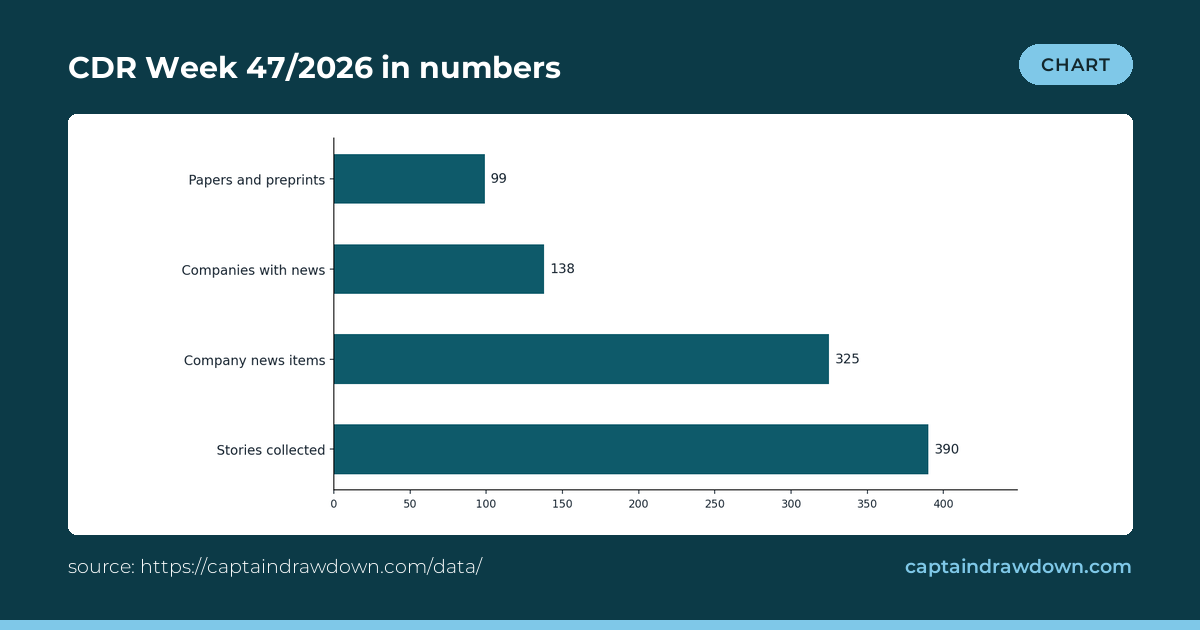
- Stories collected by the newsroom: 390, of which 99 papers and preprints
- Companies with news this week: 138 (325 items) of 1,685 active companies in the directory
- New companies added: 337
- Registry records refreshed: 143
- Data release 2026-11.5 published on 2026-11-16: captaindrawdown.com/data
Counts cover 2026-11-13 to 2026-11-20; 57,175 researchers are in the census.