A model of enhanced rock weathering (ERW) in Ghanaian soils found that a median 84.1% of the applied charge weathered within 20 years while a median 0.0023% crossed the 1 m accounting boundary. Dissolved rock is not yet carbon dioxide removal (CDR), and three more ERW papers this week show how far the answer depends on what gets measured.
Tropical soils: 84.1% weathered, 0.0023% exported
The Frontiers in Climate paper ran a daily charge-conserving model across four Ghanaian climates, four tropical soil archetypes, five feedstocks and three hydrologic structures, 2,400 simulations in all. After 20 years, 48.8% of simulations exported no charge and 91.6% failed to reach 10% breakthrough. The authors condense this into a barrier ratio: initial proton demand plus exchange headroom, relative to the applied charge. The median ratio was 2.27, and no simulation above 0.865 reached 10% breakthrough. In 75% of matched contexts at least one feedstock pair showed zero export, so the feedstocks could not be ranked. Two caveats: this is a model, not a field trial, and the boundary shifted over longer horizons as exchange-stored charge was released. My verdict: in high-barrier tropical soils, characterize the soil before choosing the rock.
Denmark: five years of field data
A five-year field experiment in Biogeosciences applied Greenlandic glacial rock flour at 50 t per hectare to a sandy agricultural soil in Denmark. A soil mass balance based on magnesium depletion puts dissolution at 56% or more of the applied material. Initial CO2 uptake comes to 3.2 to 4.9 t CO2 per hectare once carbonate speciation in the acidic soil solution is accounted for. Treated plots also held significantly higher soil organic carbon stocks, equivalent to an additional 18.3 t CO2 per hectare, roughly four to six times the inorganic figure. Read next to the Ghana model, the 56% is a weathering number and the 3.2 to 4.9 t is the removal number.
China’s rice fields: yield is not removal
A CDRXIV preprint modeling basalt-based ERW on China’s acidic rice fields estimates rice yield gains of 4.61 ± 2.45% to 6.34 ± 3.98% from a mean soil pH increase of 0.68 to 1.02 units, worth a preliminary USD 3.56 billion a year. It also estimates 204.39 Mt CO2 over 35 years from 50 t of basalt per hectare every ten years where pH stays below 6.5. Yield benefits alone give USD 609 of gross agricultural revenue per tonne of gross CO2 sequestered. A review led from Oak Ridge National Laboratory is the counterweight: it reports field-scale rates of approximately 0 to 9 t CO2 per hectare per year and rates soil pH changes and crop yield gains as less reliable indicators of CDR than alkalinity export or cation mass balance. A yield gain is a reason to spread basalt, not evidence of removal.
Permanence gets a number
A Nature Climate Change paper proposes carbon at risk, a probabilistic measure of the shortfall between contracted removals and realized storage, modeled on value at risk in finance. A single forest carbon project in California shows a 95% carbon at risk of more than 70% over 200 years, from Monte Carlo simulations driven by satellite fire data. Geological storage ranges from 0.15% for well-regulated offshore sites to 17% for poorly regulated onshore ones. The authors say early applications will rely on assumptions and abstractions. The 17% is the figure I would remember, because it shows geological storage is not a single risk class. A CDRXIV commentary arrives at a compatible recommendation from the buyer side: pair temporary removals with investments in durable engineered storage, instead of treating every credit as one fungible tonne.
Overshoot is official, removal targets are not
COP31 opened in Antalya on 9 November, the first climate summit since a United Nations Environment Programme report stated that overshooting 1.5 °C is inevitable, Nature reports. The same report confirms the need to remove hundreds of billions of tonnes of CO2 this century. Yet no country has included a clearly quantified removal target in its commitments to the United Nations, according to Steve Smith of the University of Oxford. For scale, the CDR.fyi recap counts over 33,000 tonnes of durable CDR contracted in October, including Frontier’s 20,932-tonne, $11.7 million offtake with 44.01. Biochar appears throughout that recap, and it is also why 16 of 27 EU member states have a carbon removal company, as [I mapped this week]( COP31 runs for 12 days, and I will read its final decision for one thing: whether any party attaches a number to removals.
The week in numbers
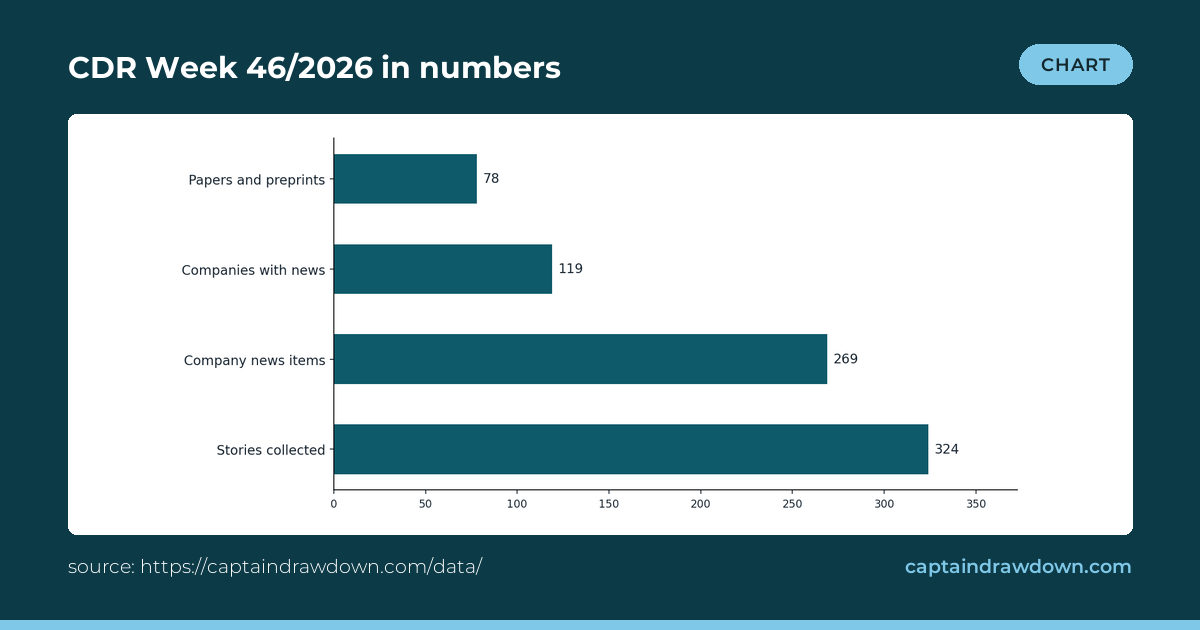
- Stories collected by the newsroom: 324, of which 78 papers and preprints
- Companies with news this week: 119 (269 items) of 1,470 active companies in the directory
- New companies added: 0
Counts cover 2026-11-06 to 2026-11-13; 57,175 researchers are in the census.