The most useful paper this week gives carbon dioxide removal (CDR) a single probabilistic number for permanence risk, and its first calibration puts a California forest project’s 95% carbon at risk above 70% over 200 years. Geological storage scores between 0.15% and 17% on the same scale, which makes the permanent versus non-permanent label look crude.
Carbon at risk: permanence gets a metric
A Nature Climate Change paper borrows value at risk from finance. It defines carbon at risk (CaR) as the probabilistic shortfall between contracted removals and realised storage at a chosen confidence level and time horizon. For forests, Monte Carlo runs driven by satellite fire data give a single-project 95% CaR above 70% over 200 years in California. For geological storage, the Storage Security Calculator gives 0.15% for well-regulated offshore sites and 17% for poorly regulated onshore ones. The authors say buffer pools are currently sized by convention, and they show that portfolios can manage tail risk cost-effectively. They also concede that early applications rest on assumptions until the underlying distributions can be estimated from observed data. My verdict: the metric is the right tool for buffer sizing and insurance pricing, but these figures are proof of concept, not ratings.
The negative result: basalt did little for Belgian maize
A 16-month field trial in Belgium applied two basalts and a tephrite at 50 t/ha, and lime at 2 t/ha, to a loamy-sand maize field with a topsoil pH of 6.66. Weathering was clearly happening, with pore water alkalinity up 87.9% under Hühnerberg basalt and 65.1% under Bolsdorfer. Soil pH rose by about 0.5 units after the first season, but that gain faded over time. None of the treatments changed cation exchange capacity. Crop biomass and quality were unaffected, including plant nickel and chromium content. The authors conclude that the agronomic benefits of basalt may be limited in fertile, near-neutral soils. The upside is that they found no harm to the crop.
Enhanced rock weathering elsewhere: yield gains, with a metals caveat
An ETH Zurich mesocosm study compared six enhanced rock weathering (ERW) feedstocks at 40 t/ha over 2 years on a pH 7.2 soil. Ryegrass yield rose by 13% ± 2%, but nickel, chromium and cobalt also increased relative to the controls. The authors say feedstock selection has to balance yield against trace-metal accumulation. A Yale modelling study of China’s acidic rice fields projects rice yield gains of 4.61% to 6.34% and 204.39 Mt CO2 sequestered over 35 years. It values the yield benefit alone at USD 609 per tonne of gross CO2. That estimate is a national projection built on earlier empirical data, not a field result, and it targets exactly the acidic soils where the Belgian trial suggests the benefits sit.
Biochar yields: the same acid-soil pattern
A Nature Reviews Earth & Environment synthesis of global field experiments finds that biochar raises crop productivity by 12.8% on average. Tap-root crops gain 32%, while fibrous-rooted staple cereals gain only 8%. The gains are largest in warm, acid, clay-rich soils. They decline over time but can persist beyond 3 years. That mirrors the weathering evidence: acid soils respond, and near-neutral soils respond less, with the ETH mesocosm as the exception. The agronomy is better than the business, though. My directory count found that [biochar accounts for 46 of 76 likely-dead CDR firms]( ## Durability and additivity
In a lab wood vault, oxygen under a clay seal fell from 21% to 0% within 10 days. Methane then rose to 0.2% over the next 1.5 months before the system settled into a deep anoxic state with negligible methane. Zeng and Zapata say this cannot show that anoxia holds for millennia, and they argue that wood vaults are fundamentally different from landfills. Separately, an Earth System Model study tested permutations of direct air capture (DAC), ocean alkalinity enhancement (OAE) and direct ocean capture. It finds that the radiative forcing benefits of CDR and emission cuts are largely additive, and that CDR works marginally better at low background CO2.
The next test for carbon at risk is whether a buyer, registry or insurer adopts it to size a real buffer pool.
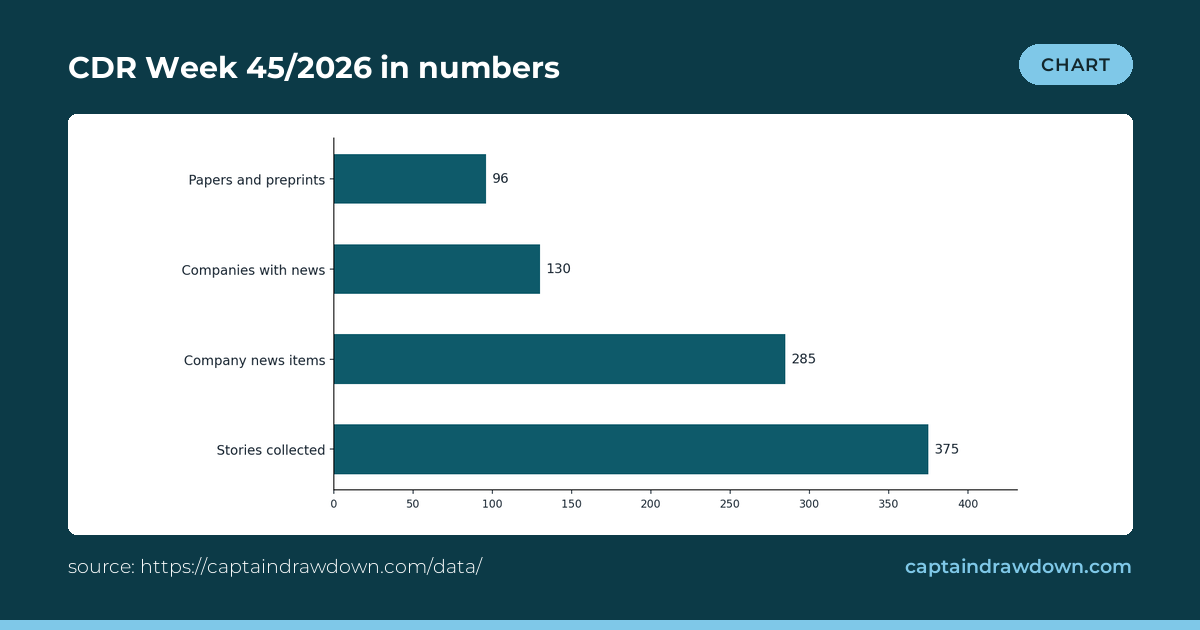
The week in numbers
- Stories collected by the newsroom: 375, of which 96 papers and preprints
- Companies with news this week: 130 (285 items) of 1,470 active companies in the directory
- New companies added: 0
- Data release 2026-11.4 published on 2026-11-05: [captaindrawdown.com/data]( Counts cover 2026-10-31 to 2026-11-07; 55,865 researchers are in the census.