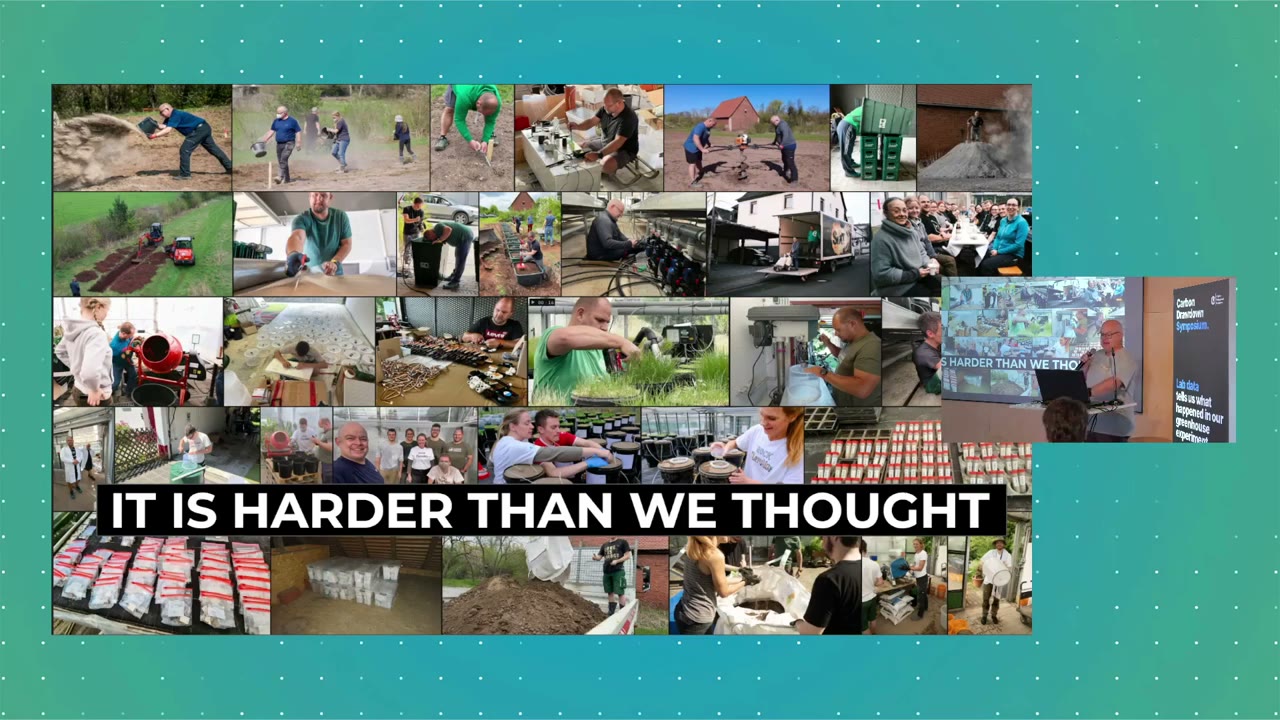
Near the end of the first-ever Carbon Drawdown Initiative (CDI) Symposium, the man who paid for the whole thing stood up to thank everyone and said something you almost never hear from a project’s funder:
“It’s now five years ago since we literally spread the first ton of rock on the field… and I still cannot tell if we’ve done CDR since then. That drives me nuts. And it’s just one field.”
— Dirk Paessler, closing remarks
That sentence is the honest summary of two days in Erlangen, where a hand-picked room of soil scientists, geochemists and policy people gathered to pick apart what is arguably the most-measured enhanced-rock-weathering experiment in the world — and to confront a genuinely awkward result.
This article walks through what the conference concluded, and just as importantly, where those conclusions come from. The whole event is on YouTube as a playlist; every claim below links to the talk it came from. You do not need to be a weathering scientist to follow it.

The idea, in one paragraph
Enhanced rock weathering (ERW) is one of the more promising ways to pull CO₂ back out of the air. The recipe sounds almost too simple: grind up a common silicate rock like basalt, spread it on a farm field, and let nature do chemistry. Rain and CO₂ in the soil form a weak acid; that acid dissolves the rock; the dissolving rock releases calcium and magnesium and, crucially, converts dissolved CO₂ into bicarbonate — a stable, dissolved form of carbon that eventually washes to the ocean and stays put for a very long time. Spread rock, remove carbon, help the crop. As Dirk put it in his welcome: “How hard can it be?”
The answer, six years in, is: much harder than anyone thought. And the reason is worth understanding, because it changes how you should read every ERW carbon credit on the market today.
Why this matters right now (the policy clock)
Before the science, the stakes. Chris Sherwood of the Brussels-based Negative Emissions Platform laid out why 2026 is a pivotal year for permanent carbon removal in Europe. The EU has formally accepted that it needs permanent CO₂ removal to hit net zero, and it has built a certification system — the CRCF (Carbon Removal and Carbon Farming framework) — that will eventually feed removal credits into the EU’s compliance carbon market (the ETS). On 15 July the Commission is expected to propose linking removals to the ETS; later in the year, national removal targets for member states — potentially an even bigger demand driver, “because most of the money in Europe is actually at the national level.”
Here is the catch for ERW: the CRCF already has approved methods for direct air capture, BECCS and biochar — but not for enhanced rock weathering. There is no timeline for one. Sherwood’s blunt advice to the room was about unity: biochar got its methodology, but because the field is split into two camps over how to prove permanence, the Commission won’t let biochar into the ETS. “The more divergence, the less your chances are of getting in.” In other words: the science has to converge on how you measure ERW before ERW can earn compliance-grade money.
Which is exactly the problem this conference walked straight into.
Where the data comes from: the world’s largest ERW greenhouse
CDI’s story is a study in productive failure. As Dirk recounted, the team started in 2022 with three neat circles of rock on a field near Fürth, “measured the hell out of it” — and saw nothing in the data. They buried 300-litre buckets in the same soil with the same rock. Again nothing. (The eventual verdict on that particular field: the soil was, in Dirk’s words, “just shitty for ERW.”)
So they built a greenhouse — what Jens Hammes called the world’s largest greenhouse experiment for enhanced rock weathering. Inside, conditions are controlled and pushed hard: temperature above 19 °C, irrigation cranked to 2,000–4,000 mm/year, so that weathering runs roughly twice as fast as it would outdoors in Germany. Hundreds of pots hold many different soils crossed with many different rock “feedstocks” — from mild basalt to fast, aggressively alkaline steel slag — each pot slowly leaching water into a collection tank below so the chemistry can be tracked for two full years.
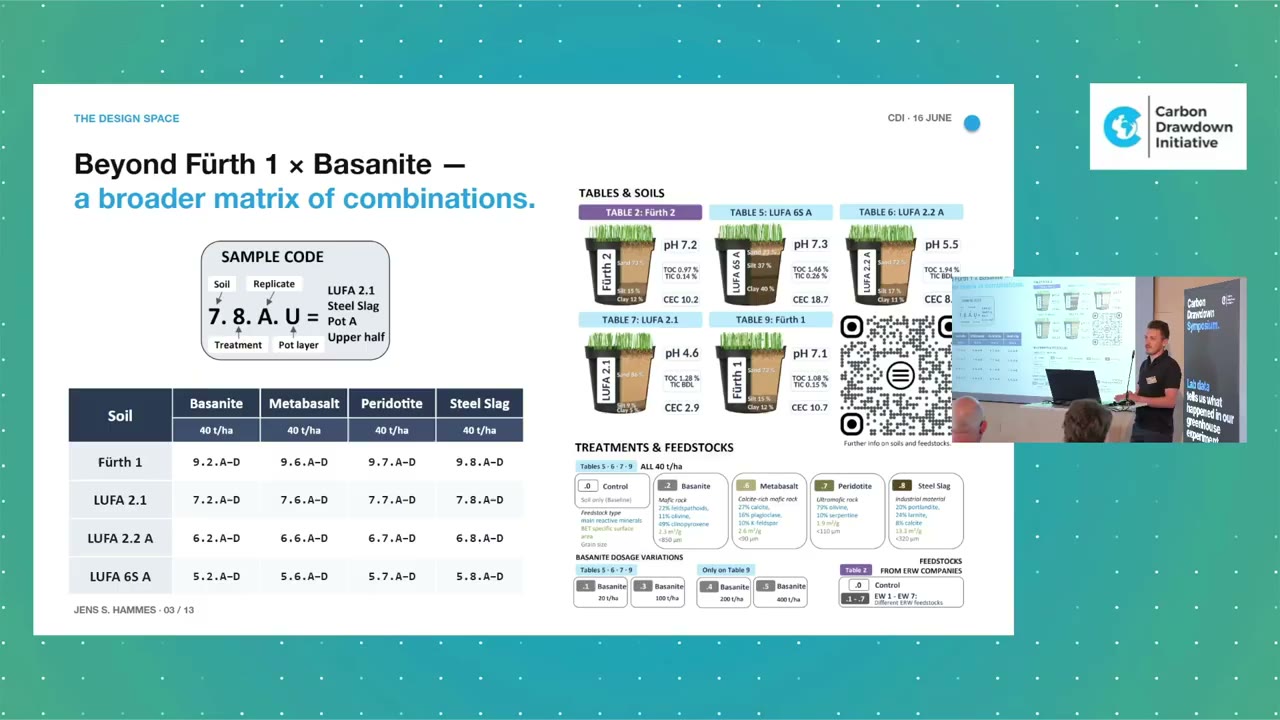
Then CDI did the thing that makes this symposium unusual. Rather than analyse everything in-house, they publicly offered the samples to outside research teams — dig into our soil, our plants, our leachate, and tell us what you find. The talks in the playlist are those independent teams reporting back. That openness is the point: it is how you build data that “the rest of the world outside of enhanced rock weathering will actually trust.”
The uncomfortable headline: the signal didn’t show up
Here is the result that framed everything else. When you add alkaline rock and it weathers, you expect the drainage water to carry more alkalinity (roughly: more dissolved bicarbonate — the captured carbon). Across the field, the buried XXL lysimeters, and the greenhouse, Hammes showed the opposite of a triumphant chart: leachate alkalinity was “lower to unchanged” in the rock-treated pots. In many cases the untreated control pots leached more alkalinity than the treated ones.
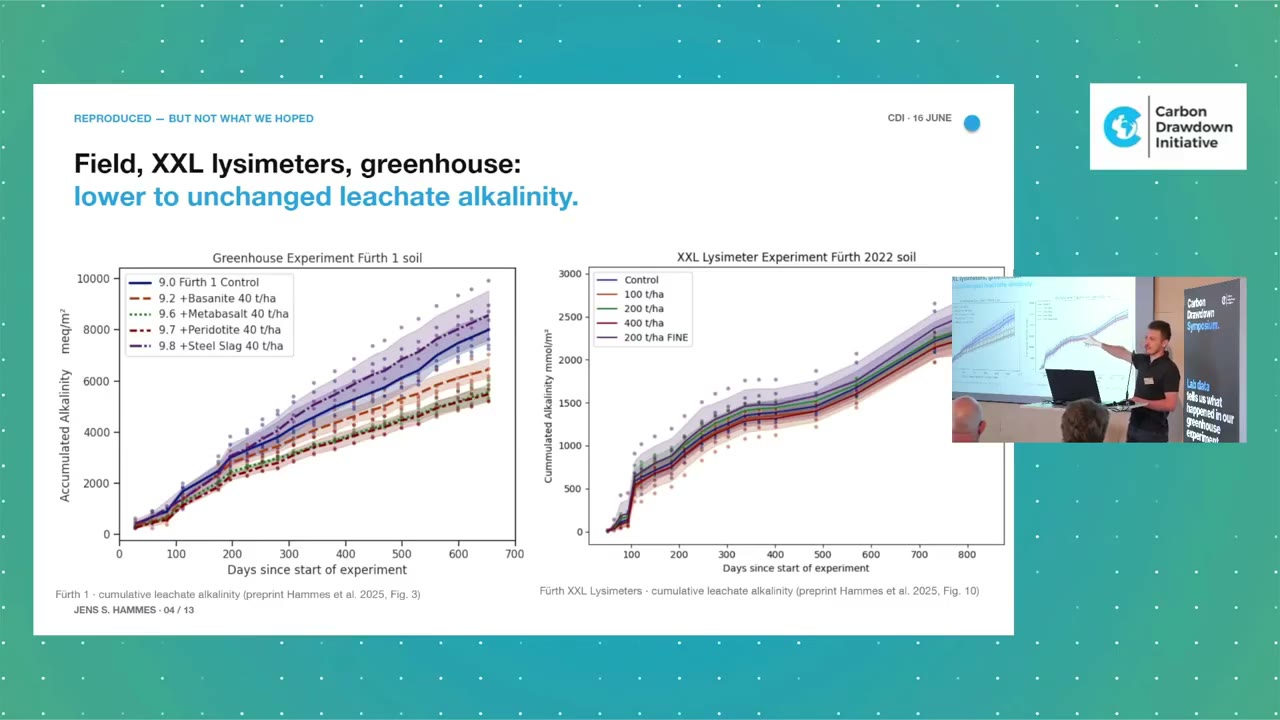
This is not a measurement glitch; it reproduces across scales. And it is the crux of the ERW measurement problem that Mel Murphy described: ERW is a complex, open system where the place the rock dissolves and the place carbon actually gets removed are decoupled, spread across days to decades and across a heterogeneous field. Meanwhile the industry is already selling credits — over 20,000 tonnes of ERW removal verified across two registries and three methodologies — with, as Murphy put it, no consensus yet on how the measurement should even be done. Her plea to the field was for open data and transparency, so the community doesn’t end up “greenwashing MRV at scale.”
So: the rock is clearly dissolving. The carbon isn’t clearly leaving. Where does it go?
The leading explanation: the soil is not a passive pipe
The most important conceptual talk came from Mike Kelland, presenting a CDI-funded collaboration. He named the flaw in the textbook picture directly: it assumes soils are “inert vessels for weathering… passive conduits for alkalinity.” They are nothing of the sort. Soils actively drive weathering — and actively sabotage the carbon accounting.
The mechanism is variable-charge buffering, and it’s worth a plain-language version because it is the intellectual center of the whole event.
Soil particles carry negative electric charge, which lets them hold onto positively charged nutrients (calcium, magnesium, potassium). The number of these “parking spots” is the soil’s cation exchange capacity (CEC). Some of that charge is fixed — but a big share of it, on organic matter and iron/aluminium oxides, is variable: it appears and disappears depending on how acidic the soil is.
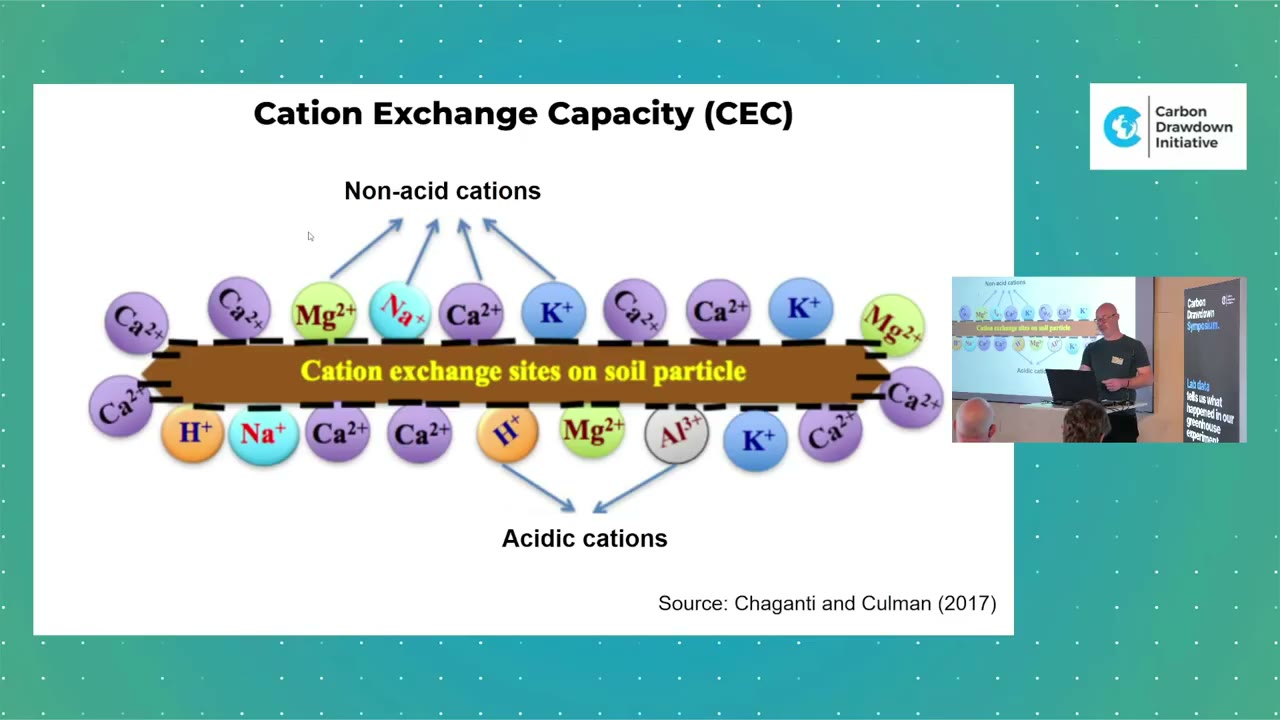
Now watch the trap close, step by step, as Kelland laid it out:
- You add alkaline rock dust. It dissolves, consuming acid and releasing calcium and magnesium. The soil starts to become less acidic (pH rises).
- That pH rise flips on new negative parking spots on the variable-charge surfaces. Creating those spots also releases acid back into the water, which pushes the pH back down — buffering the change.
- Those brand-new parking spots immediately grab the freshly released calcium and magnesium and hold them in the soil — so they never wash out as alkalinity.
The punchline is startling: you can dissolve the rock without removing any carbon at all. In Kelland’s words, this is “the potential mechanism for dissolving the feed stocks without producing any carbon dioxide removal. We don’t need carbon… for this cycle to work.” The rock disappears; the cations get parked; the carbon signal never appears in the water. And in the acidic soils he studied, the low export isn’t a bug to fix — it’s chemistry doing what chemistry does. “It’s low because it should be low.”
He was careful about what’s genuinely new here — measurements confirmed the soil really is forming new exchange sites (CEC can double or triple), not just swapping old ions around. And he flagged something even bigger lurking underneath, which we’ll get to.
Following the cations: they’re there, just… stuck
If the calcium and magnesium aren’t leaving as alkalinity, they should still be somewhere in the soil. Two talks went looking.
Lucilla Boito used sequential chemical extractions — dissolving the soil in stages — to sort the weathered cations into pools with very different lifetimes: loosely held (exchangeable), locked in carbonates, bound to oxides, or trapped in clays. Her finding: the cations are genuinely scattered across all of these pools, and the pattern depends on both the rock and the soil. There is “no single fate” for a cation. (Honest caveat from the same talk: the extraction method also chews up bits of the original rock, so the raw pool numbers can’t be taken at face value — a reminder of how hard even the bookkeeping is here.)
Philip Pogge von Strandmann put hard numbers on the leak, using two independent methods (a soil mass balance, cross-checked with expensive lithium-isotope measurements that agreed with the cheaper approach). His headline figure: 50–90% of the dissolved calcium and magnesium leaves the water and goes back into secondary minerals — new clays and oxides — the same way natural basalt weathering behaves. On the original 2.25-year field soils, he estimated 6–14% of the potential carbon-drawdown capacity was already irreversibly lost into those new minerals.
Most tellingly, he split the carbon budget into four buckets: rock that hasn’t dissolved yet; carbon genuinely sequestered; carbon “delayed in the cation exchange capacity”; and carbon irreversibly lost. That third bucket — cations parked on exchange sites, not yet (and maybe never) converted to bicarbonate — is Kelland’s variable-charge trap, now with a number attached. And the pushed-hard greenhouse soils showed far more dissolution and far more of this exchange capacity than the field.
So the two mechanisms compound: some weathered cations get permanently diverted into new minerals, and a lot more sit parked on exchange sites in limbo. Either way, the water stays quiet.
The plants got something out of it, even if the climate didn’t (yet)
Not all the news was sobering. Xavier Dupla analysed what ERW did to the crop and soil health, and found real agronomic wins even on a poor, neutral-pH soil where weathering is slowest: soil acidity fell about 33%, and calcium, magnesium and silicon became more available to plants. The forage grass itself got better — indigestible lignin dropped by about 34% and fat content rose ~10%, a meaningful quality gain for animal feed.
There was a catch that ties right back to the main story. Because weathering floods the soil with divalent calcium and magnesium, those ions muscle potassium off the exchange sites, and the displaced potassium leaches away — so potassium availability actually fell, a warning for potassium-hungry crops. It’s the same tale from the plant’s point of view: the cations released by the rock don’t sail off to the ocean, they get taken up by the crop and swapped around on the soil’s exchange sites. Dupla’s reframe is worth holding onto — perhaps, for now, carbon removal is better understood as a co-benefit of the agronomic benefits than the other way around. (A companion talk by Mathilde Hagens looked specifically at how much of the cation pool ends up in the harvested ryegrass itself — another sink that keeps the budget from closing in the water.)
The wildcard nobody can measure yet: soil carbon
Here is where the conference got genuinely humbling. Kelland dropped a warning in passing: the changes ERW might cause in the soil’s own carbon stock — the organic carbon in roots, microbes and humus, plus inorganic carbonate carbon — could be large enough to “completely dwarf” the tiny alkalinity signal everyone’s been chasing. Treated pots even showed increased CO₂ coming off the soil. So is the rock quietly building soil carbon (which would help), or burning it off (which would hurt)? A whole afternoon went at that question — and mostly bounced off it.
- Benjamin Möller chased phytoliths — microscopic glass beads that grass grows inside its own tissue, each sealing a little organic carbon away for centuries. ERW does make plants produce dramatically more of them (basanite raised phytolith content ~150% on one soil). But the carbon actually locked inside works out to a rounding error: an estimated 1–2 kg of carbon per hectare per year — “likely insignificant” next to the numbers ERW needs. (He suspects the standard method over-destroys the very carbon it’s trying to count, so the true figure may be higher — but not a rescue.)
- Teams from Wageningen and the AWI polar institute brought serious lab methods (Rock-Eval; ramped-pyrolysis oxidation) to detect whether ERW shifted soil carbon from “fresh” to “stable” forms. The candid verdict from Manuel Ruben and Malte Höhn: on these two-year pots the data is “messy” and not yet reproducible, and the method isn’t ready as a fast commercial indicator “on such a short time scale.”
The audience surfaced why it’s so hard, and this is the part a non-specialist should take away: any ERW-driven change in soil carbon is a tiny nudge to an enormous existing pool; soil carbon re-equilibrates over centuries, so two years is far too short; and — the sneaky one — these pots were former cropland now growing grass, so a big pulse of new root carbon floods every pot, treated and control alike, masking the rock’s effect entirely. In short: soil carbon might be the most important part of the ERW story, and right now nobody can measure it cleanly enough to say.
What the conference actually concluded
Put the pieces together and the CDI Symposium’s real output isn’t a number. It’s a sharpened, honest picture:
- The classic “spread rock → measure alkalinity in water” model badly underestimates how much the soil interferes. Rocks dissolve; a large fraction of the released cations is trapped on newly created exchange sites (variable-charge buffering) or diverted into new minerals — 50–90% for Ca/Mg — so the carbon-removal signal in the water is weak, absent, or even negative over two years. This is the central, reproducible finding.
- That does not automatically mean “ERW doesn’t work.” It means much of the action is happening in solid soil phases that the standard water-based accounting doesn’t see, and possibly in soil-carbon changes that current methods can’t yet resolve. The open scientific question — asked directly in the room — is whether this trapped carbon is delayed (real removal, just slow to report) or denied (never converted). As Kelland said: “We don’t actually know. We need to go measure.”
- There are real co-benefits (less soil acidity, better forage) that may drive adoption regardless — but also real risks (potassium loss, possible soil-carbon release with aggressive feedstocks like steel slag) that honest MRV has to catch.
- The measurement problem is now the whole ballgame — and it’s also the policy bottleneck. No robust, scalable MRV, no EU CRCF methodology, no compliance market for ERW.
Tellingly, Dirk noted the talks “wonderfully contradicted each other” — which was the point. Day two was an un-conference built to reconcile those contradictions rather than paper over them.
What happens next
CDI’s answer to “the signal is fuzzy” is not to give up; it’s to widen the lens. Jens Hammes previewed the next greenhouse experiment: roughly 500–600 buckets spanning soils from pH 3.3 to 7.5 (deliberately including the extremes), crossed systematically with feedstocks ordered by how fast they dissolve. The bet is that mapping a wide gradient — rather than nailing one combination — will reveal which soil and rock properties actually drive the outcome. Early machine-learning work is encouraging: a random-forest model using just the starting soil and rock properties already predicts the leached alkalinity within ±20% about half the time, and adding cheap continuous monitoring (electrical conductivity and drainage volume) pushes that toward ~68%. If that holds, it points at dramatically cheaper MRV — a model plus two annual measurements instead of measuring everything, everywhere, forever.
The current pots run until the end of 2027. The bigger open question Dirk threw to the room was what to do in 2028: another few hundred pots? Back out to real fields? Into the lab? He wants the community to decide — because, as he said, this is a marathon, not a sprint.
The takeaway
It would have been easy to walk out of Erlangen discouraged. A funder six years and one greenhouse deep, still unable to say for certain he’s removed a single verified tonne from that first field. But that’s the wrong read. The value of the CDI Symposium is precisely that it refused to manufacture a clean answer. It showed a young industry the difference between “the rock dissolved” and “carbon was removed” — a difference that a lot of today’s optimistic accounting glosses over — and it did so in the open, with contradictions on full display and the underlying samples handed to anyone willing to measure them.
Dirk closed with a joke, a riff on Kennedy’s moonshot line, printed on a gift for the greenhouse wall: “We do this not because it is easy — because we thought it would be easy.” Then he corrected the room, deadpan: “We actually thought it was easier.”
That’s the honest state of enhanced rock weathering. Not “it doesn’t work.” Not “it’s proven.” Something more useful, and more trustworthy: we are finally measuring it well enough to know what we don’t know — and that is how a real carbon-removal method is built.
This overview was compiled from the full CDI Symposium 2026 talk recordings. Slide images are screenshots from those talks (© Carbon Drawdown Initiative and the respective speakers). Two talks — Mathilde Hagens on base-cation uptake by ryegrass and on Rock-Eval soil-carbon analysis — did not have machine-readable captions available at the time of writing; their findings are referenced here only where corroborated by other talks. Where a figure is quoted, follow the linked talk to the speaker’s own words.