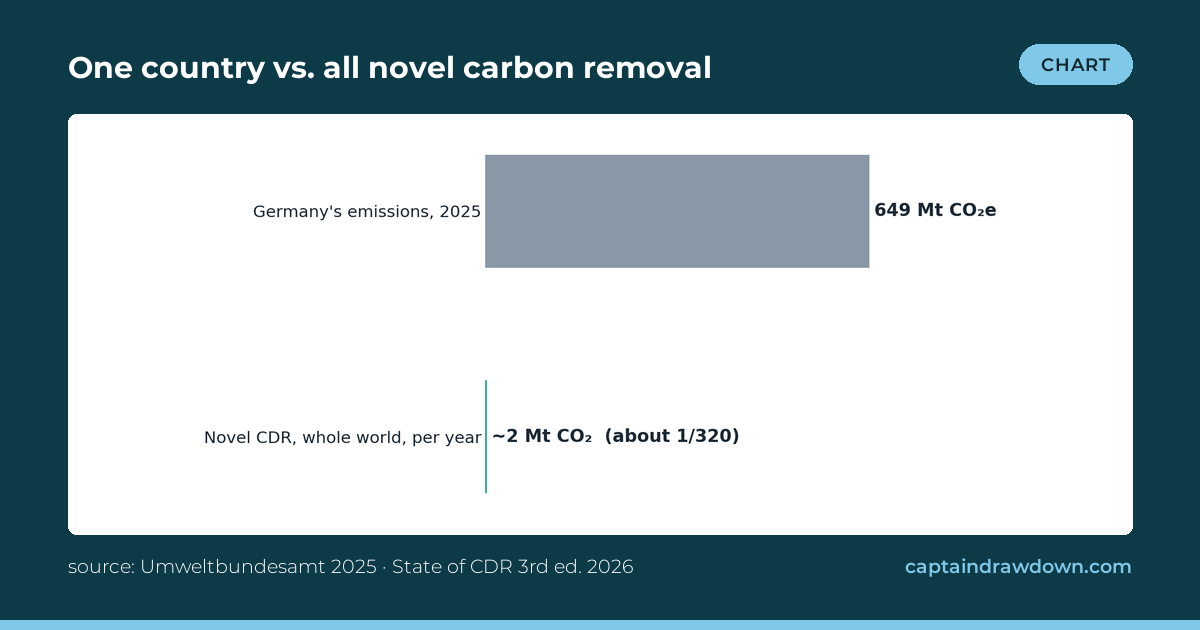
Germany emitted about 649 million tonnes of CO₂-equivalent in 2025, according to the Umweltbundesamt. In the same period the whole world removed about 2 million tonnes with novel, durable methods (direct air capture, biochar, enhanced weathering, BECCS), per the third edition of The State of Carbon Dioxide Removal. One country emits roughly 320 times the planet’s entire novel removal output. No amount of individual tonne-buying closes a gap of that size, and the idea that it should comes from a frame the oil industry made popular.

That frame got a fresh airing on 31 October in a video by Matt D’Avella on why the sustainability wave of the 2010s faded. It is a sponsored lifestyle video, not a source of new data, but its interview with Harvard historian Naomi Oreskes, co-author of Merchants of Doubt, lays out the mechanism cleanly. I read the full transcript. The video never mentions carbon removal; the CDR connection below is mine.
The personal footprint was built to move responsibility
BP rebranded itself as “beyond petroleum” in July 2000, a campaign reported at $200 million. In 2004 it launched a personal carbon footprint calculator. The idea came from creative directors at its ad agency, Ogilvy & Mather, and the campaign won a gold Effie in 2007 (OpenMind, 2023; Science Norway, 2025). The footprint concept itself is older and came from ecological-footprint research. BP’s contribution was to point it at the household and put it in front of millions of people. BP declined to comment to Science Norway.
The video places this in a longer pattern, with Oreskes supplying the history. It quotes the 1969 Brown & Williamson tobacco memo, “Doubt is our product”, and the 1971 “Crying Indian” ad from Keep America Beautiful, a group backed by beverage and packaging companies, which closed with “People start pollution. People can stop it.” The ad ran while US states were moving to restrict single-use containers. The move is always the same: if the problem is personal behaviour, the producer does not need regulating.
The same move is still running. Beyond Plastics put Bluetooth trackers into Starbucks cold cups and dropped them in in-store recycling bins at 35 stores. Of the 36 trackers that returned usable data, none reached a recycling facility: 16 ended in landfills, 9 at incinerators, 8 at waste-transfer stations, 3 at sorting facilities (Beyond Plastics, May 2026). According to the video, Starbucks questioned the study’s methods and blamed local recycling infrastructure. The video quotes a larger count (69 trackers, 47 with data) that I could not find in the published report, so I use the report’s numbers.
“Offset your footprint with CDR” repeats the frame
Carbon removal now has its own version of the footprint pitch: calculate your emissions, buy the same number of removal tonnes, call yourself net zero. Let’s do the arithmetic for one German.
649 million tonnes over about 83.5 million residents is roughly 7.8 tonnes per person per year (territorial emissions only; a consumption footprint including imports is higher). At the consumer prices listed in the CDR shop directory, that is about $1,200-1,300 a year with biochar at $150-165 per tonne, about €3,100 with enhanced weathering at ~€400, and $3,900-7,800 with direct air capture at $500-1,000. Expensive, but affordable for some households.
Price is not the real limit. If every German tried it, they would need about 650 million tonnes a year, against about 2 million tonnes of novel removals delivered worldwide. The tonnes do not exist, and they will not exist at that scale for decades. Personal neutralisation fails on supply before it fails on price.
The frame also does damage. It turns removal into a private absolution for a flight or a steak. That feeds the oldest objection to CDR, “mitigation deterrence”: the worry that removal becomes an excuse to keep emitting. Selling CDR with the footprint frame confirms the critics’ story.
Individual buyers are not the problem. The label on the purchase is. Voluntary contracts for removals came to about 40 million tonnes last year, concentrated among very few buyers, above all Microsoft, which the State of CDR authors call a “critical vulnerability”. Every individual and small-company buyer spreads that demand a little and keeps young suppliers alive. A tonne bought by a person is a vote for a technology to exist, not an eraser for their emissions. Shops and buyers should say exactly that.
The tonnes that matter are bought by states and obligated emitters
Oreskes ends the video by rewriting the 1971 slogan: “Policy can stop people from profiting from pollution.” For carbon removal, the policy version already exists in a few places:
- Sweden runs a reverse auction for BECCS. Stockholm Exergi won about SEK 20 billion (~$1.8 billion) in support for up to 15 years, for a plant designed to remove 800,000 tonnes of biogenic CO₂ per year (ESG Today, January 2025). At full capacity that one plant would equal about 40% of today’s global novel removals. It is a contract for future tonnes, not tonnes delivered.
- Denmark gave Ørsted a 20-year contract to capture and store about 430,000 tonnes of biogenic CO₂ a year from two power stations. Ørsted itself says the state subsidy and Microsoft’s offtake were both needed to make the project work (Ørsted, May 2023).
- The supply-side idea goes furthest: a “carbon takeback obligation” would require fossil fuel extractors and importers to store a progressively rising share of the CO₂ from what they sell, on a path to net zero by 2050 (Jenkins et al., Joule, 2021). Their model puts its cost on a par with a carbon price of similar ambition. That is a model result, not a market price. But it hands the footprint back to the producer, which is the exact reversal of what BP’s calculator did.
The gap these instruments have to close is national, not personal. National climate plans pledge 3.6 billion tonnes of removals a year by 2050, at least 5.2 billion tonnes short of a 1.5 °C pathway, a figure the State of CDR authors call a lower bound. Germany’s climate law already says that “after 2050, negative greenhouse gas emissions shall be achieved” (KSG §3). It does not say who buys the tonnes.
How a society decides that removal matters
If personal footprints are the wrong unit, three things follow for anyone who wants CDR taken seriously:
- Count removals per country, not per person. The useful number is a national removal target in tonnes per year, with a date. Germany has a direction (“negative after 2050”) and no number.
- Argue about who pays. Taxpayers through auctions like Sweden’s, emitters through an obligation like the takeback idea, or a mix. That is a real political choice, and it cannot even start while CDR is marketed as a lifestyle product.
- Buy as a citizen, label it honestly. Personal purchases fund the learning curve. Call them a contribution, not neutralisation, and put the same energy into asking your representatives which ministry will be the buyer of the tonnes in the climate law.
Which German party will be the first to write a removal target in tonnes, with a named buyer, into its programme?