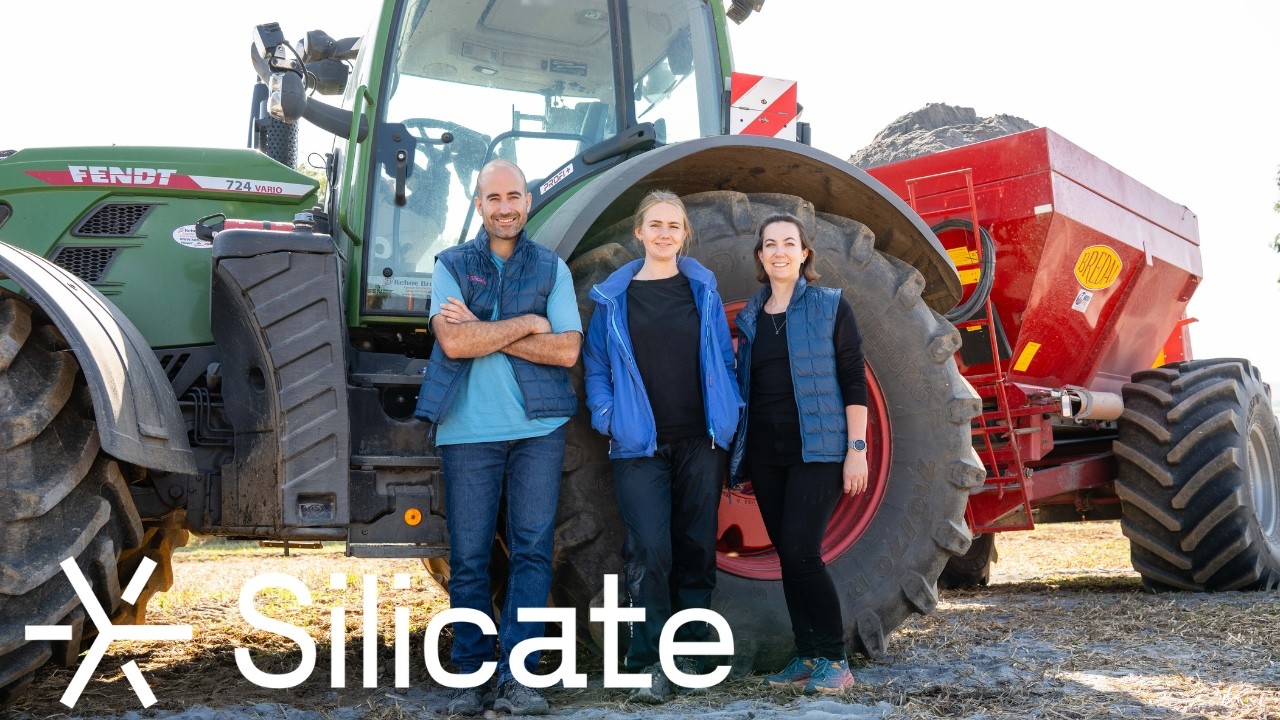
This is the first post in our CDR Watch series — short takes on the best carbon removal videos we find.
Most enhanced weathering companies spread crushed basalt on farmland. Silicate does something different: they use limestone.
That might sound like a small detail, but it changes the game in a few important ways.
Why Limestone?
Basalt is the standard feedstock for enhanced weathering because it’s rich in silicate minerals that react with CO₂. The problem: basalt weathers slowly. You need fine grinding, warm climates, and wet soils to get meaningful reaction rates.
Limestone — calcium carbonate — dissolves much faster. When carbonic acid (CO₂ dissolved in rainwater) meets limestone, the reaction produces dissolved bicarbonate that carries carbon into groundwater and eventually the ocean, where it’s stored for thousands of years.
Farmers already know this material. Limestone has been used to buffer acidic soils for centuries. Silicate is essentially taking an established agricultural practice and turning it into a carbon removal pathway.
The Dual Benefit
This is what makes the approach clever: every tonne of limestone applied improves soil pH and removes CO₂. Farmers get a direct agronomic benefit — better nutrient availability, improved crop yields — while generating verified carbon removal.
That alignment matters. One of the biggest challenges in enhanced weathering is convincing farmers to participate. When the material is already something they’d want to use, the adoption barrier drops significantly.
Where They Stand
Silicate was an XPRIZE Carbon Removal finalist and is running field trials in Ireland and the US, including a collaboration with Northwestern University in Illinois. They’re focused on building the MRV (measurement, reporting, and verification) framework to prove that the carbon actually stays removed.
The company is based in Ireland and operates across the US — and yes, they’re in the CDI portfolio.
Watch the Video
The explainer above is a solid 3-minute overview of their approach. If you follow enhanced weathering, this is worth your time. Silicate’s limestone angle is one of the more interesting divergences from the basalt consensus — and the data from their field trials will be important for the whole EW sector.
CDR Watch highlights videos that explain carbon removal clearly and accurately. Got a recommendation? Tag us on Bluesky or X.
🔗 Related Reading
- [What Is Enhanced Weathering? A Primer](/posts/what-is-enhanced-weathering/)
- CDR Roundup: What’s Moving in Carbon Removal (Feb 2026)
- Why Carbon Removal Needs More Than Trees
- [Enhanced Rock Weathering: Promising, But Not Simple](/posts/2026-02-25-erw-promising-but-not-simple/)