🔑 Key Takeaways
Multi-year DAC offtakes are becoming the norm. Sirona Technologies’ deal via Patch follows a pattern: buyers are moving from exploration to long-term procurement with multi-year contracts securing permanent removals. The shift matters — it signals genuine market maturation, not just pilot-stage experimentation.
Aviation’s CDR paradox deepens. Boeing is buying 40,000+ tonnes of quality CDR via Carbonfuture, while the SASHA Coalition argues that CORSIA lets the sector avoid harder decarbonization — leaving 1.1 billion tonnes unregulated since 2012. The gap between voluntary ambition and compliance reality is widening.
Carbon pricing uncertainty freezes capital. Canadian Natural’s $8.25 billion investment pause shows that unclear carbon rules don’t just slow policy — they freeze actual dollars.
📊 Quick Numbers
| Metric | Value | Source |
|---|---|---|
| CDR spend (all time) | $787.7M | cdr.fyi |
| CDR tonnes sold | 44.1M tCO₂ | cdr.fyi |
| Delivered | 2.7% | cdr.fyi |
| Active purchasers | 1,013 | cdr.fyi |
| Active suppliers | 721 | cdr.fyi |
| Boeing CDR procurement | 40,000+ tCO₂ | Carbon Herald |
| Aviation CO₂ unregulated (2012–2023) | ~1.1 Gt | Carbon Herald |
| CNRL paused investment | $8.25B | Globe and Mail |
Market Moves
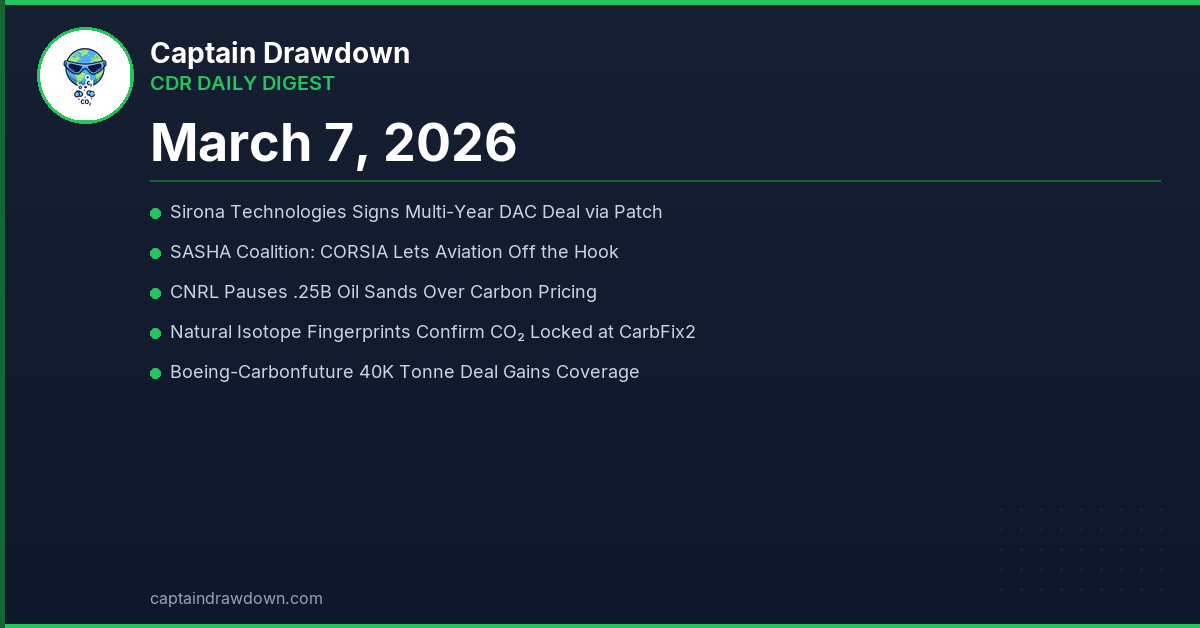
Sirona Technologies Signs Multi-Year DAC Deal via Patch
Belgian modular DAC company Sirona Technologies secured a new multi-year offtake facilitated by carbon credit platform Patch. Credits come from Sirona’s modular DAC projects with geological CO₂ mineralization storage. The buyer was drawn by permanence, scalable modular deployment, and the advantage of locking in supply early. Sirona says multi-year contracts are becoming the norm as buyers move from exploration to structured procurement. (Carbon Herald)
Boeing–Carbonfuture 40K Tonne Deal Picks Up Major Coverage
Yesterday’s Boeing–Carbonfuture deal continues making waves, covered by BusinessGreen, GasWorld, QCI, and others. At 40,000+ tonnes from four biochar projects in the Global South, it’s being called one of aviation’s boldest CDR procurements. (BusinessGreen · GasWorld)
Bloomberg: Middle East LNG Disruptions Could Lift Carbon Credit Demand
Qatar’s force majeure on LNG exports — removing roughly 20% of global supply — could push industries toward cheaper, higher-emission fuels. That would increase ETS liabilities and potentially drive compliance carbon credit demand higher. (Bloomberg)
CNRL Pauses $8.25B Oil Sands Expansion Over Carbon Pricing
Canadian Natural Resources deferred a massive mine expansion, citing unresolved carbon pricing rules. The company wants CCS-using firms exempted from Alberta’s industrial carbon price ($130/t under discussion). The Pathways CCS project hangs on an April 1 deadline. (Globe and Mail · Financial Post)
Policy & Regulation
SASHA Coalition: CORSIA Is Letting Aviation Off the Hook
ICAO’s carbon offset scheme for aviation has left approximately 1.1 billion tonnes of CO₂ unregulated between 2012 and 2023 — equivalent to Greece’s total emissions — by keeping international flights outside the EU ETS. The SASHA Coalition (launched by Opportunity Green) warns that continuing this exemption through 2035 could leave another 1.3 billion tonnes unregulated and forfeit ~$150 billion in potential carbon market revenue. (Carbon Herald)
EU Industrial Accelerator Act Draws Global Reactions
The European Commission’s Industrial Accelerator Act, part of the Clean Industrial Deal, imposes “Made in Europe” rules on batteries, EVs, solar PV and critical raw materials. China expressed “grave concern.” European cleantech investment in 2024–2025 was below early-2020s levels, and industry watchers say the IAA’s effectiveness could be pivotal. (Reuters · C&EN)
Science & Research
Natural Isotope “Fingerprints” Confirm CO₂ Permanently Locked at CarbFix2
A University of Edinburgh study shows that natural isotopic signatures in CO₂ and water can track mineralization at Iceland’s CarbFix2 site — no artificial tracers needed. This could simplify MRV for geological CO₂ storage and significantly reduce monitoring costs for DAC+storage projects. (Edinburgh/Source)
Nature Reviews Materials: Scaling CO₂ Mineralization
A new review examines CO₂ mineralization pathways, identifies key reaction bottlenecks, and outlines what’s needed in materials design and process engineering to make mineralization cost-effective at scale. (Nature Reviews Materials)
🌡️ Market Tone
Constructive. The CDR market continues to mature structurally: multi-year offtakes are displacing one-off purchases, major corporates (Boeing) are committing at scale, and the science base for mineralization MRV is strengthening. However, the macro environment introduces crosscurrents — Middle East energy disruptions could reshape compliance carbon markets, and Canada’s carbon pricing uncertainty is freezing fossil fuel investment (which indirectly affects CCS deployment timelines). Saturday pace — no major new funding announcements, but strong continued momentum from a busy week.
Captain Drawdown publishes daily CDR market intelligence. Subscribe for updates.