🔬 Top Story: Cornell Study Puts ERW at Up to 1.1 Billion Tonnes/Year by 2100
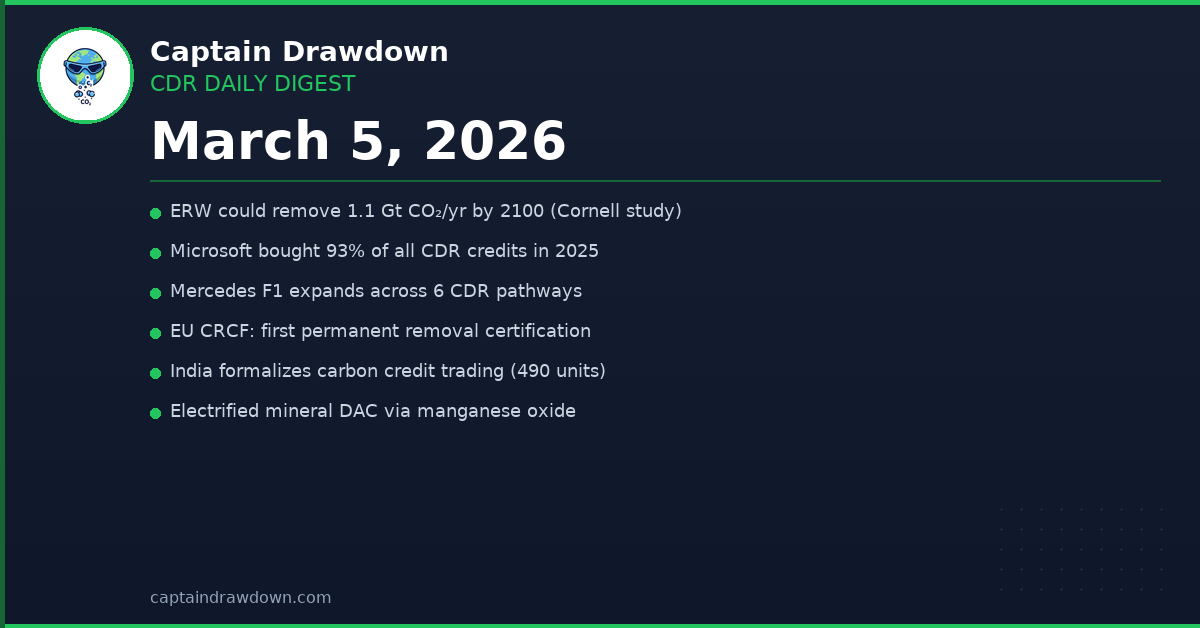
A new study in Nature Communications Sustainability by Cornell’s Chuan Liao and colleagues models realistic adoption scenarios for enhanced rock weathering (ERW) — the practice of spreading crushed silicate rocks (like basalt) on agricultural fields to accelerate natural CO₂ drawdown. The findings: 350M–750M tCO₂/yr by 2050 and 700M–1.1B tCO₂/yr by 2100. That’s far below earlier theoretical ceilings of 5 Gt/yr but still a massive contribution to climate mitigation. A key takeaway: the Global South would eventually surpass the Global North in ERW deployment as supply chains mature, making the technique a potential equity lever for global carbon markets. (New Scientist · Nature)
📊 Market Moves
Mercedes-AMG PETRONAS F1 expands CDR portfolio to ~18,900 tCO₂e. The team added seven new projects spanning DAC, biomass storage, BECCS, biochar, OAE, and ERW across six countries. Portfolio curated by CUR8. (Carbon Herald)
AirMyne secures strategic investment from ENEOS, Japan’s largest energy firm. The Berkeley DAC startup is developing liquid solvent-based technology for industrial-scale deployment and recently hired ex-Climeworks CCO Jan Huckfeldt. Part of a growing wave of Japanese investment in CDR alongside Sumitomo (Global Thermostat) and Mitsui (Heirloom). (Carbon Herald)
Microsoft bought 93% of all carbon removal credits globally in 2025, according to new BNEF/BCSE data. A testament to Microsoft’s ambition — but also a warning about market fragility. Nature-based credits average $7–20/ton; tech CDR exceeds $500/ton. (Latitude Media)
LEGO invests $2.8M in carbon removal across four projects (reforestation + tech pathways via Climate Impact Partners and ClimeFi). Total CDR spend now $8.4M. (ESG Dive)
⚖️ Policy & Regulation
EU CRCF: first permanent carbon removal certification methodologies adopted. The European Commission has adopted delegated rules for DACCS, BioCCS, and biochar under the CRCF regulation. This is effectively the world’s first voluntary standard dedicated to permanent carbon removal — defining what counts as a tonne of removed CO₂. Two-month scrutiny period; publication expected early April. An EU Buyers’ Club for removal credits is planned. (Green Earth)
France pushes EU to fund clean cooking via carbon credits. French climate envoy Benoît Faraco proposed channeling EU international credit allowances (up to 5% of 2040 target reductions, from 2036) toward clean cooking projects in developing countries. (Climate Change News)
India formalizes carbon credit trading. CERC published 2026 regulations for the Carbon Credit Trading Scheme covering 490 industrial units across seven sectors. Each certificate = 1 tCO₂e with floor and ceiling prices. (Solar Quarter)
🔭 Industry
APACdr initiative launched by the Carbon Business Council and Emerald Climate — a Singapore-anchored working group to accelerate CDR in Asia-Pacific. Summit planned during Ecosperity Week, May 18–21. (Carbon Herald)
RMI & Cornell launch live CDR Research Tracker at cdrdatabase.org, tracking DAC industry milestones across 10 technology approaches. Phase 2 expands to 13+ CDR types in summer 2026. (RMI)
🧪 Science
Electrified mineral DAC using manganese oxide published in Nature Energy. A Northwestern/Caltech team demonstrates a system that captures CO₂ from ambient air using common MnO₂, resists degradation from oxygen and humidity, and releases CO₂ when the charge is reversed. Low material cost could matter for DAC economics. (Nature Energy)
CO₂-curable elastomer: Gifu University researchers created rubber that absorbs CO₂ and becomes 1,000x harder (acrylic-like). Reversible with heat. Early stage but interesting for CCU. (Nature Communications)
Quick Numbers
| Metric | Value | Source |
|---|---|---|
| Microsoft share of CDR purchases (2025) | 93% | BNEF/BCSE |
| VCM forward contracts (2025) | $5.8B (+58% YoY) | Abatable |
| CORSIA projected demand (2026) | +78M tonnes | Abatable |
| Nature-based credit price | $7–20/ton | Sylvera |
| Tech CDR credit price | >$500/ton | Sylvera |
| CCP-approved credits (Dec 2025) | ~51M (4% of issuance) | ClimateSeed |
| ERW potential by 2100 | 0.7–1.1 Gt CO₂/yr | Nature |
🌡️ Market Tone
Constructive but concentrated. The EU is building real regulatory infrastructure (CRCF methodologies, 2040 credit flexibility), India is formalizing compliance-grade trading, and corporate buyers are diversifying across pathways. But the Microsoft 93% statistic reveals the CDR market’s uncomfortable truth: one buyer is keeping the industry alive. Japanese capital adds welcome geographic diversity, and the Cornell ERW study validates the pathway even as it tempers the most optimistic projections. The trend line points toward regulatory maturation, buyer diversification, and an integrity-led market — but the pace of demand growth outside Microsoft remains the open question.