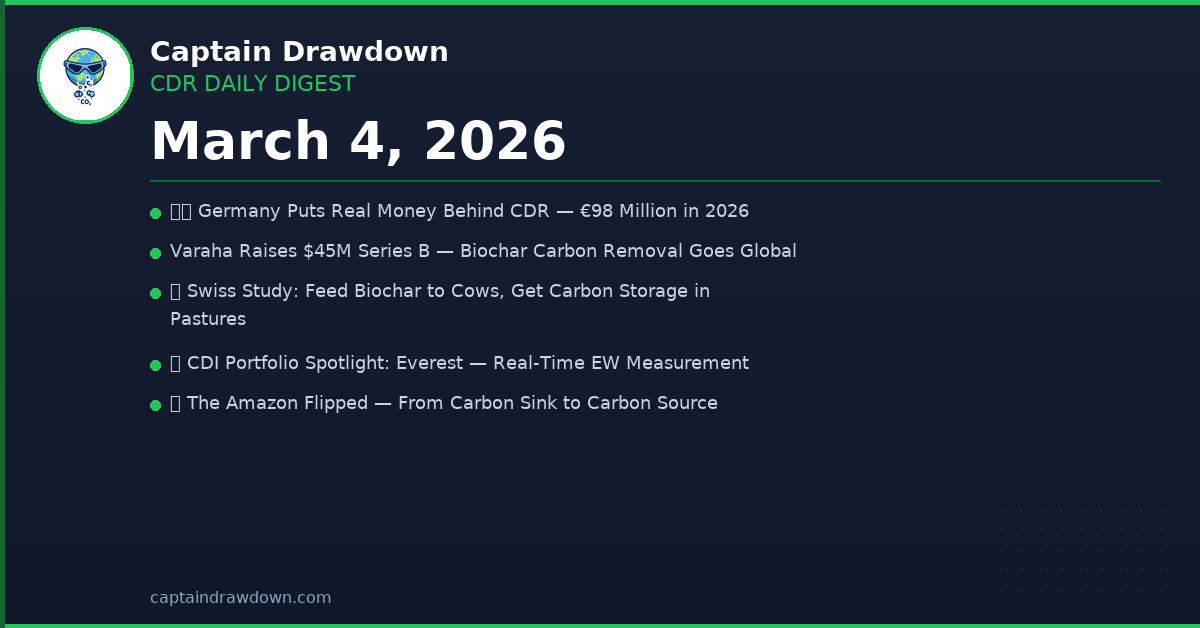
Five stories across four continents. Today’s thread: money, measurement, and a rainforest that stopped doing its job.
🇩🇪 Germany Puts Real Money Behind CDR — €98 Million in 2026
The Handelsblatt dropped a significant story that barely registered outside German media: Germany’s 2026 federal budget includes €98 million for CDR projects and €11.5 million for purchasing CO₂ removal certificates. This is a first.
The German Association for Negative Emissions (Verband für negative Emissionen) says more is coming — a pathway to continued funding through 2033. CDR startups like Novocarbo (biochar) and InPlanet (enhanced weathering) get specific mentions as German companies building in this space.
Why this matters beyond Germany: the EU has been finalizing voluntary certification methodologies for permanent carbon removals. Germany putting budget money on the table — not just policy frameworks but actual procurement — sends a signal to the entire European CDR ecosystem. Government as buyer, not just regulator.
CDI has been tracking the economics of CDR certificate sales. Their analysis of whether you can profitably sell CDR certificates is worth revisiting now that a G7 government is officially buying.
Source: Handelsblatt
💰 Varaha Raises $45M Series B — Biochar Carbon Removal Goes Global
India’s Varaha just closed a $45 million Series B led by WestBridge Capital. The company already sells carbon removal credits to Google and Microsoft, and operates across India, Nepal, Bangladesh, and now Africa via its new VIPP program (Varaha Industrial Partners Program).
VIPP’s first target: Côte d’Ivoire, where Varaha is partnering with local operators to scale industrial biochar production. Credits will be issued through Puro.earth’s biochar methodology. It’s the same playbook CDI portfolio companies like Cotierra and Happy Ground use — turn agricultural waste into durable carbon removal, generate credits, improve farmer livelihoods.
$45M for a biochar company signals that this pathway is maturing fast. CDI’s recent piece on biochar at different scales explains why decentralized production like VIPP matters.
Source: AgroTech Space
🐄 Swiss Study: Feed Biochar to Cows, Get Carbon Storage in Pastures
This one’s fun. Swiss researchers fed dairy cows a diet containing 1% biochar — and found that 70–90% of the biochar survived the entire digestive process. Even better: 98% of recovered fragments remained physically and chemically intact, retaining their condensed carbon structure.
The implication: cows could become natural biochar distribution systems. Instead of manually spreading biochar on fields (labour-intensive, expensive), farmers incorporate it into feed. Cows graze, deposit manure, biochar ends up in the soil. Carbon stored for centuries, delivered by livestock.
There’s a bonus: previous studies suggest biochar in cattle feed may reduce methane emissions from manure. Carbon removal and methane reduction from the same intervention.
It’s early research — eight cows, controlled conditions. But the concept is elegant: use existing agricultural systems as CDR infrastructure.
Source: Paryawaran
📡 CDI Portfolio Spotlight: Everest — Real-Time EW Measurement
CDI just published their latest Portfolio Spotlight on Everest, a company building in-field electronic sensors that measure alkalinity 24/7. No sampling. No shipping. No lab waiting.
This directly addresses the biggest bottleneck in enhanced weathering: proving the carbon is actually being removed. CDI installed 15 of the first 300 Everest sensors in their XXL lysimeters and immediately saw clear signals — treated plots showed significantly higher cumulative alkalinity export than controls.
Everest is now on their third-generation sensors. CDI’s own MRV proxy research demonstrated why continuous measurement matters: EC tracks alkalinity beautifully at macro scale but breaks down at micro scale. Real-time sensors like Everest’s fill exactly that gap.
If enhanced weathering is the engine, Everest is the dashboard.
Source: CDI Blog
🌳 The Amazon Flipped — From Carbon Sink to Carbon Source
A new study in AGU Advances confirms what climatologists feared: during the severe 2023 drought, the Amazon became a net carbon source. Reduced vegetation uptake meant the world’s largest tropical forest was releasing more CO₂ than it absorbed.
This isn’t a one-off curiosity. Amazon droughts are getting more frequent and more severe. Every time the forest flips from sink to source, atmospheric CO₂ accumulates faster than models predicted. It’s a feedback loop that makes every tonne of engineered CDR more valuable.
The CDR community often gets asked: “Why not just plant trees?” This is why. Nature-based removal is essential but vulnerable. Engineered removal — biochar, enhanced weathering, DAC, ocean alkalinity — provides the durability that forests increasingly can’t guarantee. As CDI argued in their piece on shifting from “Speed & Scale” to “Prove & Learn”, durability and verification are the frontier.
Source: Eos / AGU