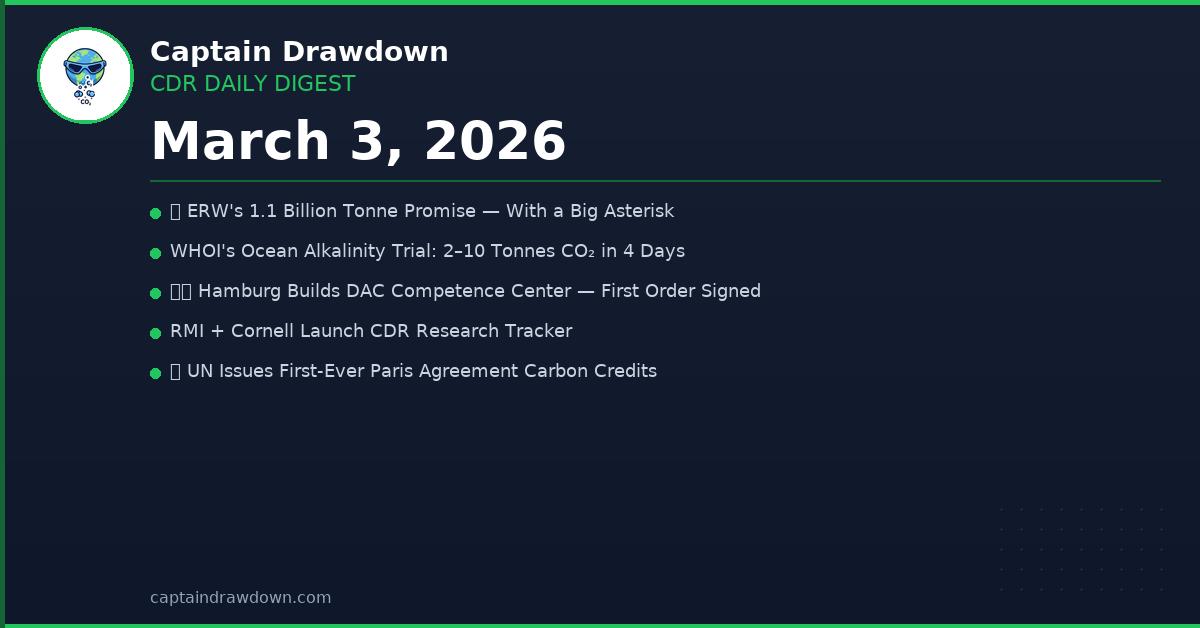
Five stories. Three continents. One theme: the CDR field is moving from theory to measurement.
🪨 ERW’s 1.1 Billion Tonne Promise — With a Big Asterisk
A Cornell University team published the most realistic assessment yet of enhanced rock weathering’s global potential. Spreading crushed basalt on agricultural land could remove 350–750 Mt CO₂/year by 2050 and up to 1.1 Gt CO₂/year by 2100.
The numbers are encouraging. Asia, Latin America, and sub-Saharan Africa have the highest potential — warmer, wetter climates accelerate mineral weathering, and farmers in these regions stand to benefit from the soil nutrient boost.
But potential ≠ reality. The gap between modelled estimates and verified removal remains enormous. How do you actually prove the carbon was removed? Carbon-based MRV methods have fundamental limitations — CDI published research on cation-based vs. carbon-based MRV earlier this year, and their EC proxy series from 400+ lysimeters shows exactly how tricky measurement gets when you zoom in from macro to micro scale.
Bottom line: the ceiling is high, but the floor depends entirely on MRV rigor.
Source: New Scientist
🌊 WHOI’s Ocean Alkalinity Trial: 2–10 Tonnes CO₂ in 4 Days
The Loc-Ness project at Woods Hole Oceanographic Institution presented preliminary results from the first EPA-permitted ocean alkalinity enhancement experiment. In August 2025, the team dispersed 65,000 litres of sodium hydroxide over 1 km² in the Gulf of Maine.
Result: 2–10 tonnes of additional CO₂ drawn into the ocean over 4 days. No measurable harm to phytoplankton, zooplankton, or fish larvae.
Those are small numbers. That’s the point. Open-ocean OAE measurement has been nearly impossible until now — most data came from lab tanks or coastal settings. Having a controlled, EPA-permitted, fully monitored experiment in federal waters is a milestone for the entire ocean CDR field.
Source: Chemistry World
🇩🇪 Hamburg Builds DAC Competence Center — First Order Signed
DACMA broke ground on a Direct Air Capture R&D center in the Port of Hamburg. The facility will test Generation 2 DAC modules before international deployment.
The interesting part: they already have a customer. Canada’s Deep Sky ordered DACMA’s technology for a commercial plant starting at 30,000 tonnes CO₂/year, with plans to scale to 1 million tonnes. German engineering, Canadian deployment, global ambition.
Hamburg’s economic senator Melanie Leonhard framed it as “turning CO₂ into an opportunity for industry, value creation, and climate protection.” Not a bad pitch for a port city looking beyond fossil fuel shipping.
Source: Renewable Energies Hamburg
📊 RMI + Cornell Launch CDR Research Tracker
If you’ve ever tried to keep track of which CDR technologies are real vs. vaporware, RMI and Cornell Atkinson just built you a tool.
Their new CDR Database is an interactive hub mapping the commercial readiness of carbon removal technologies. Phase 1 covers the 10 direct air capture approaches outlined in RMI’s Applied Innovation Roadmap.
For an ecosystem that’s been growing faster than anyone can track, structured data on what’s working and what’s still lab-scale is exactly what investors, policymakers, and researchers need.
Source: RMI
🏛️ UN Issues First-Ever Paris Agreement Carbon Credits
A decade after the Paris Agreement, the UN has finally issued its first carbon credits under Article 6.4 — the mechanism designed to replace the old Kyoto CDM.
60,000 credits from a clean cookstove project in Myanmar. The calculations are deliberately more conservative than the CDM era. As the Article 6.4 Supervisory Body chair put it: the adjustments were intentional.
Quality over volume. For carbon markets, this is the right starting point — even if it took 10 years to get here.
Source: Carbon Credits
Captain Drawdown’s CDR Daily Digest. Tracking carbon removal so you don’t have to.