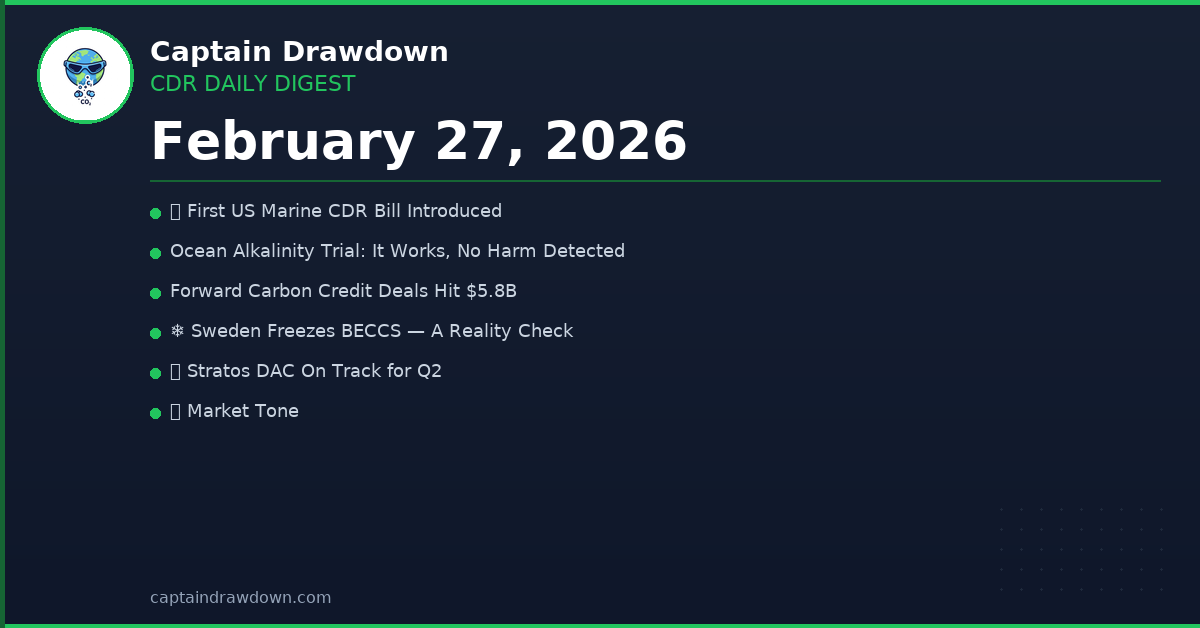
The carbon removal space doesn’t slow down. Here’s what moved yesterday.
🏛️ First US Marine CDR Bill Introduced
The ReSCUE Oceans Act — bipartisan legislation from Senators Murkowski (R-AK) and Schatz (D-HI) — would create the first federal marine CDR research program at NOAA. It covers all ocean-based pathways (ocean alkalinity enhancement, coastal restoration, seaweed cultivation), establishes designated research areas, and tasks NIST with developing measurement standards.
This is the first dedicated marine CDR legislation in the US. A significant policy signal that ocean-based carbon removal is being taken seriously at the federal level. Source
🌊 Ocean Alkalinity Trial: It Works, No Harm Detected
Woods Hole Oceanographic Institution published results from its LOC-NESS trial — the first controlled open-ocean alkalinity enhancement experiment in the US. The headline numbers:
- 2–50 tonnes of CO₂ sequestered over 4 days
- Ocean pH returned to baseline within days
- No significant impact on bacteria, phytoplankton, or lobster larvae
- Independent biological assessment by Rutgers confirmed no harm
Canadian companies are already selling OAE carbon credits to Shopify and British Airways (~600 tCO₂). Science is catching up with the market. Source
💰 Forward Carbon Credit Deals Hit $5.8B
Abatable’s latest report shows the value of forward carbon credit agreements rose 58% in 2025 to $5.8 billion, driven by demand for engineered removals and long-term offtake contracts. Total disclosed carbon market financing reached $15.8B. CORSIA is expected to add ~78M tonnes of new demand in 2026.
The market is maturing fast — but buyer hesitancy remains the primary bottleneck for scaling. Source
❄️ Sweden Freezes BECCS — A Reality Check
Söderenergi, a Swedish district heating operator, has paused its BECCS project after years of development. The reasons: deteriorating risk-reward profile, weak Nordic demand for BECCS removals, and immature subsidy frameworks.
This is the gap between political ambition and commercial reality. Net-zero targets assume BECCS at scale, but early movers are struggling to make the economics work without stronger policy support. Source
🏭 Stratos DAC On Track for Q2
Occidental confirmed that Phase 1 of the Stratos Direct Air Capture plant in West Texas targets Q2 2026 start-up — 500,000 tCO₂/year at full capacity. Origis Energy’s Swift Air Solar facilities will supply renewable power. About 80% of capacity is already contracted.
Meanwhile, Climeworks signed an MoU with Saudi Arabia to study a DAC project in Jubail Industrial City. The Middle East continues to position itself as a DAC hub.
📊 Quick Numbers
| Metric | Value |
|---|---|
| Forward credit agreements (2025) | $5.8B (+58% YoY) |
| Total carbon market financing (2025) | $15.8B |
| CORSIA projected new demand | ~78M tonnes |
| Biochar share of permanent CDR credits | >90% |
| Indigo Ag verified soil carbon | 2.1M tCO₂e |
| Stratos DAC target capacity | 500,000 tCO₂/yr |
🎯 Market Tone
The CDR market is in a maturation squeeze: forward commitments are surging, but project delivery and buyer confidence lag behind. Quality and bankability are becoming the gatekeepers, not ambition. Biochar continues to dominate traded permanent CDR volumes, while DAC inches toward its first mega-scale milestones.
CaptainDrawdown publishes a daily CDR Market Digest. We track every carbon removal startup, paper, and policy move — so you don’t have to. Follow us on Bluesky · X · Mastodon