Mineralisation The CDR Researcher Census holds 666 scientific works on binding CO2 in rock, tailings, slag and concrete published since 2010, written by 2,293 researchers. 2,035 of them have a work since 2021: that is the number in the row above and the base of the top lists. A work counts when carbon mineralisation is its subject, judged from title and abstract (how I count a work and a researcher). All pathways side by side: comparison.
- 106 works in 2025, 17 in 2020 (factor ×6.2)
- 176 works in 2026 up to 28 Nov
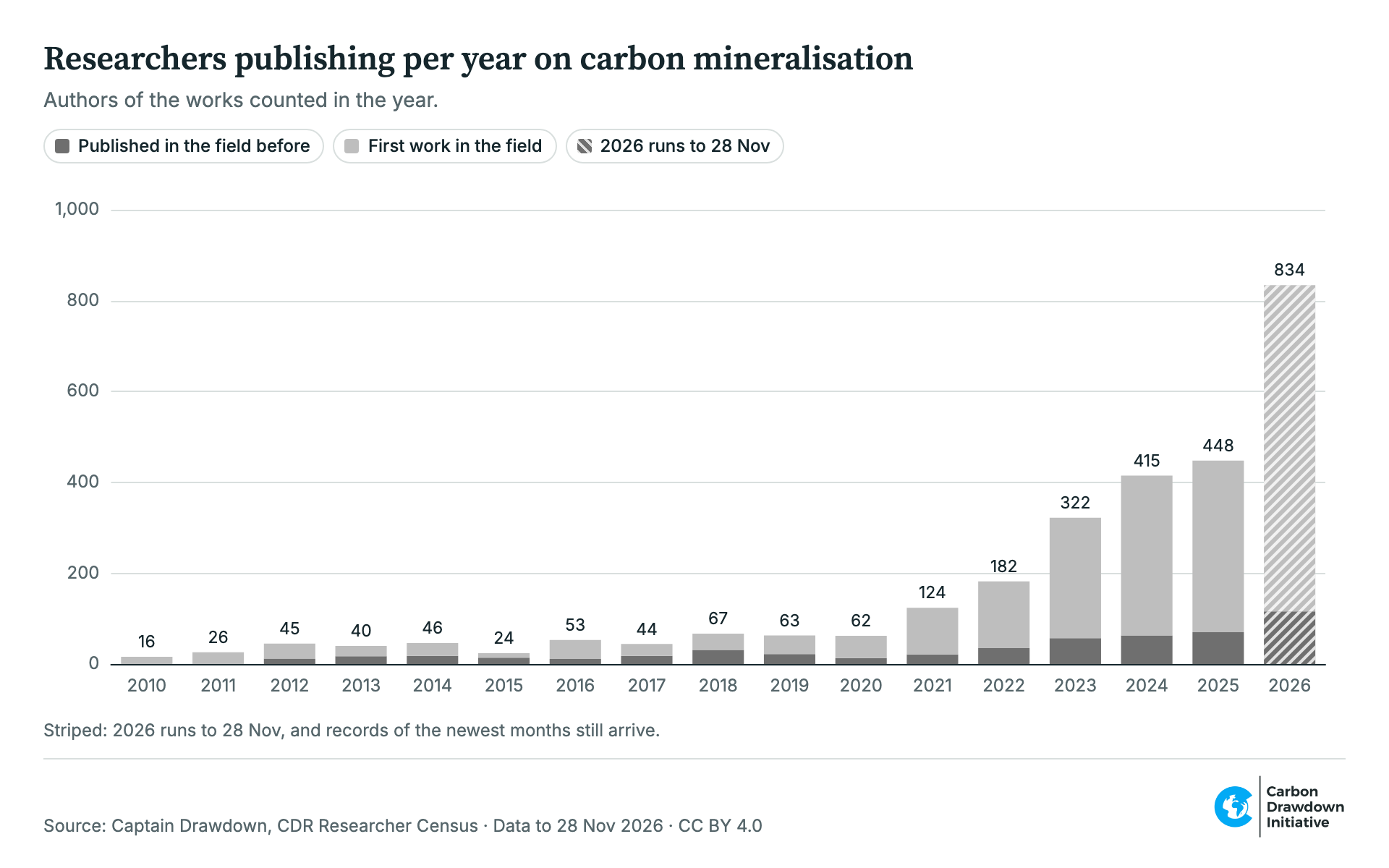
- 448 researchers publishing in 2025, 378 of them with their first work in the field
Works per year
106 works appeared in 2025, against 17 in 2020. 2026 stands at 176 up to 28 Nov, 166 % of the whole of 2025.
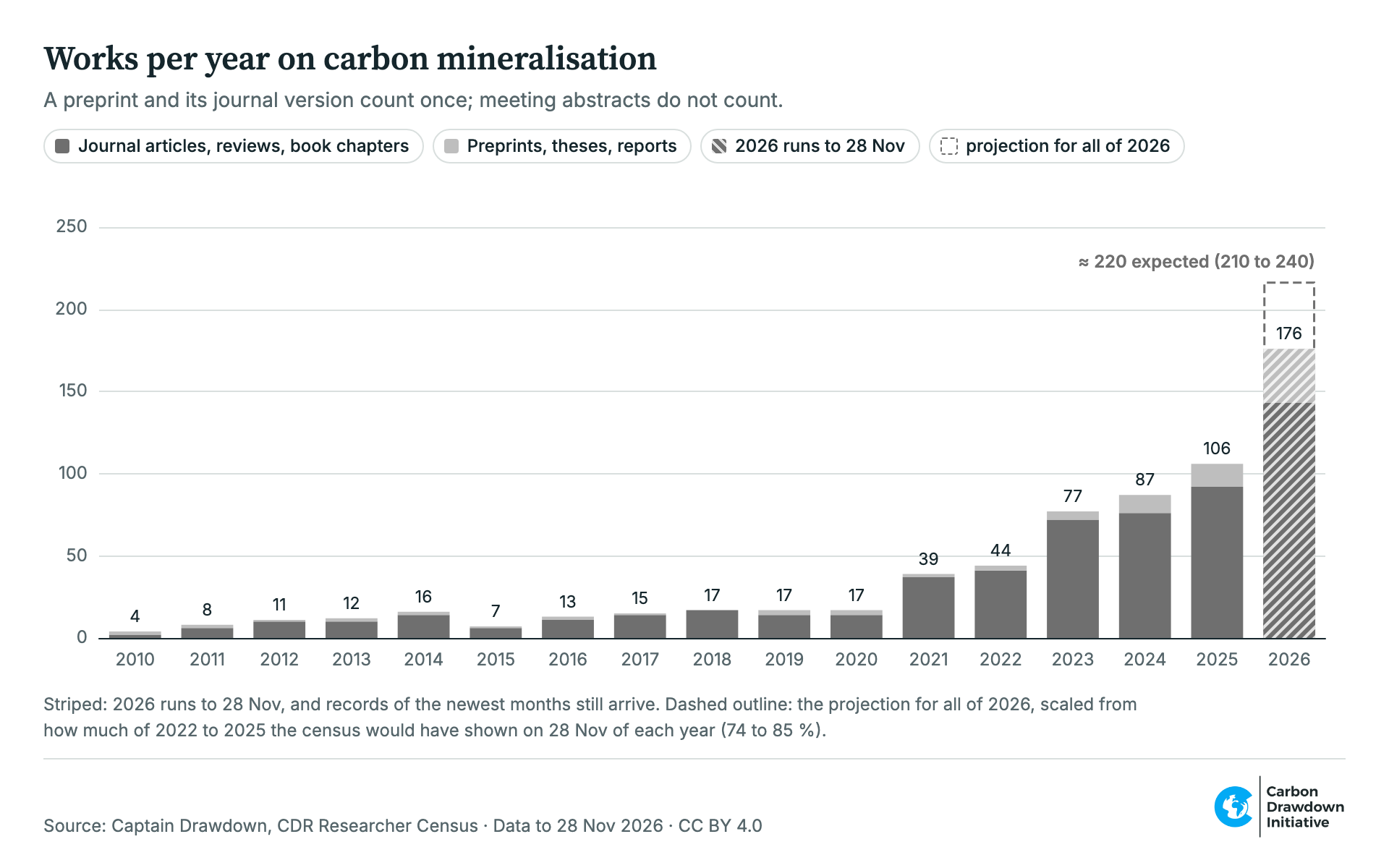
Dashed outline: about 220 works expected for all of 2026 (210 to 240), scaled from how much of earlier years was visible on the same day. The same calculation missed 2025 by 4.1 % (how the projection works).
Researchers
448 researchers published on carbon mineralisation in 2025; 378 of them had not published in the field before. In 2020 it was 62 researchers.
Works per quarter
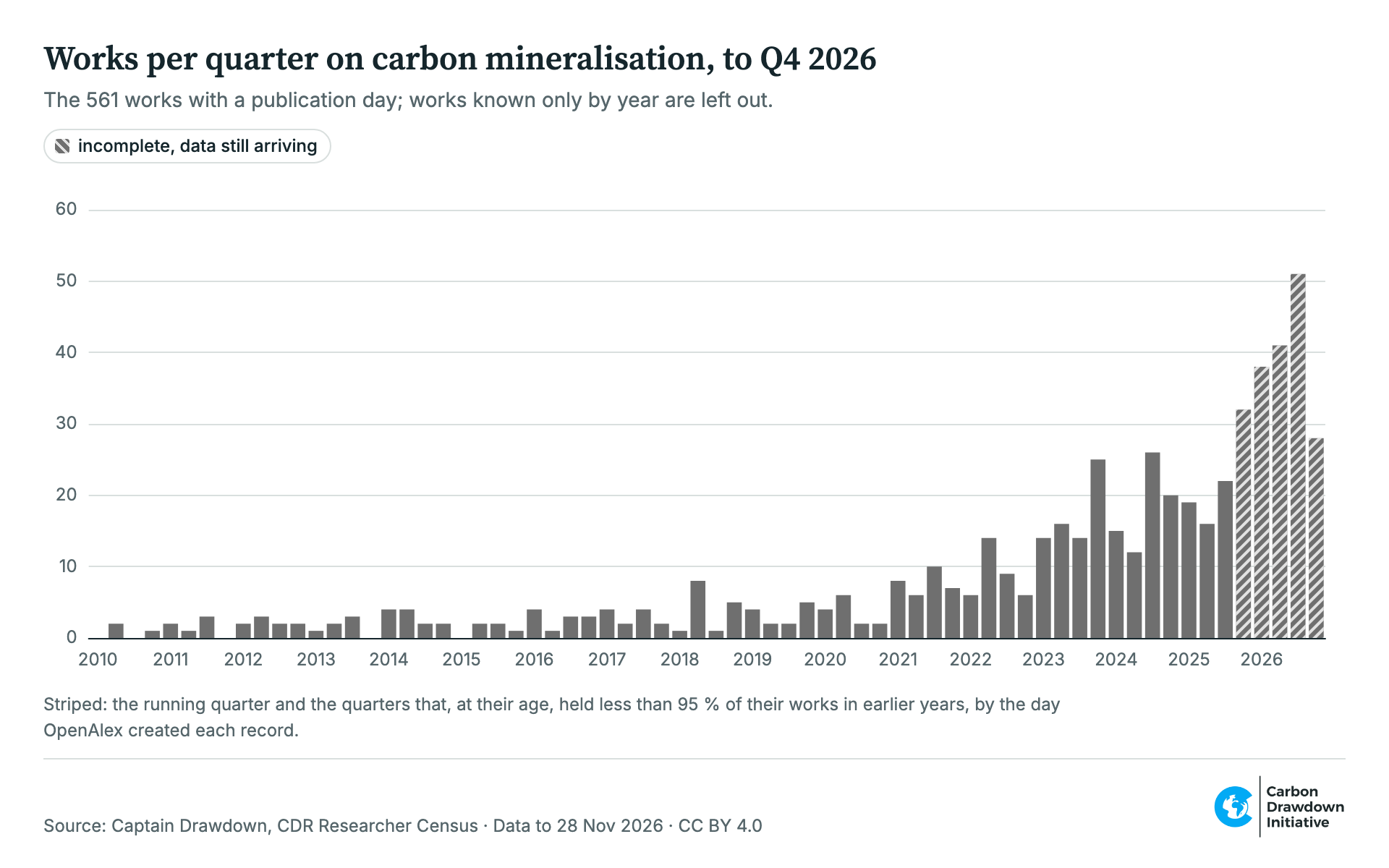
Quarters show the recent course more finely than years. The striped quarters still gain works. In earlier years a quarter held 92 % of its works 59 days after it ended, and I draw a quarter striped until that share reaches 95 %: today the running quarter and 4 before it (how the stripes are set).
Kind of work
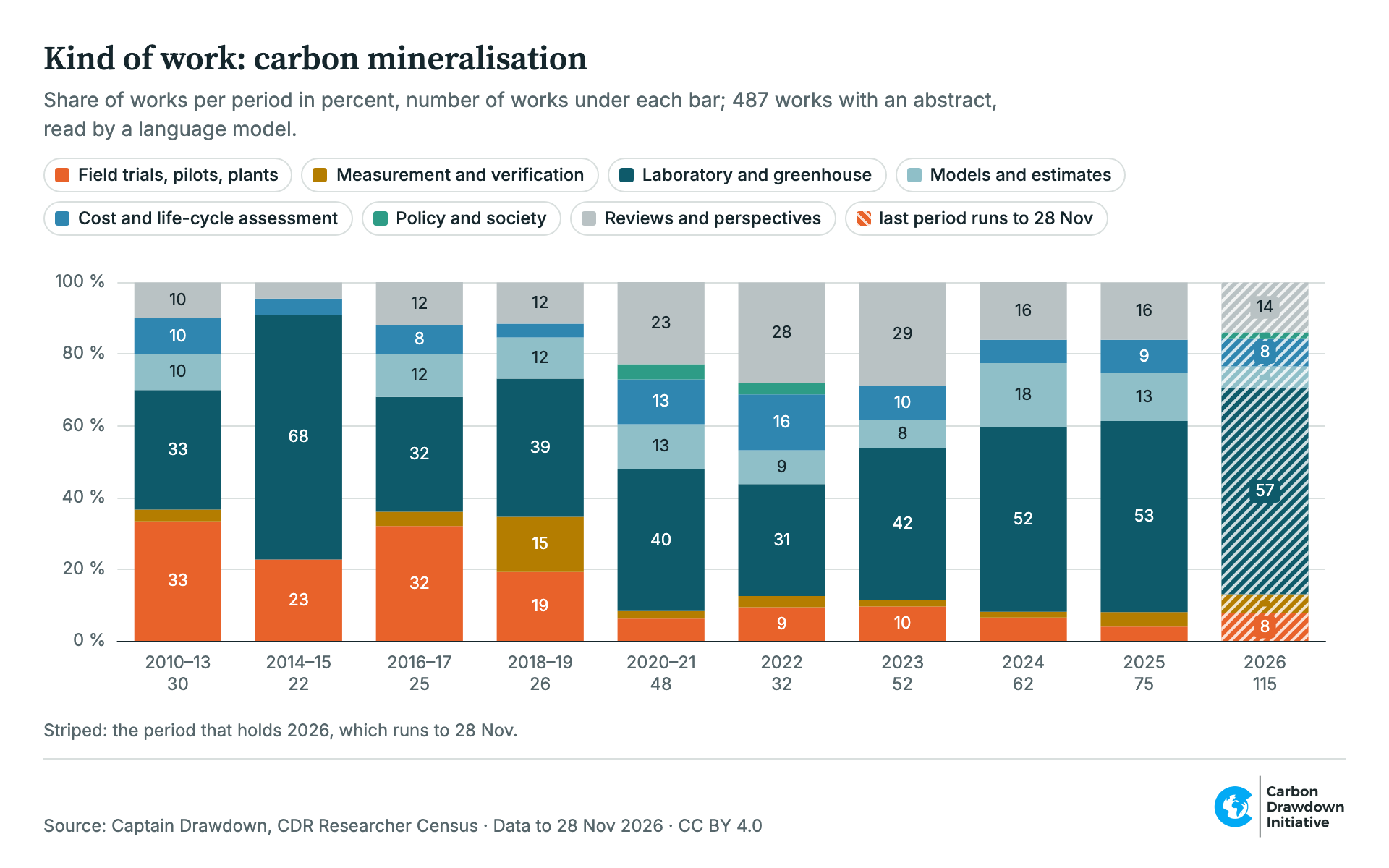
Each work with an abstract is sorted by its main kind: field trial, laboratory experiment, model, assessment, policy study or review. In 2024 to 2026 the largest group is “laboratory and greenhouse” with 55 % of 252 works.
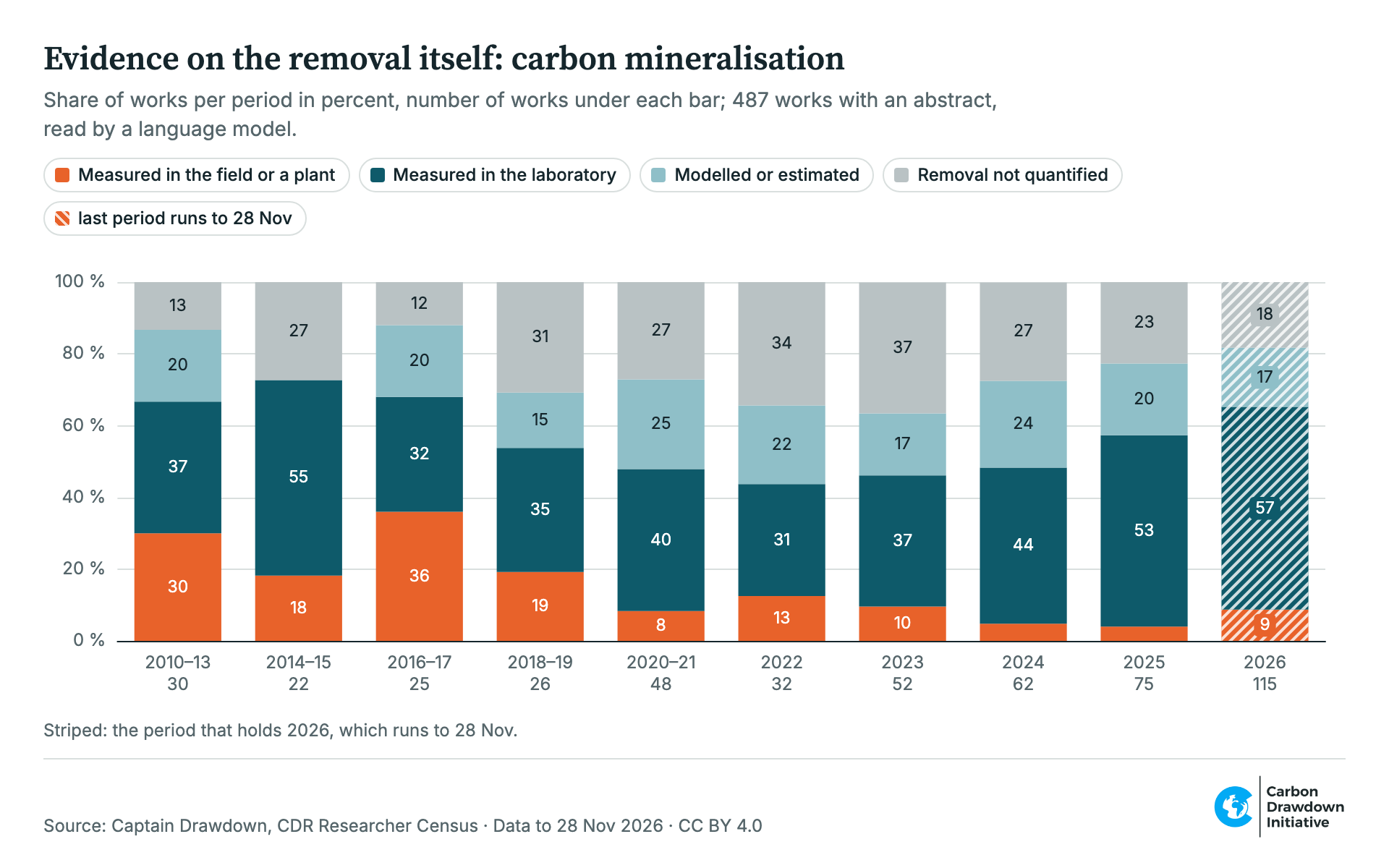
Evidence on the removal
The strongest evidence on the removal that a work itself reports: measured in the field or a plant, measured in the laboratory, modelled, or not quantified. In 2024 to 2026, 6 % of the works report removal measured in the field or in a plant.
Variants
What the 487 works with an abstract are about, by variant of the method.
| Variant | Works | Share |
|---|---|---|
| Industrial waste | 114 | 23 % |
| Mine tailings | 104 | 21 % |
| Cement and concrete | 95 | 20 % |
| Minerals in a reactor | 60 | 12 % |
| In-situ injection | 41 | 8 % |
| Several variants | 30 | 6 % |
| Other | 36 | 7 % |
| Not specified | 7 | 1 % |
Funders
315 of 555 works since 2021 name a funder (57 %). Share of those works that name at least one funder from the region: EU and member states 19 %, United States 26 %, China 21 %, United Kingdom 9 %, Other 40 %. A work with funders from two regions counts for both, so the shares add up to more than 100. The source is the funding acknowledgement as OpenAlex records it; it holds no amounts, and a work that names no funder is not necessarily unfunded.
| Funder | Works |
|---|---|
| National Natural Science Foundation of China | 55 |
| U.S. Department of Energy | 35 |
| Natural Sciences and Engineering Research Council of Canada | 25 |
| National Key Research and Development Program of China | 20 |
| National Science Foundation | 19 |
| European Commission | 16 |
| Engineering and Physical Sciences Research Council | 14 |
| Advanced Research Projects Agency - Energy | 13 |
| Natural Environment Research Council | 12 |
| Canada Research Chairs | 11 |
More
- Top researchers on carbon mineralisation: most active, most cited, Europe.
- All pathways compared
- Method: what counts as a work on carbon removal and how the works are read.
- Data and API