Enhanced weathering The CDR Researcher Census holds 718 scientific works on spreading rock on land to remove CO2 published since 2010, written by 2,154 researchers. 2,064 of them have a work since 2021: that is the number in the row above and the base of the top lists. A work counts when enhanced rock weathering is its subject, judged from title and abstract (how I count a work and a researcher). All pathways side by side: comparison.
- 156 works in 2025, 17 in 2020 (factor ×9.2)
- 216 works in 2026 up to 28 Nov
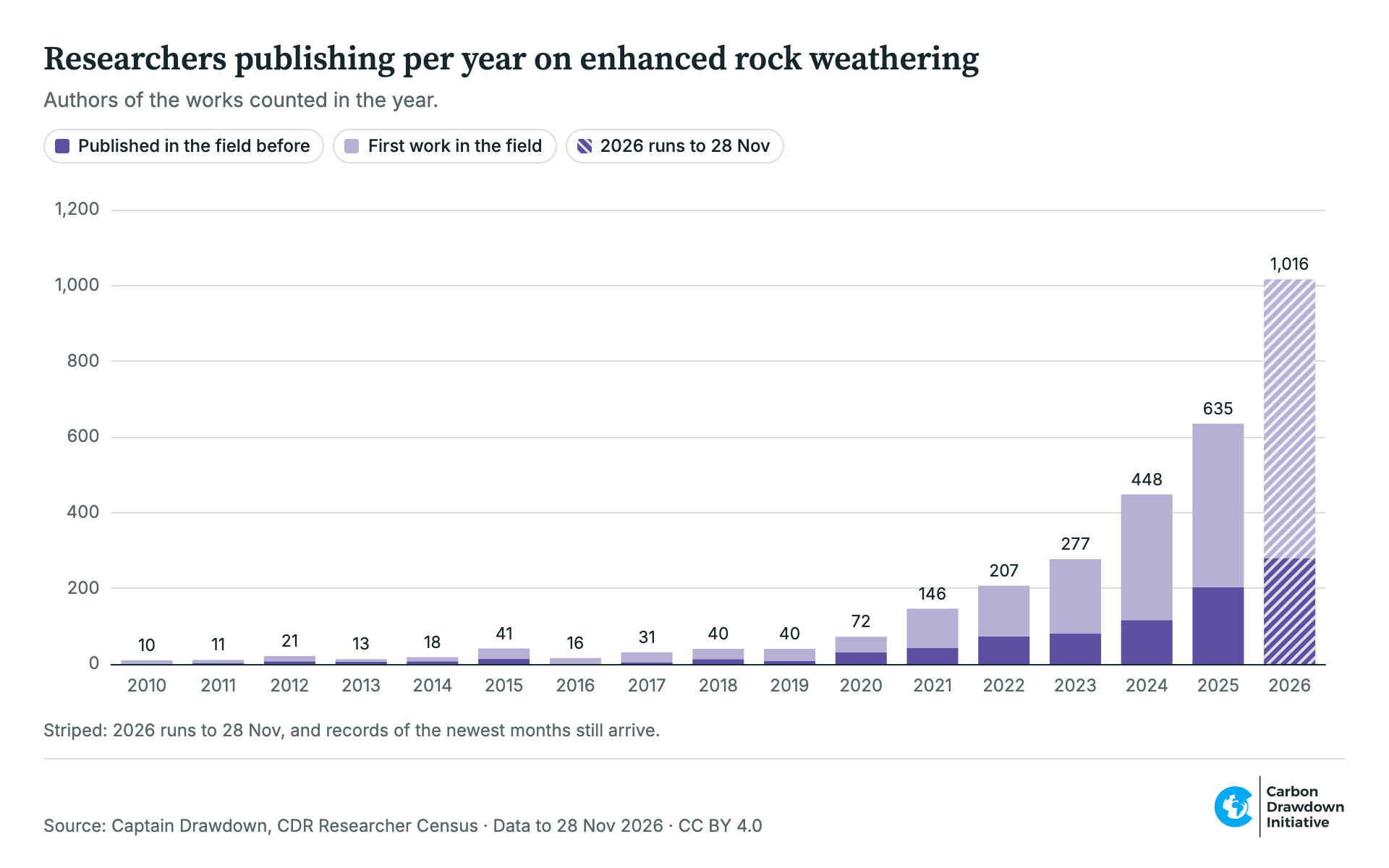
- 635 researchers publishing in 2025, 432 of them with their first work in the field
Works per year
156 works appeared in 2025, against 17 in 2020. 2026 stands at 216 up to 28 Nov, 138 % of the whole of 2025.
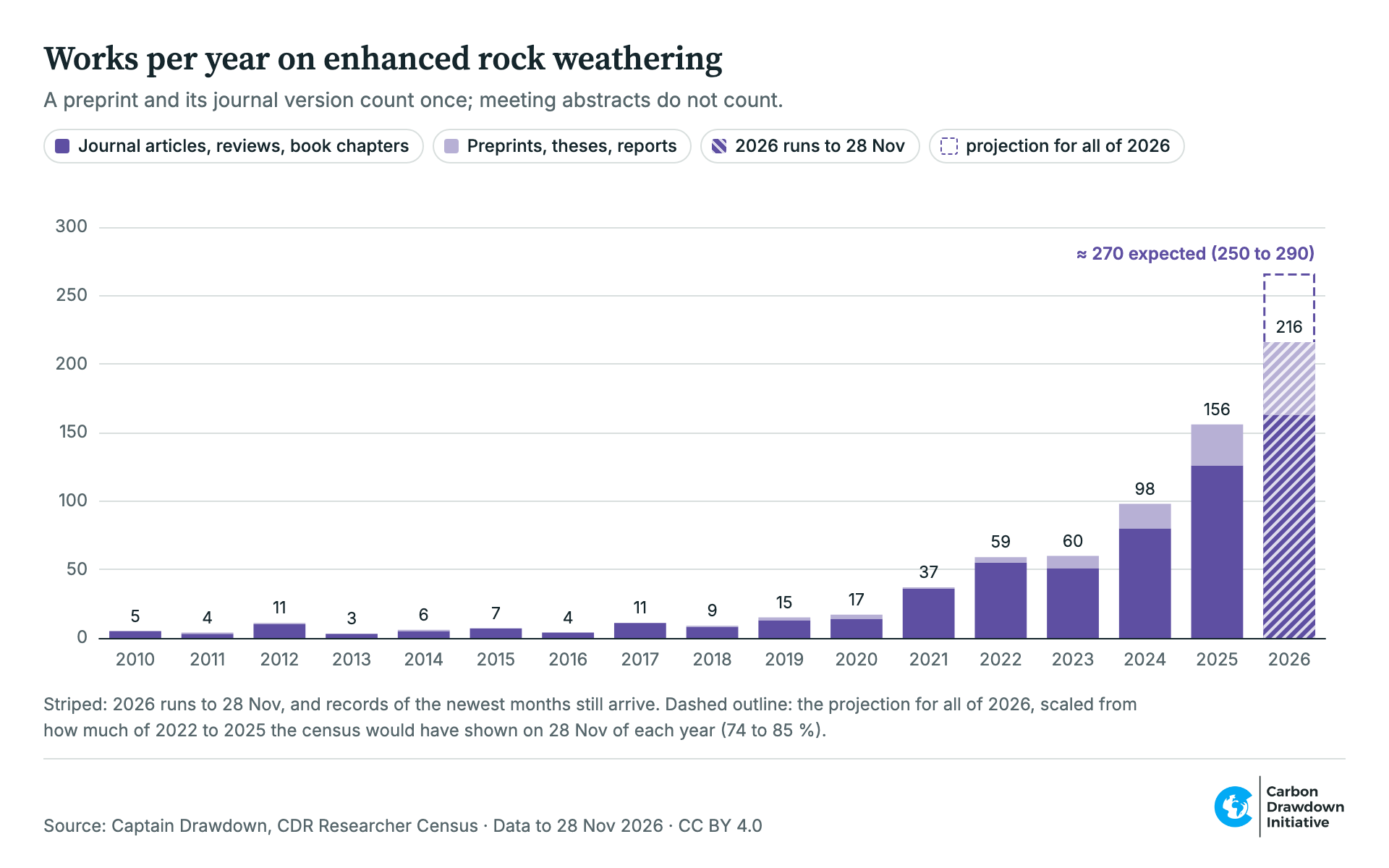
Dashed outline: about 270 works expected for all of 2026 (250 to 290), scaled from how much of earlier years was visible on the same day. The same calculation missed 2025 by 2.2 % (how the projection works).
Researchers
635 researchers published on enhanced rock weathering in 2025; 432 of them had not published in the field before. In 2020 it was 72 researchers.
Works per quarter
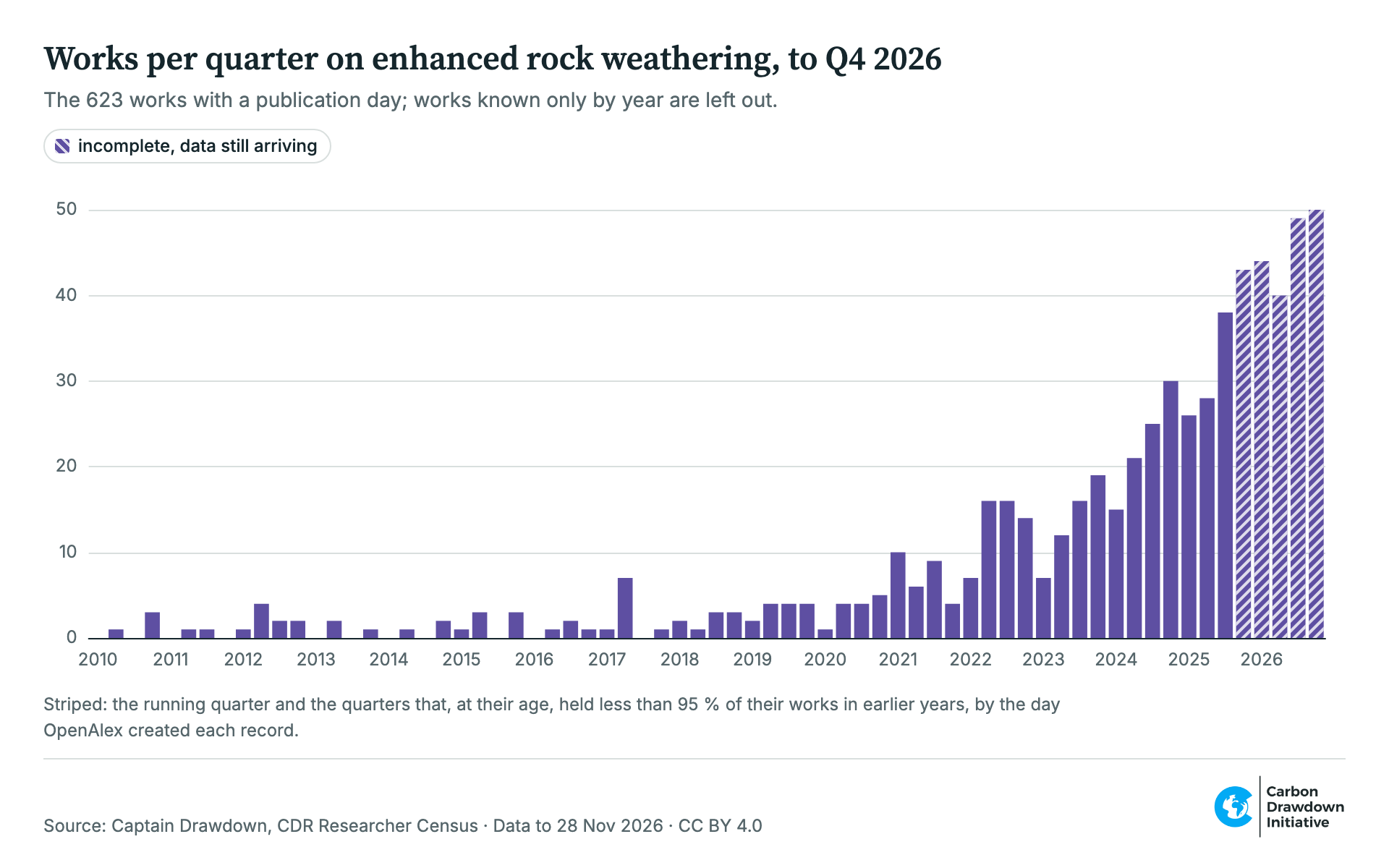
Quarters show the recent course more finely than years. The striped quarters still gain works. In earlier years a quarter held 92 % of its works 59 days after it ended, and I draw a quarter striped until that share reaches 95 %: today the running quarter and 4 before it (how the stripes are set).
Kind of work
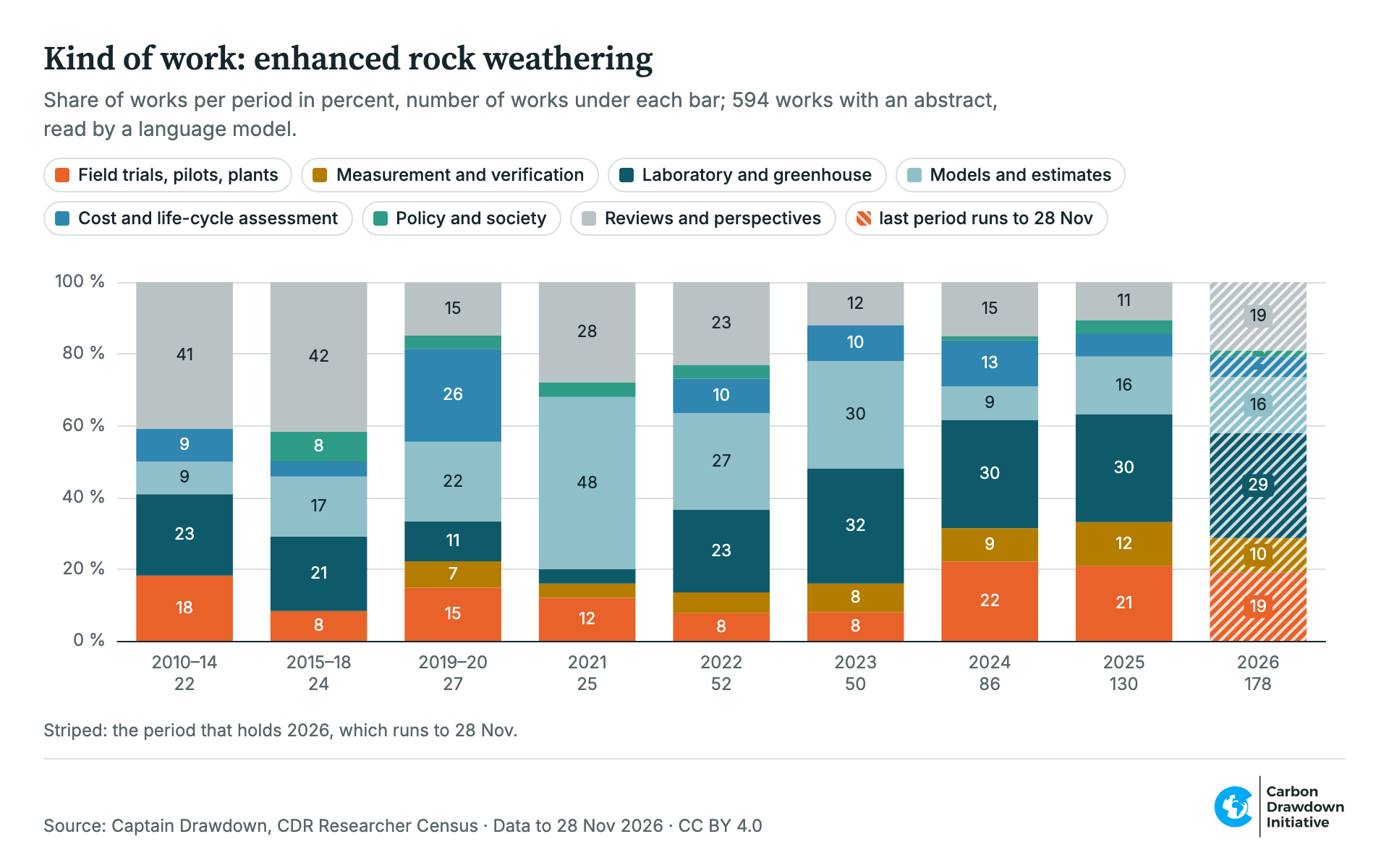
Each work with an abstract is sorted by its main kind: field trial, laboratory experiment, model, assessment, policy study or review. In 2024 to 2026 the largest group is “laboratory and greenhouse” with 30 % of 394 works.
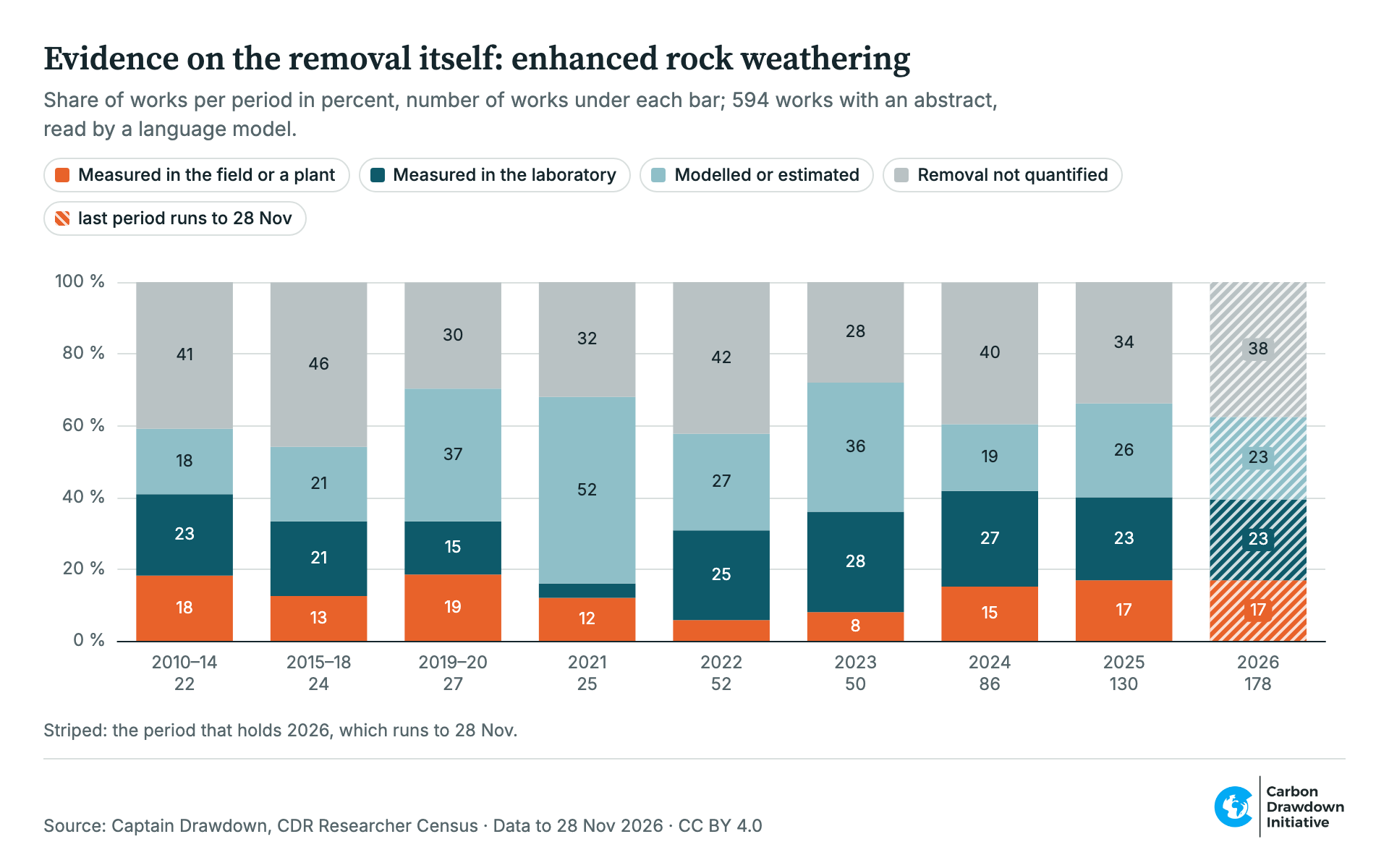
Evidence on the removal
The strongest evidence on the removal that a work itself reports: measured in the field or a plant, measured in the laboratory, modelled, or not quantified. In 2024 to 2026, 16 % of the works report removal measured in the field or in a plant.
Variants
What the 594 works with an abstract are about, by variant of the method.
| Variant | Works | Share |
|---|---|---|
| Basalt | 158 | 27 % |
| Olivine | 41 | 7 % |
| Other silicate | 37 | 6 % |
| Wollastonite | 33 | 6 % |
| Carbonate rock | 14 | 2 % |
| Cement and concrete | 10 | 2 % |
| Steel slag | 9 | 2 % |
| Glacial rock flour | 7 | 1 % |
| Several variants | 112 | 19 % |
| Other | 17 | 3 % |
| Not specified | 156 | 26 % |
Funders
389 of 734 works since 2021 name a funder (53 %). Share of those works that name at least one funder from the region: EU and member states 25 %, United States 33 %, China 17 %, United Kingdom 20 %, Other 31 %. A work with funders from two regions counts for both, so the shares add up to more than 100. The source is the funding acknowledgement as OpenAlex records it; it holds no amounts, and a work that names no funder is not necessarily unfunded.
| Funder | Works |
|---|---|
| National Natural Science Foundation of China | 51 |
| U.S. Department of Energy | 39 |
| European Commission | 36 |
| Yale University | 33 |
| Leverhulme Trust | 31 |
| Natural Environment Research Council | 28 |
| National Science Foundation | 27 |
| Grantham Foundation for the Protection of the Environment | 26 |
| Fonds Wetenschappelijk Onderzoek | 24 |
| UK Research and Innovation | 23 |
More
- Top researchers on enhanced rock weathering: most active, most cited, Europe.
- All pathways compared
- Method: what counts as a work on carbon removal and how the works are read.
- Data and API