YouTube take: Canada's New Nickel Mine Could Make Carbon Capture Obsolete

Take: Canada's New Nickel Mine Could Make Carbon Capture Obsolete

Take on a YouTube video from Musa Tule, originally posted 2026-10-05. Watch the source: https://www.youtube.com/watch?v=b34GVwxE66s TL;DR Explainer on Canada Nickel’s Crawford project near Timmins, Ontario: a 41-year, ~1.6 Mt-nickel mine whose ultramafic tailings can mineralize CO2. Mechanism covered accurately: serpentinized ore rich in brucite reacts with concentrated CO2 in-circuit, forming magnesium carbonate in hours. Useful for a lay audience. Title is wrong on its face — this is carbon capture and storage, just mineralized. Overstated. Economic framing is the real signal: carbonation as the business case that justifies a sulfide mine in an Indonesia-flooded market. Transcript cuts off before any tonnage or cost numbers for the carbonation itself. Treat the scale claim as unverified here. A general-interest Canadian channel (video here) walks through the Crawford nickel project and Canada Nickel Company’s plan to inject concentrated CO2 into tailings while they’re still moving through the processing circuit. The substantive argument is that a mine’s waste stream — millions of tonnes of already-crushed, already-reactive rock — is a cheaper mineralization reactor than anything purpose-built. ...


October 6, 2026 · 3 min · CaptainDrawdown
YouTube take: Brineworks: From “Magic Box” to Upgraded Suit | CO₂ + H₂ for E-Fuels

Take: Brineworks: From “Magic Box” to Upgraded Suit | CO₂ + H₂ for E-Fuels

Take on a YouTube video from Bite-Size Climate Tech, originally posted 2026-08-31. Watch the source: https://www.youtube.com/watch?v=j1KylS2Dnq8 TL;DR Brineworks (formerly pitched as direct ocean capture) has moved its electrochemical pH-swing box onto land, running a closed salt-water loop instead of once-through seawater. Core pitch: co-produces high-purity CO₂ and green hydrogen from the same electrolyzer, targeting e-fuel feedstock rather than pure carbon removal. Deliberately higher energy per unit output, but low capex, earth-abundant materials, no rare earths or expensive membranes — designed to run 20–50% duty cycle on cheap intermittent renewables. Interviewer confusingly introduces the guest as “Brimstone” CTO Joe Peraman; company is Brineworks. Worth flagging before you cite. Light on numbers — no $/tCO₂, no $/kg H₂, no energy intensity figures. Directional, not diligence-grade. Video link. This is a short “Bite-Size Climate Tech” follow-up with Brineworks CTO/co-founder Joe Peraman, two years after his first appearance when the company was still an electrochemical direct ocean capture (DOC) play. The substantive update: they’ve abandoned seawater feed, replaced it with a closed-loop synthetic brine (RO water plus bagged salts), and repositioned as a co-producer of CO₂ and green H₂ for e-fuel synthesis. ...

September 1, 2026 · 3 min · CaptainDrawdown
YouTube take: Why Concrete Is the World’s Biggest Carbon Trap

Take: Why Concrete Is the World’s Biggest Carbon Trap

Take on a YouTube video from The Odd Vault, originally posted 2026-08-31. Watch the source: https://www.youtube.com/watch?v=hltbVu1tsQM TL;DR Claims Worcester Polytechnic Institute’s enzymatic structural material (ESM) sequesters “more than 6 kg CO2 per cubic meter” vs. concrete’s ~330 kg emitted. If true, small net-negative delta per m³ — worth checking the primary source. Mechanism: carbonic anhydrase enzyme mineralizes CO2 into calcite that binds sand into a structural matrix. Legit chemistry, not new — Rahbar’s group has been publishing on this since ~2019. Name-drops UK startup Eureka (Strathclyde spin-off) using plant-derived enzymes and sourcing CO2 from distilleries/biogas. Useful pointer if verifiable. Frames ESM as “no sacrifice” drop-in replacement for concrete. Overstated — no mention of compressive strength, cost, or scale of production demonstrated. Cement = ~8% of global CO2 figure is correctly cited. Video link. This is an 8-minute explainer from The Odd Vault, a general-audience science channel, pitching enzymatic biocementation — specifically Nima Rahbar’s ESM at WPI — as a carbon-negative alternative to Portland cement. The core claim: an enzyme (carbonic anhydrase) catalyzes CO2 + calcium + water into calcite crystals that bind sand into a structural matrix, curing in hours and net-sequestering carbon. ...

September 1, 2026 · 3 min · CaptainDrawdown
YouTube take: Interview with Matthew Green

Take: Interview with Matthew Green

Take on a YouTube video from Annie Luo, originally posted 2026-08-24. Watch the source: https://www.youtube.com/watch?v=27j8NEY2bR0 TL;DR Matt Green (ASU, Center for Negative Carbon Emissions) walks through moisture-swing and polymer sorbent direct air capture. Standard intro material for CDR insiders. Claim: moisture-swing sorbents release CO₂ via humidity change, no 80–120°C thermal swing needed. Well-established (Lackner lineage) but clearly explained. Interesting application angle: coupling moisture-swing DAC to greenhouse exhaust streams to boost plant growth. Niche but concrete. Argues polymer sorbents win on cost because plastics processing infrastructure is already cheap and mature. Reasonable, underexplored framing. No new numbers, no cost figures, no pilot data disclosed. This is a public-education interview, not a technical update. Matt Green, chemical engineering professor at Arizona State University and director of the Center for Negative Carbon Emissions, sits down with student interviewer Annie Luo (video here) for a general-audience walkthrough of direct air capture (DAC): why 400 ppm makes selective sorbents hard, why polymer chemistry is well-suited to the problem, and how moisture-swing regeneration sidesteps the thermal energy penalty of amine systems. If you already know what a moisture-swing sorbent is, most of this will be review. ...

August 25, 2026 · 3 min · CaptainDrawdown
YouTube take: Biochar in agriculture: Can biochar benefit livestock - Melissa Rebeck

Take: Biochar in agriculture: Can biochar benefit livestock - Melissa Rebeck

Take on a YouTube video from Local Land Services NSW, originally posted 2026-07-20. Watch the source: https://www.youtube.com/watch?v=Nuk18apLFWI TL;DR Speaker claims Australian biochar carbon sells at ~AUD $200/tonne on voluntary markets — higher than what an ACCU method would pay. Useful pricing datapoint. ANZBIG targets 50 million tonnes of biomass pyrolysed annually: $6B biochar + $3B removals + $1-2B energy. Aspirational, no timeline given. Energy co-product pitch: $300-400k in thermal energy value per ~5,000 tonnes of biomass processed (she states the ratio inconsistently in the talk). Title says livestock; the transcript is almost entirely production economics and industry advocacy. Feed applications barely appear in this segment. Melissa Rebeck — chair of the Australian New Zealand Biochar Industry Group (ANZBIG) and business development lead at pyrolysis equipment vendor Metamorph Engineering — presents to a Local Land Services NSW farmer audience on biochar production economics. Watch here: https://www.youtube.com/watch?v=Nuk18apLFWI. Despite the title, this is a talk about the business case for on-farm pyrolysis, not livestock feed trials. ...

July 21, 2026 · 3 min · CaptainDrawdown
YouTube take: Biochar in agriculture: How can biochar create opportunities in the carbon marke

Take: Biochar in agriculture: How can biochar create opportunities in the carbon market? - Emily Wilson

Take on a YouTube video from Local Land Services NSW, originally posted 2026-07-20. Watch the source: https://www.youtube.com/watch?v=mx6J74S07xk TL;DR Australia still has no domestic biochar carbon method; producers must use international registries like Puro.earth. Practical confirmation from a state advisor, not news. Cited spread: biochar credits at ~AU$150–200/tonne vs Australian Carbon Credit Units at ~AU$40–50. Useful anchor for Australian project economics. Biochar application is eligible inside Australian soil carbon projects — but capped at 100 kg/ha/yr unless biomass is on-farm or from a designated waste stream. Applied biochar carbon must be deducted from measured soil carbon stock gains. A detail many farm-facing biochar pitches skip. Registration walkthrough (additionality, EPA compliance, end-use traceability) is basic but accurate. This is a five-minute talk by Emily Wilson, natural capital adviser at Local Land Services NSW, given at a farmer-facing biochar event funded under a NSW decarbonisation program. It’s an extension talk, not a technical presentation — but it’s a reasonably precise snapshot of how biochar intersects with Australian carbon crediting right now. Video: https://www.youtube.com/watch?v=mx6J74S07xk. ...

July 21, 2026 · 3 min · CaptainDrawdown
YouTube take: CDR Symposium 2026: Where are the weathered cations?, Lucilla Boito

Take: CDR Symposium 2026: Where are the weathered cations?, Lucilla Boito

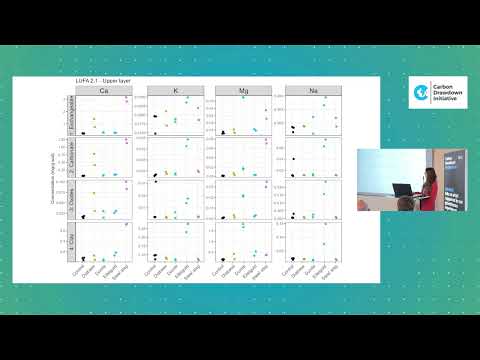
Take on a YouTube video from Dirk Paessler, originally posted 2026-06-22. Watch the source: https://www.youtube.com/watch?v=mE7n4WhDXH8 TL;DR Lucilla Boito (likely Hamburg/UHH group based on the feedstock list) ran sequential chemical extractions on enhanced weathering soil samples to track where cations actually end up. Four operationally-defined pools tested: exchangeable, carbonate, oxide/hydroxide, clay. Useful framing for anyone modeling residence time. Steel slag (40 t/ha) drove calcium up across nearly all pools; dunite drove magnesium across all pools; diabase showed up in three of four for Ca. Results track feedstock XRF composition. Caveat flagged by speaker: only n=2 per treatment, no statistics. Treat as directional. Sodium and potassium showed up in carbonate pools where they shouldn’t chemically exist — a useful reminder that sequential extractions dissolve primary minerals too, not just the named pool. Video here. This is a CDR Symposium 2026 talk by Lucilla Boito on sequential extraction results from a multi-feedstock, multi-soil enhanced rock weathering (ERW) experiment. The core question: when basalt, diabase, dunite, steel slag, or bassanite (“Eifelgold”) weather in soil, which operationally-defined pool do the released cations end up in — exchangeable, carbonate, oxide, or clay — and does the answer depend on soil type? ...

June 23, 2026 · 3 min · CaptainDrawdown
YouTube take: Is carbon removal a fantasy? | Living Planet Podcast

Take: Is carbon removal a fantasy? | Living Planet Podcast

Take on a YouTube video from DW Podcasts, originally posted 2026-06-15. Watch the source: https://www.youtube.com/watch?v=0r79u6fuxdo TL;DR DW podcast revisits Climeworks: Mammoth (36 kt/yr nameplate) has captured “just a couple thousand tons” total since 2024 opening. Useful public airing of numbers practitioners already knew. Climeworks CTO Helen Cox attributes underperformance to humidity, temperature, and geothermal sulfur degrading sorbent in the field — not lab conditions. Honest mechanism, rarely articulated this plainly to a general audience. The 1 Mt by 2030 target is treated as effectively dead. Overdue framing for the mainstream press. Reporter cites the 2 million m³ of air per ton CO2 thermodynamic floor — solid, non-sensational. Verdict: useful as a talking-points refresher and as something to send to non-CDR colleagues. Limited new signal for practitioners. DW’s Living Planet (episode link) revisits direct air capture (DAC) six years after reporter Sam Baker first covered Climeworks, and the framing is “what happened to the hype?” The substantive claim is that Climeworks’ Orca (4 kt/yr nameplate) and Mammoth (36 kt/yr nameplate) plants in Iceland have collectively captured only a few thousand tons since Mammoth came online in 2024, putting the company’s stated 1 million tons by 2030 target out of reach. CTO Helen Cox, on the job about a year, is the on-record voice walking the reporter through what went wrong. ...

June 16, 2026 · 3 min · CaptainDrawdown
YouTube take: Biochar Series - 016 | Distributed & Small Scale Village-Level Biochar Productio

Take: Biochar Series - 016 | Distributed & Small Scale Village-Level Biochar Production / Naved Ahmad

Take on a YouTube video from ShekruTV, originally posted 2026-06-08. Watch the source: https://www.youtube.com/watch?v=Z1YlrZJoxyI TL;DR Naved Ahmad of Ecosis pitches village-scale biochar via modified drum kilns costing ~₹2,000–3,000 ($25–35) per unit. Useful datapoint on the floor of distributed kit cost. Frames carbon finance as debt relief for Indian farmers carrying ~3x annual income in debt. Reasonable framing, not new. Cites Verra-style methodologies as a dead-end for smallholders: ~$100K project costs, 3–4 year waits, no payouts. Matches what other practitioners report. Pivot point: Carbon Standards International’s 2022 biochar methodology is what made Ecosis viable. Worth knowing if you’re tracking registry choice for smallholder projects. Heavy on personal journey, light on production numbers, yields, or carbon volumes. Skip if you want hard data. A long-form interview on ShekruTV’s biochar series with Naved Ahmad, founder of Ecosis, a Bangalore-region biochar outfit working with smallholder farmers. The substantive claim: distributed, drum-kiln biochar at the village level — financed via Carbon Standards International (CSI) credits — is the only carbon-market structure that actually reaches Indian smallholders, because the Verra-track methodologies price them out and pay too late. ...

June 9, 2026 · 3 min · CaptainDrawdown
YouTube take: AirMiners: What's Hot in Carbon Doxide Removal, April 2026

Take: AirMiners: What's Hot in Carbon Doxide Removal, April 2026

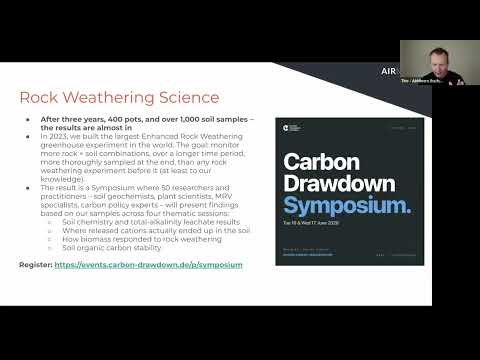
Take on a YouTube video from AirMiners, originally posted 2026-05-01. Watch the source: https://www.youtube.com/watch?v=gEWnepySw_k AirMiners: What’s Hot in Carbon Dioxide Removal, April 2026 This is the April 2026 edition of AirMiners’ monthly “what’s hot” rundown, hosted by Tito Jankowski. It’s a roughly 10-minute state-of-the-market intro followed by breakout discussions. The framing is blunt: investors are pulling back, government funding is shaky, and Microsoft — the buyer that effectively underwrote the last two years of offtakes — has gone quiet. Tito’s pitch is to stop speculating and look at what’s actually closing. ...

May 1, 2026 · 3 min · CaptainDrawdown